
Driving in Cambodia
We did not drive in Cambodia, not even a motorbike. No thank you.
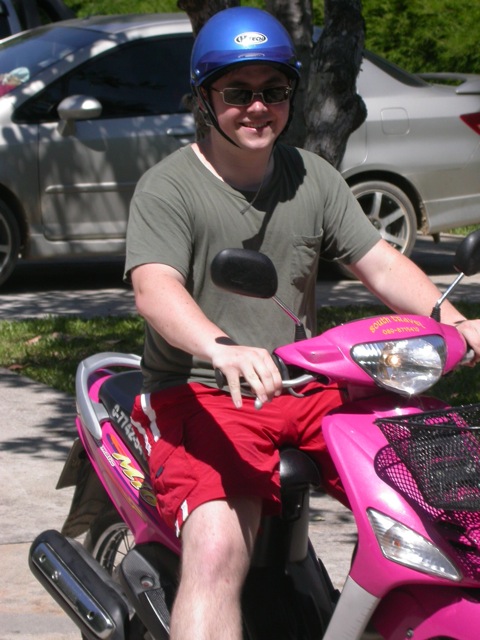
Grant in Thailand
I still remember our effort in Thailand that started with Grant steering up and down the driveway of our hotel and ended with us hailing a cab. We do have a moped at home, and I’m sure that given the time and inclination, Grant would be an excellent motorbike driver. The place to learn is NOT on the streets of Cambodia.
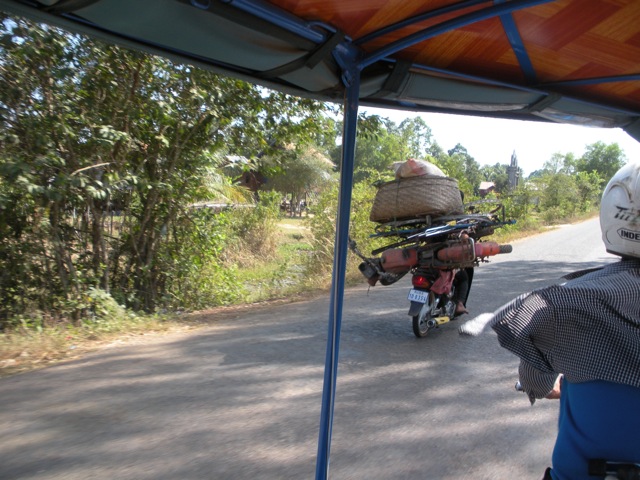
A basket on a bike on a motorbike on a motorbike
From the moment the taxi pulled away from the airport, announcing his merge with the horn, I knew I was going to be a nervous passenger. You see, they all drive with one hand on the wheel and one hand on the horn. I’m not sure what they were trying to say (I don’t speak horn or Khmer), but sometimes it had a bit of attitude and sometimes it was friendly. The basic rule of the road seems to be: I’m bigger, so I’m going first.
I’m not sure if there are any other rules, as it was common to run red lights, turn at will without signaling, and drive on the wrong side of the road. They have a very casual relationship to lane markers, including the central dividing one, and it wasn’t unusual to have three or four “lanes” of traffic moving where only two were marked.
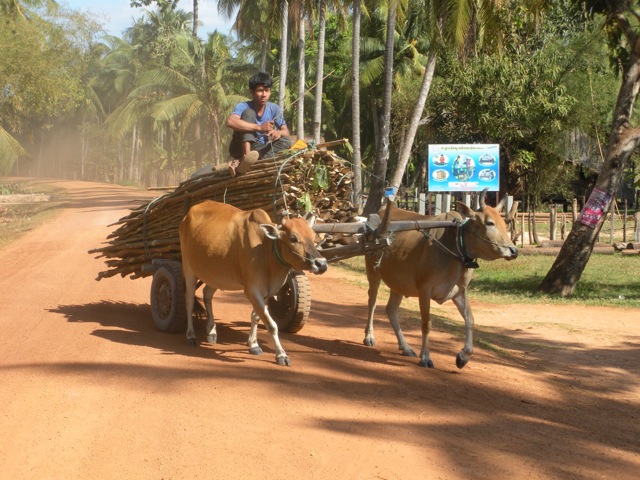
Two cowpower
Bigger is a relative term in a country where six people can ride on a motorbike together, and it’s not unusual to see an enormous load strapped to a tiny vehicle. Anything with wheels that can be propelled by horsepower, manpower, or cowpower goes, and we saw it all! Pigs and chickens headed to market, whole families on a single motorbike, vans stuffed to overflowing with luggage and so many passengers that even the driver was sharing his seat and there were people seated on the roofs!
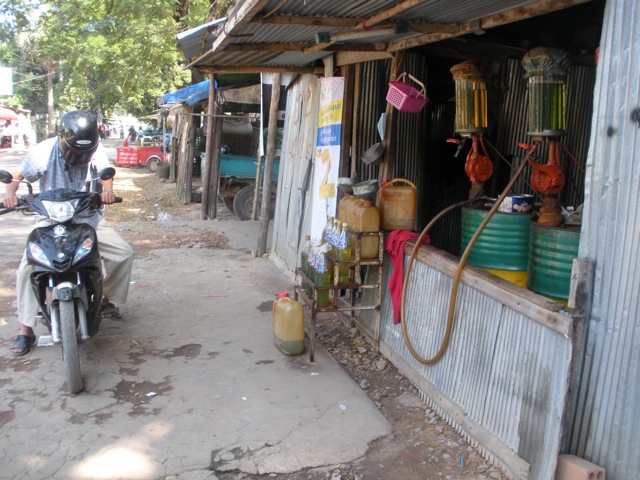
Typical gas station in Siem Reap
In the cities the roads were paved, but on the major country roads (like the road between Phnom Penh and Siem Reap) the pavement was a little intermittent. This made for some bumpy bus rides, but also added to the charm of the tuk-tuk rides around Siem Reap and Kampot.
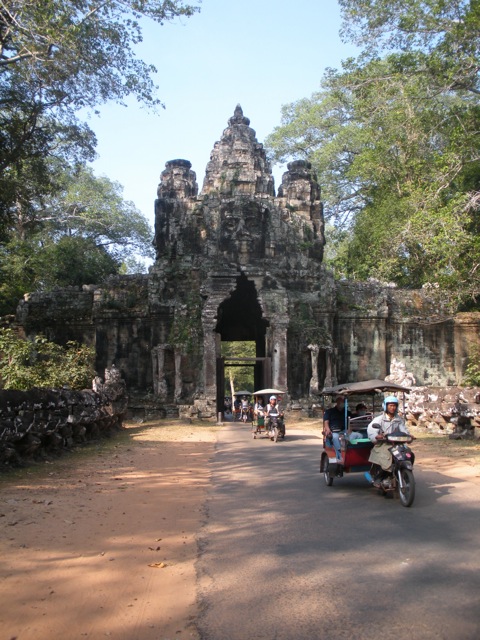
Tuk-tuks exiting the east gate at Angkor Thom
We had our own driver in Siem Reap, arranged through our guesthouse, and he really made the trip for us. His name was Ti, but we called him Mr. T or Speed Racer, affectionately. His vaguely British accented English was very precise, and he had great suggestions for trying to stay one step ahead of the Korean tour buses, as he put it. He was very enthusiastic about sharing his country with us, and on our last day we went exploring across the countryside and we all marveled at how beautiful it was: the emerald rice fields, the dusty red roads, and the huge smiles on the faces of all the kids we passed as we waved like maniacs at each other.
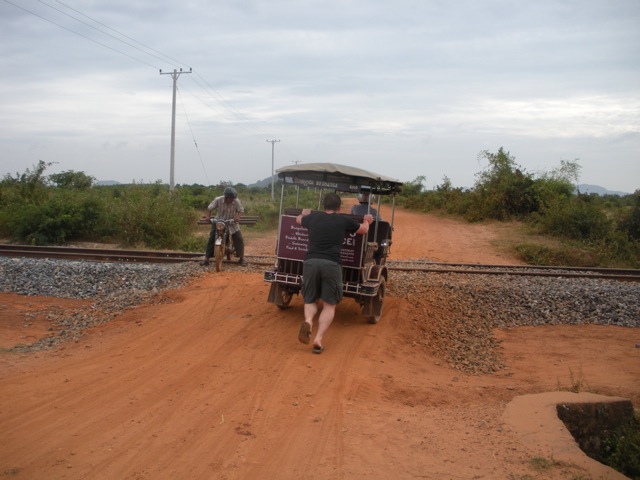
Grant lending a helping hand
In Kampot, we went on a countryside tour via tuk-tuk to the salt fields, limestone cave, the beach and Crab Market at Kep, and to a pepper plantation. Also an interesting drive, especially when we had to get out every time we crossed railroad tracks for Grant to help push the tuk-tuk over. Needless to say, we didn’t call this driver Speed Racer, and we were a little concerned about the amount of gas puddling below his bike when we stopped.
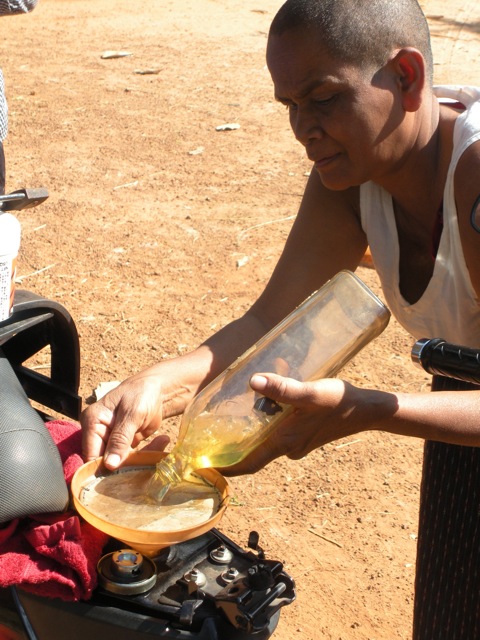
Topping off our tank with a little Johnny Walker
Luckily, there are gas stations everywhere, and they are a bit more informal that you might be used to. All you need is a wooden rack, and funnel, and a few bottles filled with gasoline. Soda bottles or Johnny Walker bottles were definitely preferred, and you pass one of these ad hoc gas stations every few minutes.
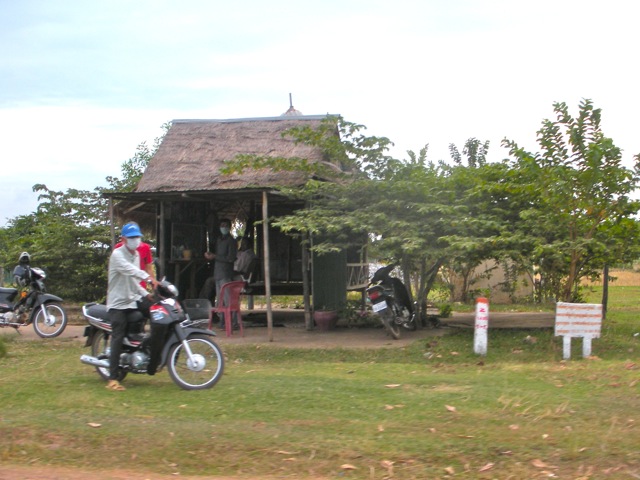
Shave and a haircut, two bits.
There were also lots of casual stores selling baskets, cold drinks and homemade food, but my personal favorite was the roadside barber shop. Only requirement is a roof and a chair, and there was usually someone in the chair either getting a trim or a shave!
We spent a fair amount of time on the road; since there is no passenger train service in Cambodia, bus travel is the primary way to get around. We enjoyed the bus ride on the 24th from Phnom Penh to Siem Reap, which took about five and a half hours. Lovely scenery, but the highlight of that trip for me was a skinny Asian Santa greeting me at the bus station with candy.
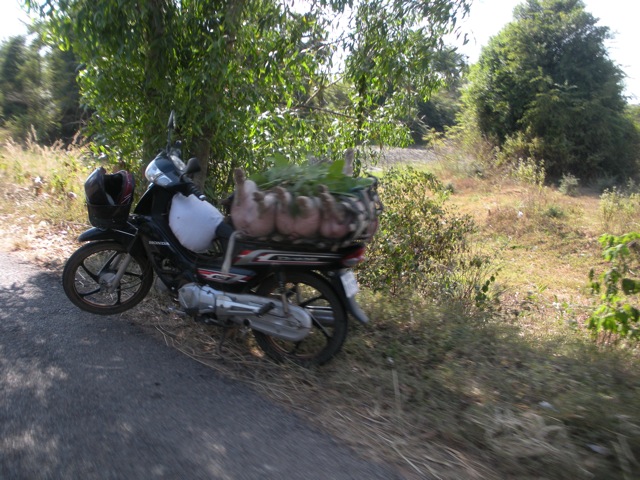
Pigs on their way to market
Slightly different experience on the trip from Siem Reap to Sihanoukville via the night bus: we’d reserved spots on the “sleeping bed” bus, and weren’t sure what to expect. There were three rows of bunkbeds, one against each wall of the bus and one down the middle, with permanently reclined seats. We were in top berths, and the roof of the bus was too low to sit up, so you had to lie down for the entire ten hour trip. It seemed popular with the backpacking crowd (for $18/person, I can see why), and it was a long, noisy, bumpy night. The upside was that I had a window next to me, and with so little light pollution, there were millions of bright stars to watch.
I’m glad we got to see so much of the country, and that transportation was so affordable and easily arranged. More importantly, I’m really happy that we didn’t have to drive ourselves!
Sounds like a sensational trip, Chris. As for the moped driving skills of certain spouses, ask him about the burn marks on the cul de sac at Caterina Heights. Glad you hired a driver – even if Grant had to push!
Thanks for sharing.
What Chris fails to mention here is that I was only able to push our tuk tuk over the railroad tracks after taking a hearty draught of whatever was in that Johnny Walker bottle.