
Angkor Archaeological Park
I had wanted to see the temples of Angkor since we visited Ayutthaya in Thailand and learned that they had drawn their inspiration from Angkor. We visited over 20 temples on our three day pass, and were awed by the experience. I could post hundreds of photos (literally), but I am trying to exercise a little restraint here. Seriously, it’s hard to do! I’ll highlight a few of our favorites, and then you poor friends (or fools) who ask to see more photos will have to suffer through a longer version some time in the future.
One of the big surprises for us on this trip was how much you interact directly with the temples. The shallow but steep staircases that would be roped off for everyone’s safety back home are open for exploration and you can climb up and down to your heart’s content. There are signs that caution you not to touch the carvings, although that didn’t stop some people that we saw and one can only hope that the horde of tourists are not causing too much wear and tear on the temples.
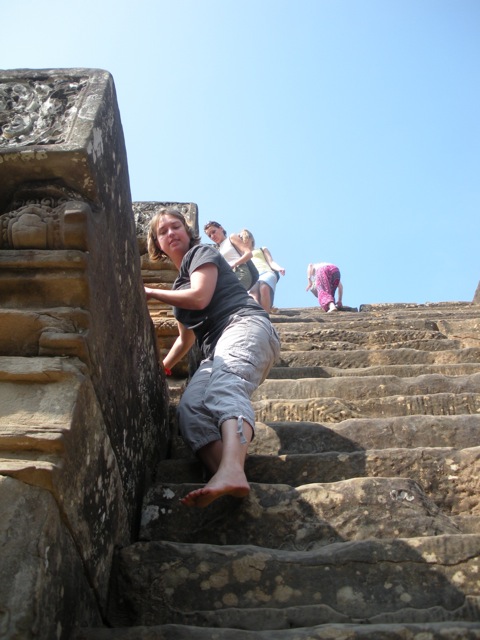
Climbing (carefully) down Ta Keo
The other pleasant surprise was in the volume of tourists. This is the high season, since the weather is cool and dry in Cambodia, and we’d been warned to expect the area to be packed. The most popular temples were more crowded, but even at Angkor Wat you could find areas where you’d be the only one in sight. I had thought we would be elbow to elbow, but we were happy to be sharing most of the temples with only a few others.
Putting this in context: The Khmer Empire was the major power in Southeast Asia for five centuries, and Angkor was its capital. From the 9th through 13th centuries, the succession of Khmer kings built temples to glorify their gods and themselves. Thinking in terms of other buildings in the world, this building period would overlap with Chichen Itza and the Maya-Toltec civilization (10th- 15th centuries), the completion of Westminster Abbey (1065), and the beginning of the construction of Notre Dame (1163).
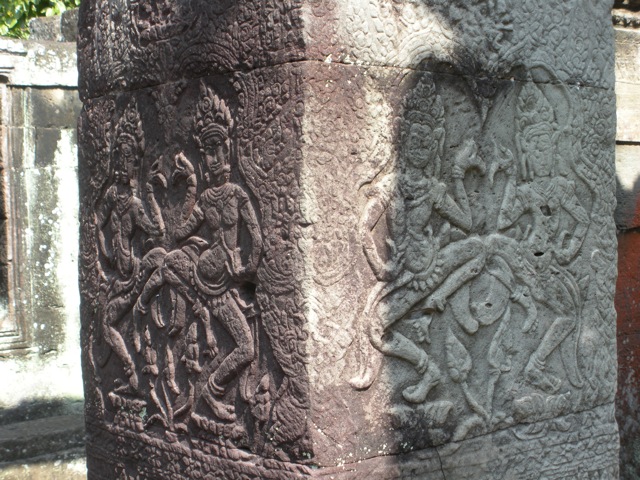
Dancing apsaras
Hinduism dominated in the Khmer Empire until the end of the 12th century, when Mahayana Buddhism gained favor. Hindu imagery is the main focus of the carvings, and you’ll find Vishnu in his many forms (including scenes from the Ramayana), Shiva or lingas (a pillar of stone representing a phallus or the essence of Shiva), and lots of dancing apsaras (celestial nymphs) and nagas (multi-headed snakes). The temples themselves are constructed to represent the universe: the central tower represents Mount Meru, the enclosures are the mountains around it, and the moat that usually surrounded the temple is the primordial ocean.
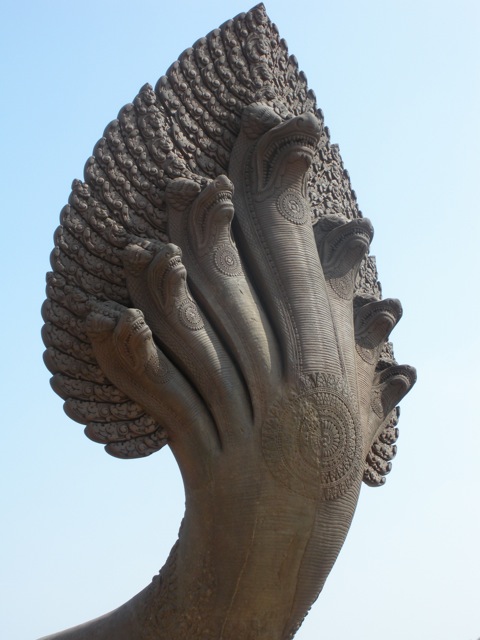
Restored naga at Angkor Wat
Buddha is everywhere. That’s not a religious statement; you will find statues of him around many corners, or remnants of statues (in some cases, just feet). As Buddha’s popularity rose, existing Hindu shrines were converted to Buddhist temples along with new construction like Bayon, and the imagery existed happily side by side. In the middle of the 13th century, there was a brief resurgence in Hinduism and some of the Buddhas lost their heads by order of the king. Today, Theravada Buddhism is the main religion in Cambodia, and it’s common throughout Southeast Asia to dress both whole and fragmented Buddha statues.
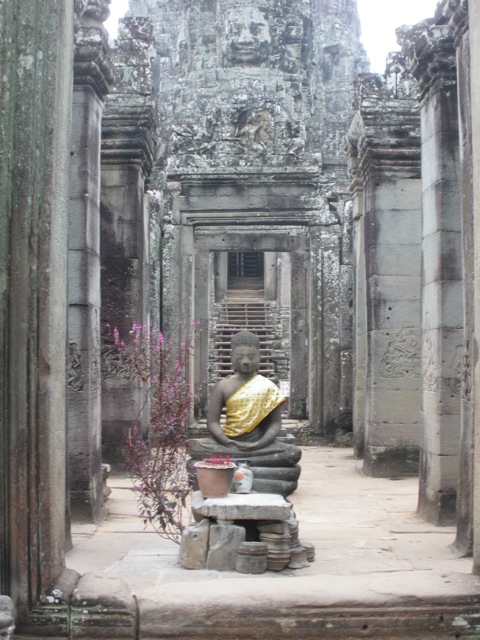
Buddha at Bayon
Ok, on to the temples!
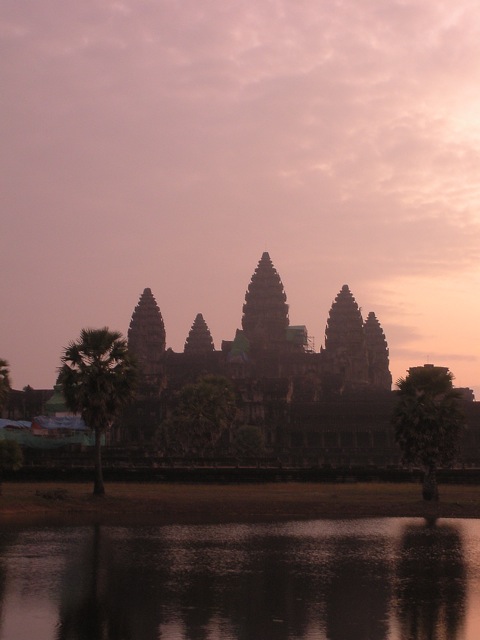
Dawn at Angkor Wat
Angkor Wat: Built in the early 12th century, it’s the world’s largest religious monument. Sunrise is a big attraction here, and we obligingly attended on Christmas morning. We stood on the central causeway in the dark for a while, watching the tour groups gather by the reflecting pool on the left, where you can angle to get the sun rising between the towers. We skipped this view; in the overcast dawn it wasn’t the most impressive sunrise we’ve ever seen, and we didn’t feel like joining the pack quickly forming. Once the sun rose, we joined the smaller group of like-minded folks by the reflecting pool on the right.
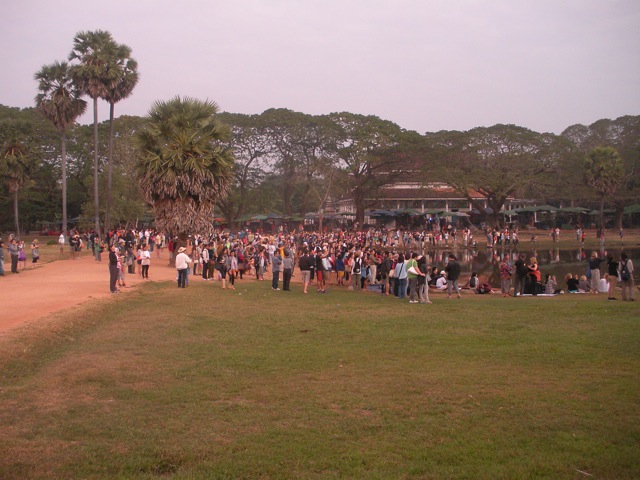
Where we did not want to be
Many temples later, we were exhausted when we returned to Angkor Wat in the afternoon. Our spirits were lifted when we spotted a big guy in a Santa hat and we followed Santa around the bas-relief panels. These are simply massive, spanning the entire length of each side of the temple and depicting battle scenes and mythological stories.
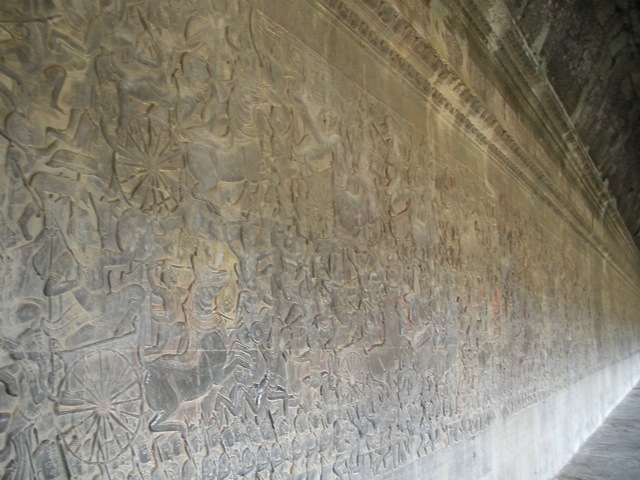
Bas-reliefs at Angkor Wat
We worked our way in and up, admiring the view from the central towers. Even this guy had to sit down to take it all in.
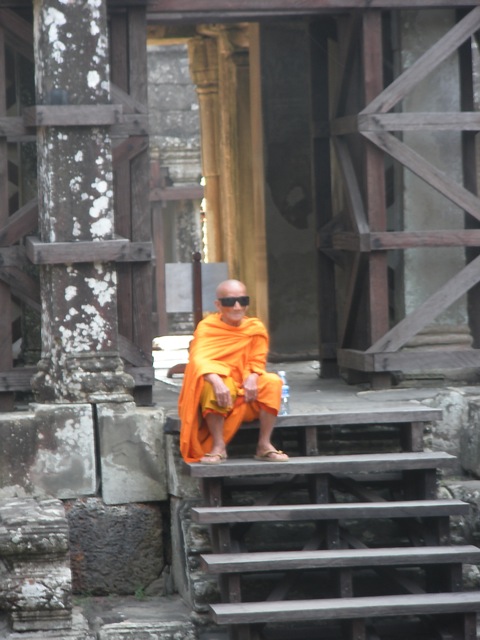
Coolest monk in the world
Bayon: This was our favorite temple, and I doubt we’re alone in this although we certainly were when we saw it. Per the agenda of our tuk-tuk driver, Mr. T, we saw sunrise at Angkor Wat and then skedaddled to get ahead of the tour groups so we were the only ones here early on Christmas morning.
Bayon is at the center of Angkor Thom, one of the largest Khmer cities ever built. The approach is impressive, over a bridge lined on each side with large figures holding the body of a giant naga. Nagas signify the connection between heaven and earth, and this bridge links the world of men outside with the world of gods inside the temple. To enter Angkor Thom, you first pass through a gate mounted by a face-tower (see the photo from Back in KL). Inside it is mostly forest now, and Bayon rises up through the trees as a mass of face-towers. Most of these have four enigmatically smiling faces, adding up to over 260 faces total, and the overall effect is one of profound calm.
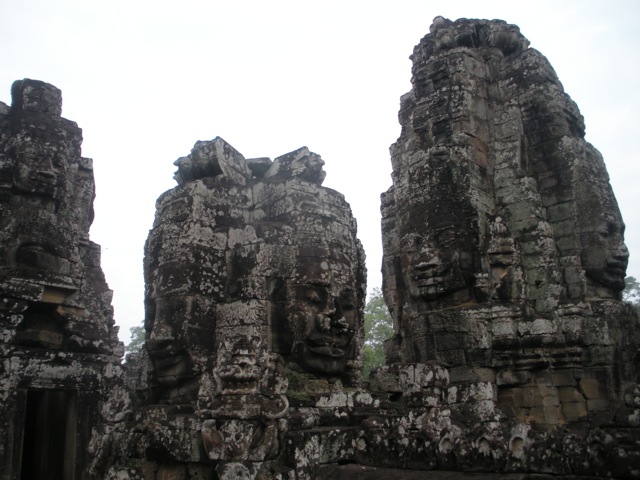
Face-towers at Bayon
We took our time exploring here, enjoying the illicit thrill of climbing all over the temple accompanied only by the sound (but not sight) of dozens of birds. At first, we weren’t sure how much exploration was truly sanctioned and we started out sedately admiring the bas-reliefs on the lower level before we found a steep wooden staircase. We hesitated here, because there was a sign off to the side saying “do not climb.” We finally decided that if they were serious about that message, the sign would have been in the middle of the stairs so up we went, to find ourselves eye to chin with the giant faces.
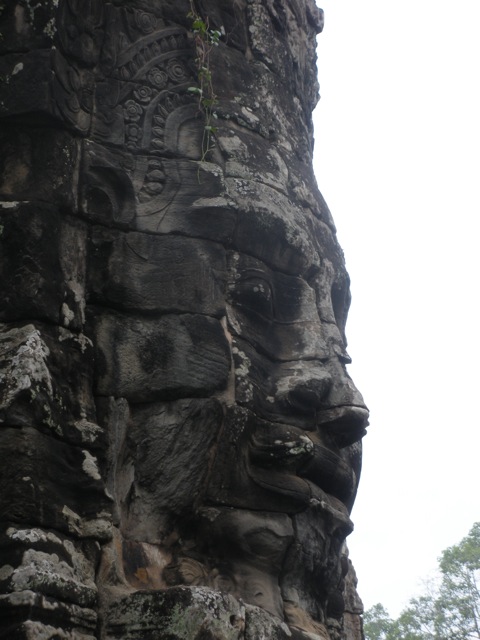
Face at Bayon
Eventually we came back down, and when we reentered the lower level we almost walked right into a small, smiling woman. She silently handed us incense sticks and demonstrated how to respectfully fan the smoke towards the headless seated Buddha in her alcove. Once we had done that, she tied a braided red string around our right wrists and muttered a blessing (surely, not a curse?). We gave a small donation, and I loved the quiet moment.
Banteay Srei: Located a bit further away from the main tourist circuits, we were surprised and a little wary when we pulled up and saw a well developed visitors center (which we didn’t see anywhere else, even at Angkor Wat). We knew this temple was going to be unique, and it was in many ways, starting with the thoughtfully curated expo that introduced the temple and placed it in a historic and artistic context. It was nice to have this available at a slight remove from the temple itself, so if it was of interest it was easy to visit, but if you preferred to view the temple on its own you could.
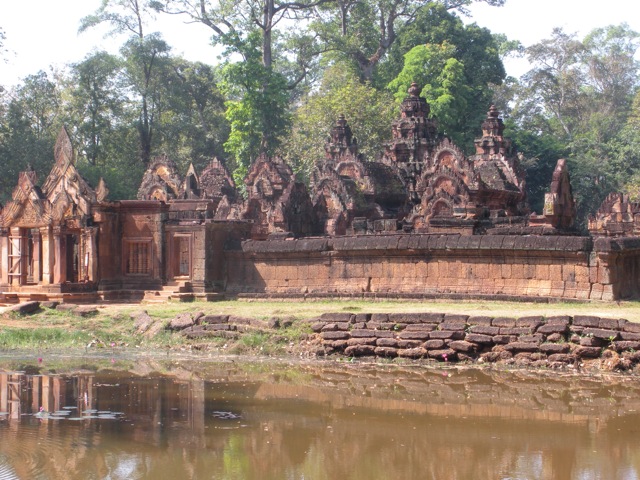
Banteay Srei
The name says it all: it translates to either Citadel of the Women or Citadel of Beauty. This temple was stunning. It’s built out of rosy sandstone, on a much smaller scale than the others and covered with intricate and delicate carvings unlike anything else we saw. I’ll let the pictures speak for themselves.
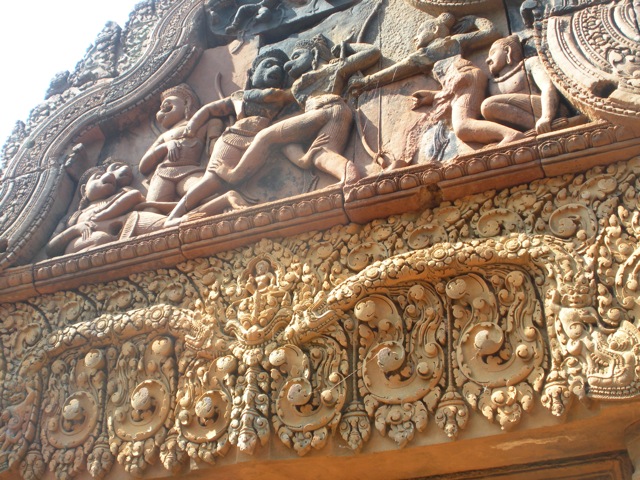
Lintel at Banteay Srei
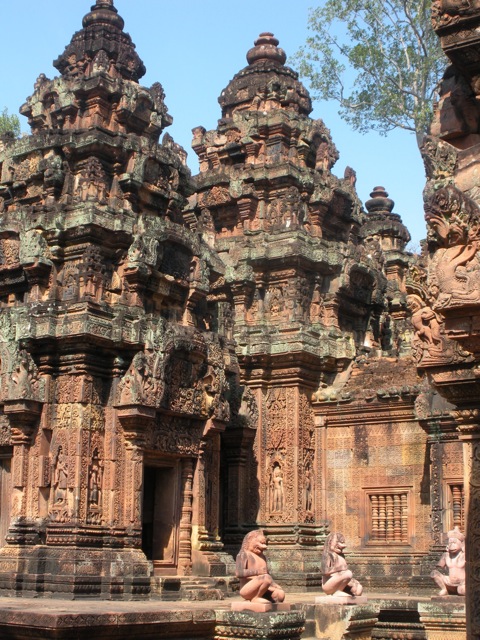
Banteay Srei's carvings
Beng Mealea: There’s a fair amount of reference to the “discovery” of the temples, but it is truly absurd to imagine that they were ever lost. To the Khmer, even when neglected, they have always been sacred places and it’s impossible to overlook these immense stone monuments. When this “discovery” is mentioned, I mentally add “by the Western world” which occurred in the mid to late 19th century. With this reference point in mind, several temples have been preserved in the state in which they were “discovered”.
Ta Prohm is the most well known of these, being the temple used in the filming of Tomb Raider. It was exciting to see on our first day touring the temples, but it was also where we encountered some of the densest tour groups of the trip. The outer enclosures there were quieter, but the inner area was packed with people, stones and signs warning you not to climb on the rubble.
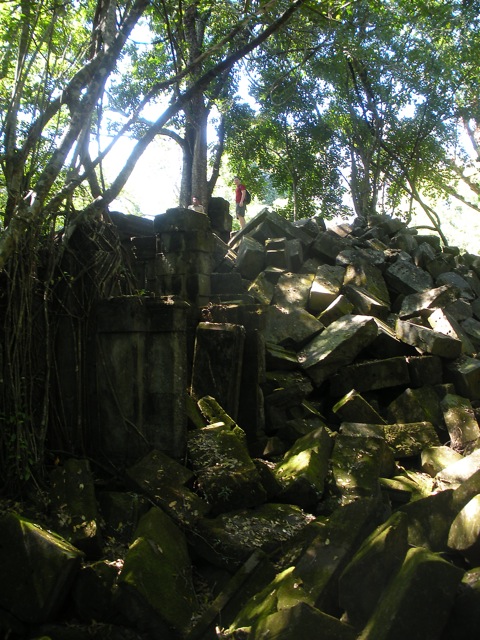
Grant on top of Beng Mealea
We had saved Beng Mealea, another semi-collapsed temple, for our last day. What a way to end it! When the guidebooks talk about living out your Indiana Jones daydreams, they aren’t kidding. Swinging on roots, ducking beneath propped up doorways, scrambling up one side and down the other, this was a great adventure.
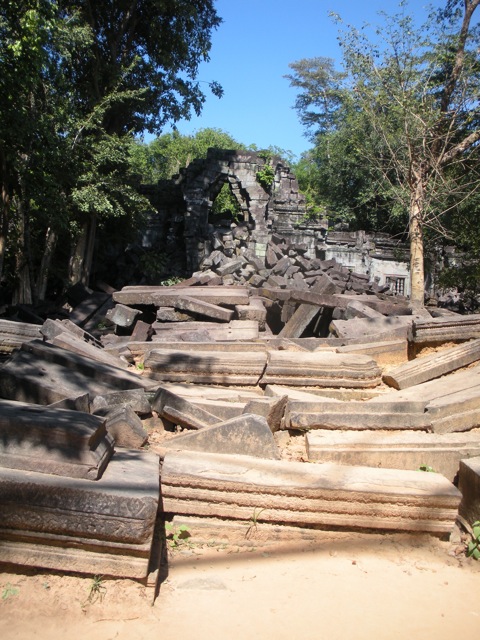
Beng Mealea's former entrance
At this point, we knew what to expect visually as Beng Mealea is a contemporary of Angkor Wat and we’d seen a few ruined temples, but we were unprepared for how we would experience it. There are no signs at all here, and several locals were hanging around near the entrance. They encouraged us to ignore the main path and cross a narrow board “bridge.” We peeked into the enclosure, and then one of them nimbly ducked through the doorway, turned around and said “Come on!” so off we went! He knew exactly where to place his feet and even though some of the stones were a little loose, it felt safe to follow him. Indy always has a local guide, right?
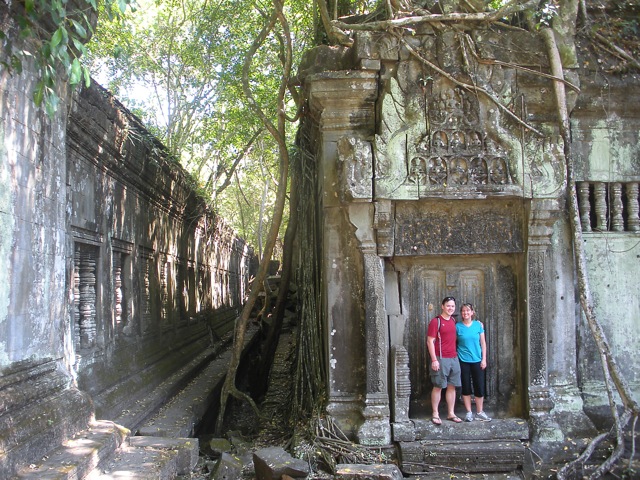
Beng Mealea
Roots looped down, creating natural swings and arches, and we felt completely alone during most of our exploration. Eventually, we bumped into a couple of other people, and ended up back on a boardwalk built to allow the not-so-adventurous to view the temple as well. Just as I thought things were winding down, our guide asked Grant if he wanted to climb up and over the central tower that was now a mass of broken blocks. You don’t have to ask Grant twice if he’d like to climb on something, so he went up while I went around. You do have to ask me twice when heights are involved, and I’d already gotten my fill of steep stuff for the trip!
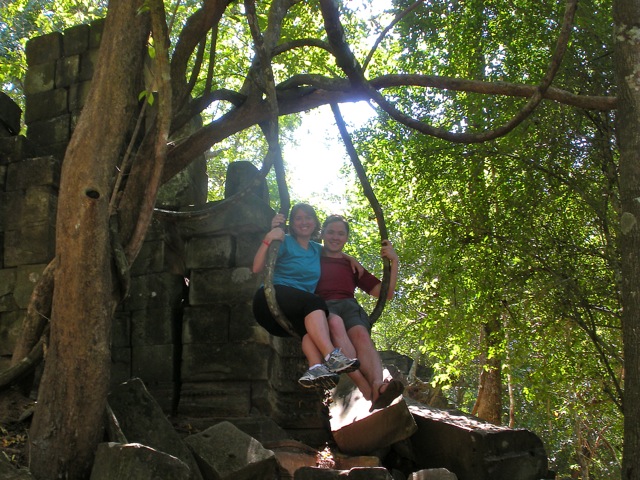
Just hanging around
Would I go back? Absolutely. There are still more temples to see, and I think I would continue to notice new things at the ones we saw on this trip. The people of Siem Reap were some of the friendliest we’ve met, and we had a great time. As you would expect, this was the highlight of Cambodia for us.
Recent Comments