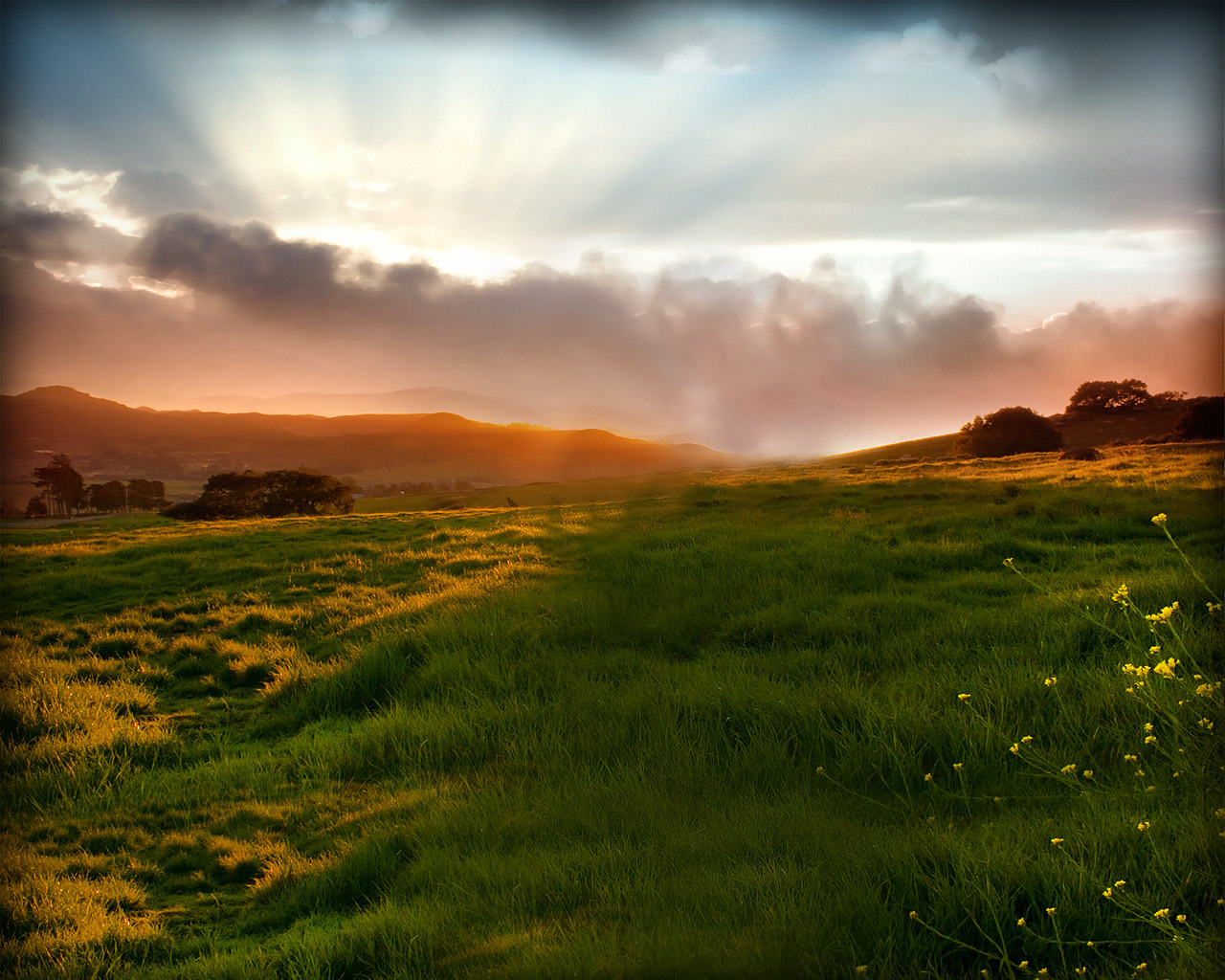

Angkor Archaeological Park
I had wanted to see the temples of Angkor since we visited Ayutthaya in Thailand and learned that they had drawn their inspiration from Angkor. We visited over 20 temples on our three day pass, and were awed by the experience. I could post hundreds of photos (literally), but I am trying to exercise a little restraint here. Seriously, it’s hard to do! I’ll highlight a few of our favorites, and then you poor friends (or fools) who ask to see more photos will have to suffer through a longer version some time in the future.
One of the big surprises for us on this trip was how much you interact directly with the temples. The shallow but steep staircases that would be roped off for everyone’s safety back home are open for exploration and you can climb up and down to your heart’s content. There are signs that caution you not to touch the carvings, although that didn’t stop some people that we saw and one can only hope that the horde of tourists are not causing too much wear and tear on the temples.
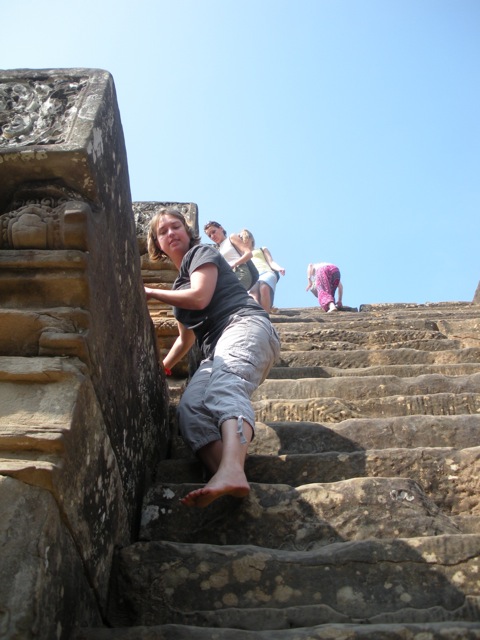
Climbing (carefully) down Ta Keo
The other pleasant surprise was in the volume of tourists. This is the high season, since the weather is cool and dry in Cambodia, and we’d been warned to expect the area to be packed. The most popular temples were more crowded, but even at Angkor Wat you could find areas where you’d be the only one in sight. I had thought we would be elbow to elbow, but we were happy to be sharing most of the temples with only a few others.
Putting this in context: The Khmer Empire was the major power in Southeast Asia for five centuries, and Angkor was its capital. From the 9th through 13th centuries, the succession of Khmer kings built temples to glorify their gods and themselves. Thinking in terms of other buildings in the world, this building period would overlap with Chichen Itza and the Maya-Toltec civilization (10th- 15th centuries), the completion of Westminster Abbey (1065), and the beginning of the construction of Notre Dame (1163).
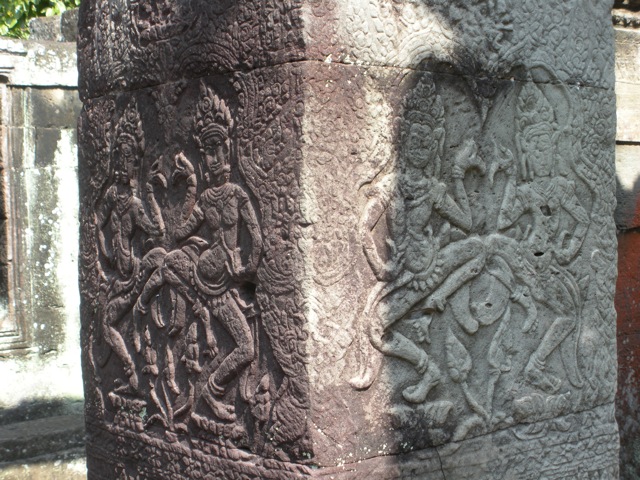
Dancing apsaras
Hinduism dominated in the Khmer Empire until the end of the 12th century, when Mahayana Buddhism gained favor. Hindu imagery is the main focus of the carvings, and you’ll find Vishnu in his many forms (including scenes from the Ramayana), Shiva or lingas (a pillar of stone representing a phallus or the essence of Shiva), and lots of dancing apsaras (celestial nymphs) and nagas (multi-headed snakes). The temples themselves are constructed to represent the universe: the central tower represents Mount Meru, the enclosures are the mountains around it, and the moat that usually surrounded the temple is the primordial ocean.
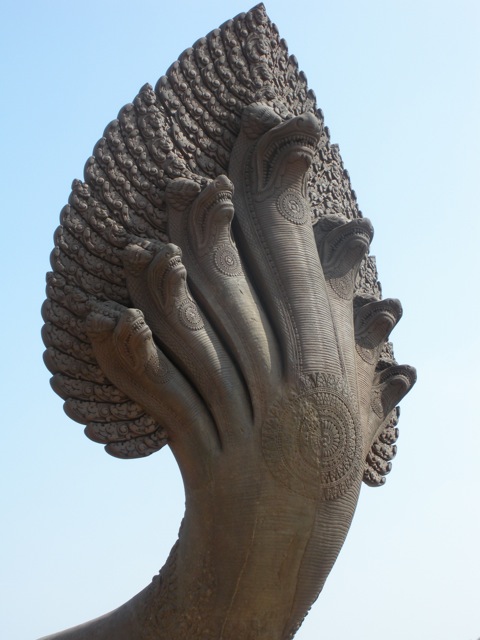
Restored naga at Angkor Wat
Buddha is everywhere. That’s not a religious statement; you will find statues of him around many corners, or remnants of statues (in some cases, just feet). As Buddha’s popularity rose, existing Hindu shrines were converted to Buddhist temples along with new construction like Bayon, and the imagery existed happily side by side. In the middle of the 13th century, there was a brief resurgence in Hinduism and some of the Buddhas lost their heads by order of the king. Today, Theravada Buddhism is the main religion in Cambodia, and it’s common throughout Southeast Asia to dress both whole and fragmented Buddha statues.
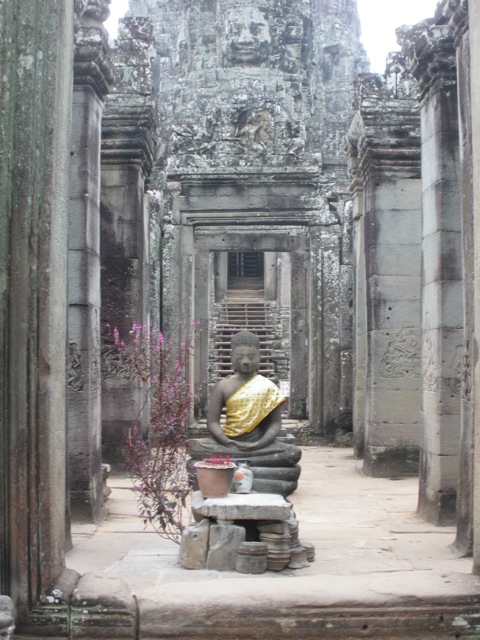
Buddha at Bayon
Ok, on to the temples!
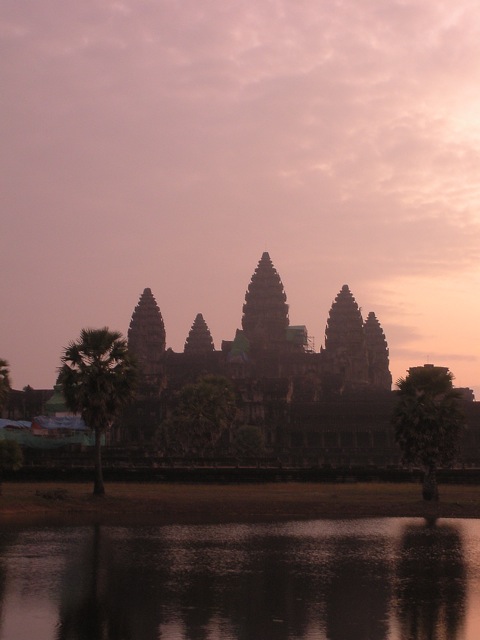
Dawn at Angkor Wat
Angkor Wat: Built in the early 12th century, it’s the world’s largest religious monument. Sunrise is a big attraction here, and we obligingly attended on Christmas morning. We stood on the central causeway in the dark for a while, watching the tour groups gather by the reflecting pool on the left, where you can angle to get the sun rising between the towers. We skipped this view; in the overcast dawn it wasn’t the most impressive sunrise we’ve ever seen, and we didn’t feel like joining the pack quickly forming. Once the sun rose, we joined the smaller group of like-minded folks by the reflecting pool on the right.
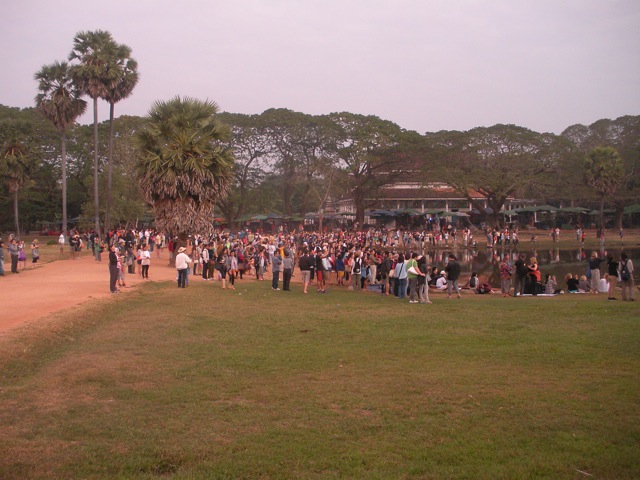
Where we did not want to be
Many temples later, we were exhausted when we returned to Angkor Wat in the afternoon. Our spirits were lifted when we spotted a big guy in a Santa hat and we followed Santa around the bas-relief panels. These are simply massive, spanning the entire length of each side of the temple and depicting battle scenes and mythological stories.
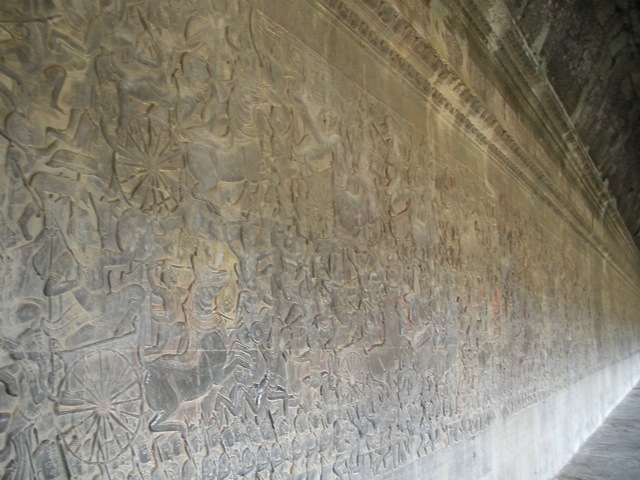
Bas-reliefs at Angkor Wat
We worked our way in and up, admiring the view from the central towers. Even this guy had to sit down to take it all in.
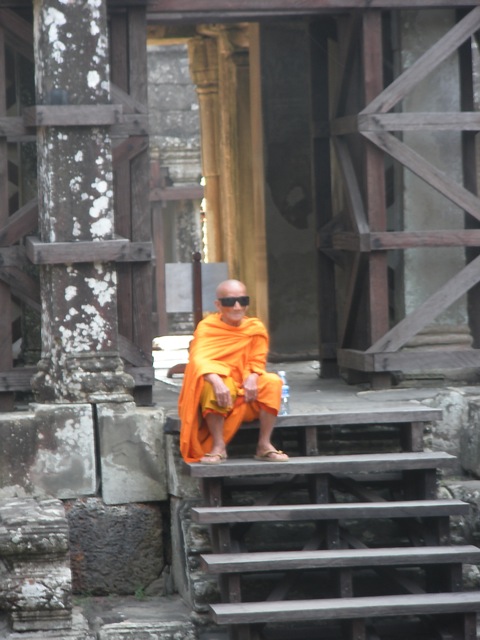
Coolest monk in the world
Bayon: This was our favorite temple, and I doubt we’re alone in this although we certainly were when we saw it. Per the agenda of our tuk-tuk driver, Mr. T, we saw sunrise at Angkor Wat and then skedaddled to get ahead of the tour groups so we were the only ones here early on Christmas morning.
Bayon is at the center of Angkor Thom, one of the largest Khmer cities ever built. The approach is impressive, over a bridge lined on each side with large figures holding the body of a giant naga. Nagas signify the connection between heaven and earth, and this bridge links the world of men outside with the world of gods inside the temple. To enter Angkor Thom, you first pass through a gate mounted by a face-tower (see the photo from Back in KL). Inside it is mostly forest now, and Bayon rises up through the trees as a mass of face-towers. Most of these have four enigmatically smiling faces, adding up to over 260 faces total, and the overall effect is one of profound calm.
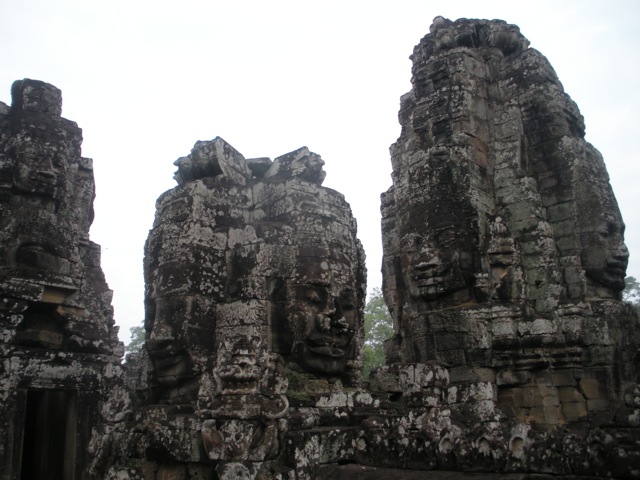
Face-towers at Bayon
We took our time exploring here, enjoying the illicit thrill of climbing all over the temple accompanied only by the sound (but not sight) of dozens of birds. At first, we weren’t sure how much exploration was truly sanctioned and we started out sedately admiring the bas-reliefs on the lower level before we found a steep wooden staircase. We hesitated here, because there was a sign off to the side saying “do not climb.” We finally decided that if they were serious about that message, the sign would have been in the middle of the stairs so up we went, to find ourselves eye to chin with the giant faces.
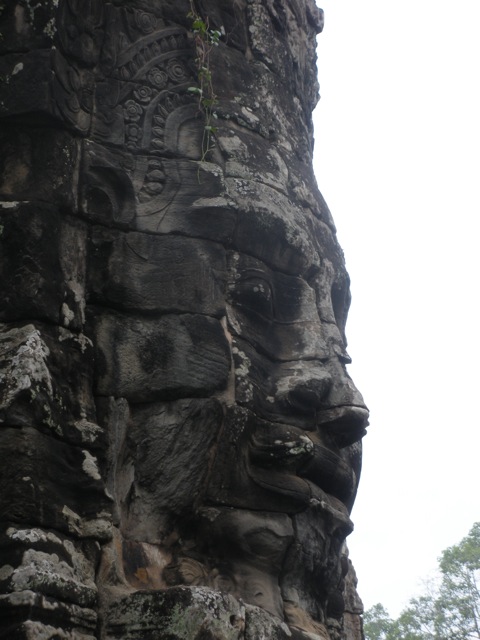
Face at Bayon
Eventually we came back down, and when we reentered the lower level we almost walked right into a small, smiling woman. She silently handed us incense sticks and demonstrated how to respectfully fan the smoke towards the headless seated Buddha in her alcove. Once we had done that, she tied a braided red string around our right wrists and muttered a blessing (surely, not a curse?). We gave a small donation, and I loved the quiet moment.
Banteay Srei: Located a bit further away from the main tourist circuits, we were surprised and a little wary when we pulled up and saw a well developed visitors center (which we didn’t see anywhere else, even at Angkor Wat). We knew this temple was going to be unique, and it was in many ways, starting with the thoughtfully curated expo that introduced the temple and placed it in a historic and artistic context. It was nice to have this available at a slight remove from the temple itself, so if it was of interest it was easy to visit, but if you preferred to view the temple on its own you could.
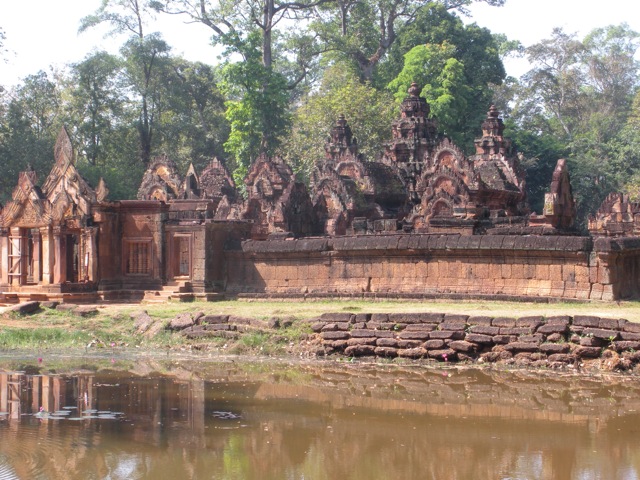
Banteay Srei
The name says it all: it translates to either Citadel of the Women or Citadel of Beauty. This temple was stunning. It’s built out of rosy sandstone, on a much smaller scale than the others and covered with intricate and delicate carvings unlike anything else we saw. I’ll let the pictures speak for themselves.
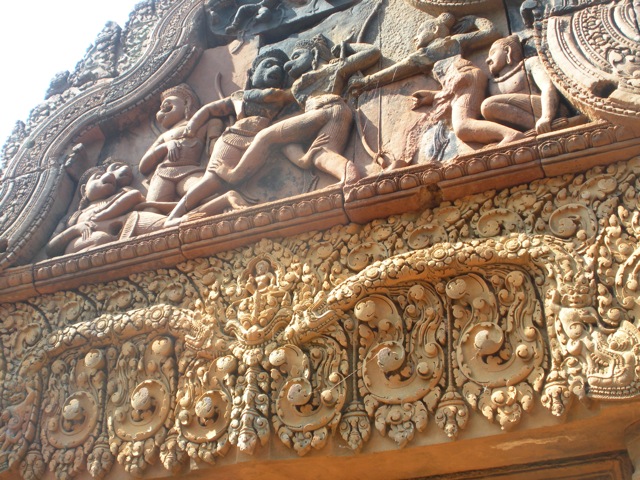
Lintel at Banteay Srei
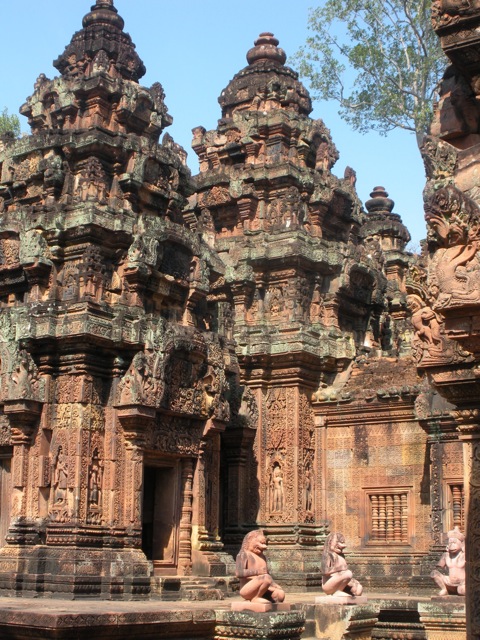
Banteay Srei's carvings
Beng Mealea: There’s a fair amount of reference to the “discovery” of the temples, but it is truly absurd to imagine that they were ever lost. To the Khmer, even when neglected, they have always been sacred places and it’s impossible to overlook these immense stone monuments. When this “discovery” is mentioned, I mentally add “by the Western world” which occurred in the mid to late 19th century. With this reference point in mind, several temples have been preserved in the state in which they were “discovered”.
Ta Prohm is the most well known of these, being the temple used in the filming of Tomb Raider. It was exciting to see on our first day touring the temples, but it was also where we encountered some of the densest tour groups of the trip. The outer enclosures there were quieter, but the inner area was packed with people, stones and signs warning you not to climb on the rubble.
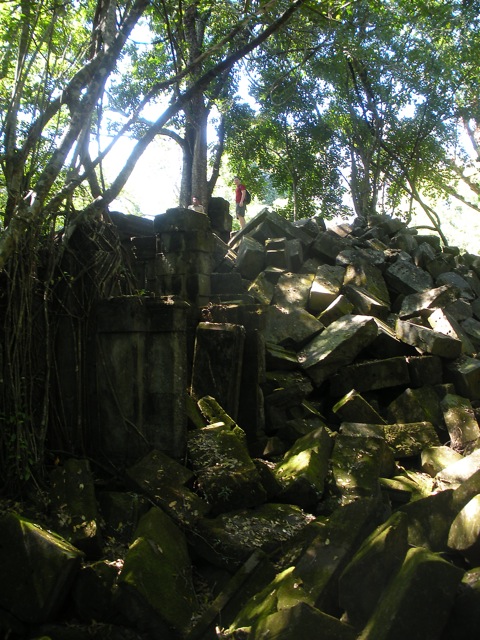
Grant on top of Beng Mealea
We had saved Beng Mealea, another semi-collapsed temple, for our last day. What a way to end it! When the guidebooks talk about living out your Indiana Jones daydreams, they aren’t kidding. Swinging on roots, ducking beneath propped up doorways, scrambling up one side and down the other, this was a great adventure.
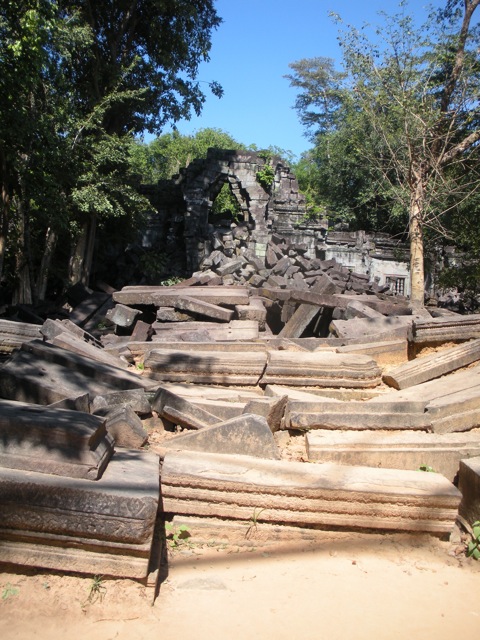
Beng Mealea's former entrance
At this point, we knew what to expect visually as Beng Mealea is a contemporary of Angkor Wat and we’d seen a few ruined temples, but we were unprepared for how we would experience it. There are no signs at all here, and several locals were hanging around near the entrance. They encouraged us to ignore the main path and cross a narrow board “bridge.” We peeked into the enclosure, and then one of them nimbly ducked through the doorway, turned around and said “Come on!” so off we went! He knew exactly where to place his feet and even though some of the stones were a little loose, it felt safe to follow him. Indy always has a local guide, right?
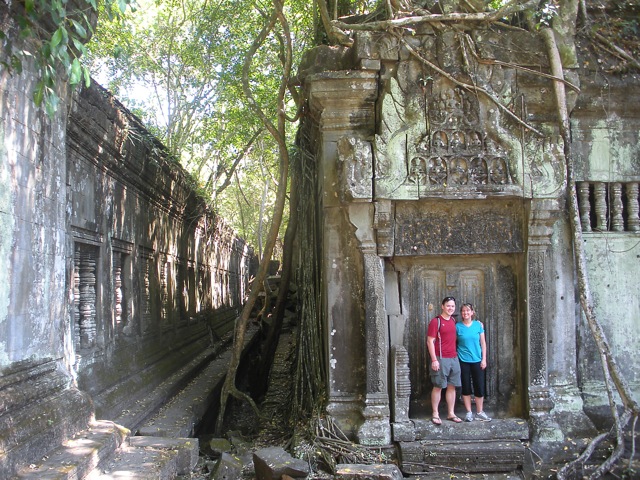
Beng Mealea
Roots looped down, creating natural swings and arches, and we felt completely alone during most of our exploration. Eventually, we bumped into a couple of other people, and ended up back on a boardwalk built to allow the not-so-adventurous to view the temple as well. Just as I thought things were winding down, our guide asked Grant if he wanted to climb up and over the central tower that was now a mass of broken blocks. You don’t have to ask Grant twice if he’d like to climb on something, so he went up while I went around. You do have to ask me twice when heights are involved, and I’d already gotten my fill of steep stuff for the trip!
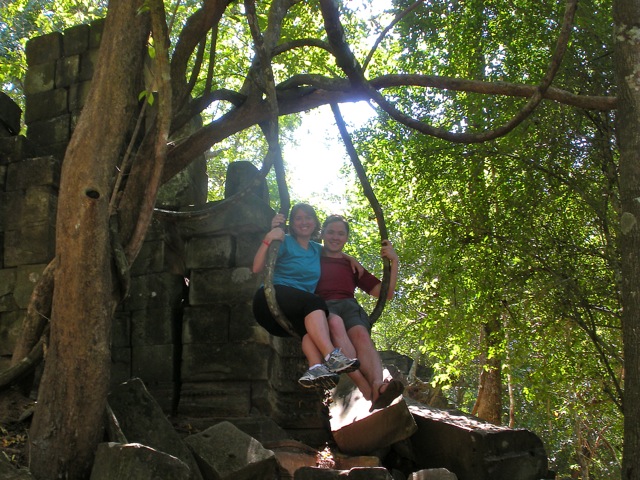
Just hanging around
Would I go back? Absolutely. There are still more temples to see, and I think I would continue to notice new things at the ones we saw on this trip. The people of Siem Reap were some of the friendliest we’ve met, and we had a great time. As you would expect, this was the highlight of Cambodia for us.
Phnom Penh
We decided to skip the Killing Fields and the genocide museum. I know a lot of people feel it is important to bear witness to this period of Cambodian history, but we thought that it would be too sad and depressing. Instead, we visited the Royal Palace and the Silver Pagoda, the National Museum, Wat Phnom, and the Central Market.
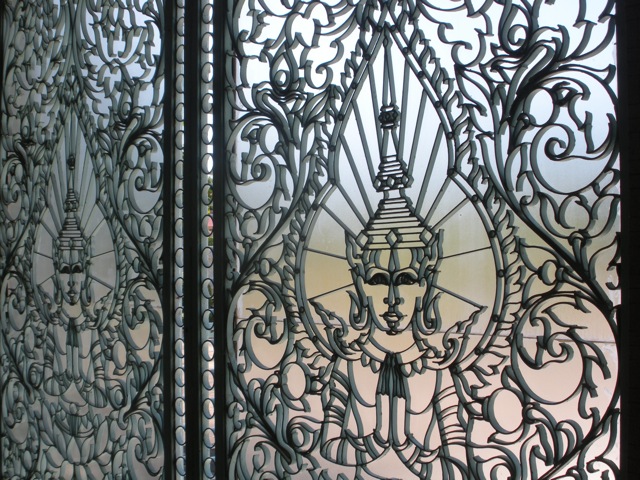
Gates at the Royal Palace
From our hotel, you could see the tips of the ornate pagoda style rooftops of the Royal Palace and the National Museum peeking over the tin roofs of the buildings around us. When we visited the palace, I was struck by the fact that there were more gardeners than guards. Much of the palace itself is off limits, but we visited the throne room pavilion, strolled through the well manicured gardens, and spent most of our time in the Silver Pagoda area.
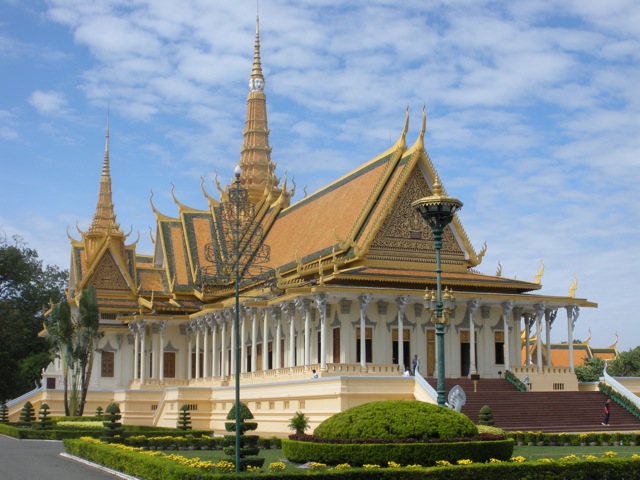
Throne Room Pavilion at the Royal Palace
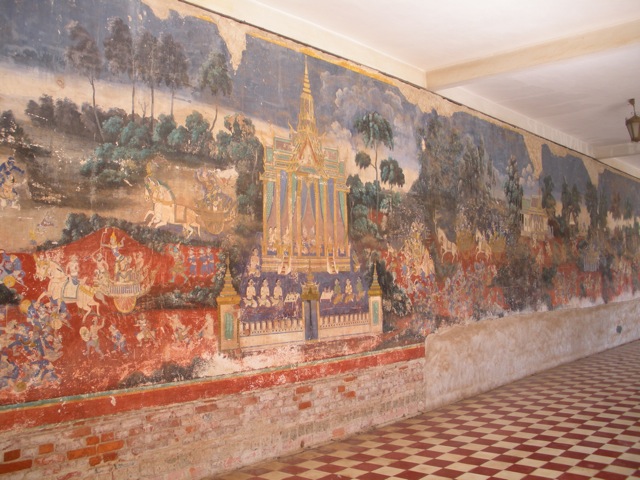
Ramayana mural at the Silver Pagoda
The wall of the outer enclosure is decorated with a mural depicting the Ramayana (a Hindu epic originating in the 5th or 4th century B.C.). We didn’t know the story at the time (wish we had), but it appears that the gist of it is that Rama’s wife Sita gets abducted by a neighboring demon king, and a great adventure ensues while he is trying to get her back. Our favorite moments included a human bridge and a serious malady:
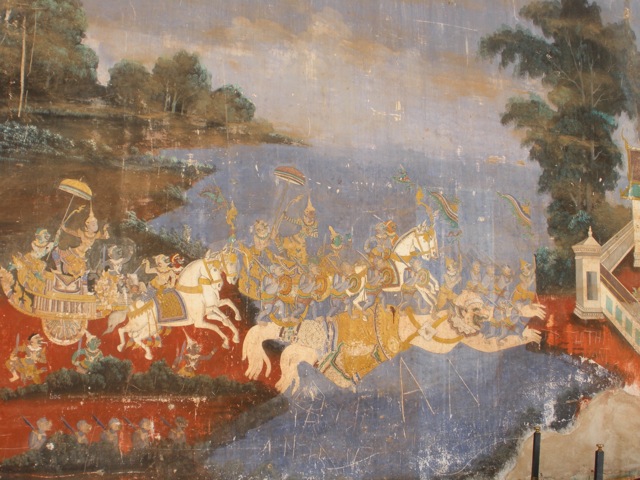
Go go gadget, supersize!
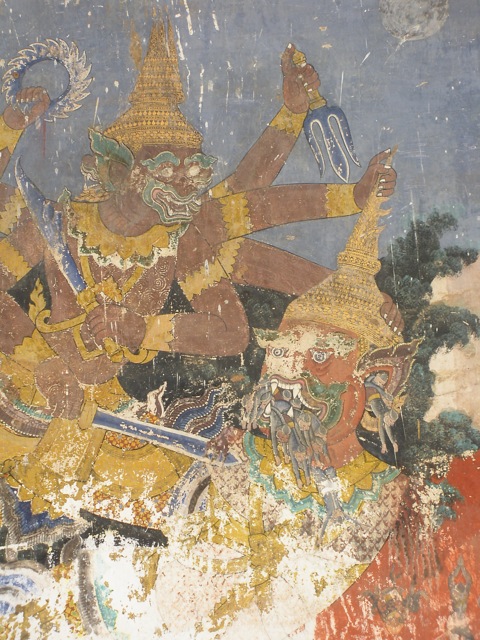
Monkey armies coming out of his ears
The Silver Pagoda itself houses many Buddhas (including an “Emerald” one, as in Thailand) and other relics, and is named for its floor, which is covered by more than 5,000 silver tiles. Most of them are covered by a carpet, but you are walking across them nonetheless, and it was unnerving to hear the floor creaking loudly beneath your feet.
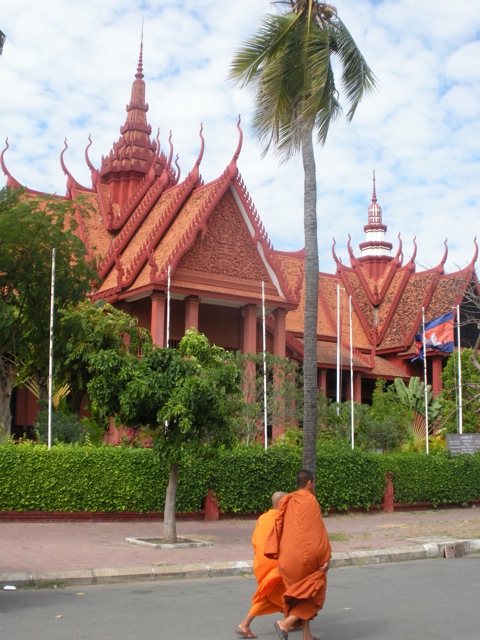
National Museum
The National Museum is one block over and was worth a visit. It focuses on Angkorian artifacts, as one would expect, and the courtyard provided a nice space to relax. Lots of sculptures here with minimal explanation, and there were two exhibits that I found particularly interesting. One of the museum’s goals is to preserve Cambodian traditions, and there was a room full of photographs of dancers from the Royal Ballet holding poses. Accompanying this were excerpts from interviews with them talking about the differences in traditional dance the way they had performed it previously and the way it was being performed at the time the photos were taken (in 1927). The other exhibit that surprised me was detailing some of the archeological work being done in the country, and the problems they have encountered with ancient bronze drums being looted as recently as in the early 2000s and sold for the value of the metal. Of course, it also focused on the education efforts and the attempts to convert former looters to archeological assistants.
After the museum, we strolled along the riverfront, and noticed stationary exercise equipment installed there. The next morning, when we were picked up for our bus ride to Siem Reap, a German woman who had stayed opposite that area commented that when she woke up, she thought she had joined the army! Apparently, there were loud early morning aerobics classes held there as well. We did see badminton being played in the squares in front of the Ministry of Defense; it’s a very popular game in Southeast Asia.
Made it to Wat Phnom, where we paid the stupid foreigners tax by walking around the base of the hill to the main entrance, and going up to the ticket booth. It was just as easy to approach the temple from any other side, and no one was asking to see tickets. I’m trying to think of it as stimulating their economy, and not just as taking advantage of us.
The Central Market was memorable for its Art Deco dome, which did create a sort of natural air conditioning effect. We had a quick lunch here at the food stalls, which ended up costing us $1.50 total! Basic and delicious.
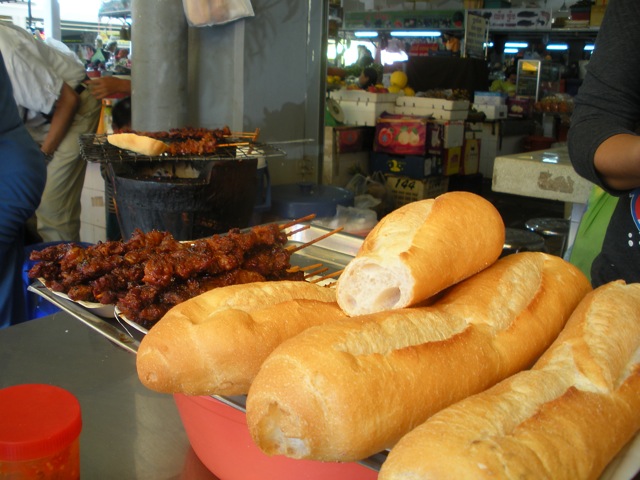
Grilled meat at Central Market
Probably safe to say that our favorite part of Phnom Penh was one of my new favorite restaurants in the world: Romdeng. This was initially suggested to us by our hotel, and we later realized that it is one of the Lonely Planet’s top picks too, and deservedly so. It’s in a villa set in a quiet enclosed garden, and we ate upstairs on a balcony with friendly geckos for company. The restaurant is associated with Friends International, which works to help get children off the streets, and in this case to give them the training they need to succeed in the hospitality industry. Romdeng is a “training” restaurant specializing in creative Cambodian cuisine, and all profits go back their projects for street children. We loved it so much that we ate here three times, even leaving Kampot a little early on our last day to squeeze in one last lunch. Great food and a worthy cause, what’s not to love?
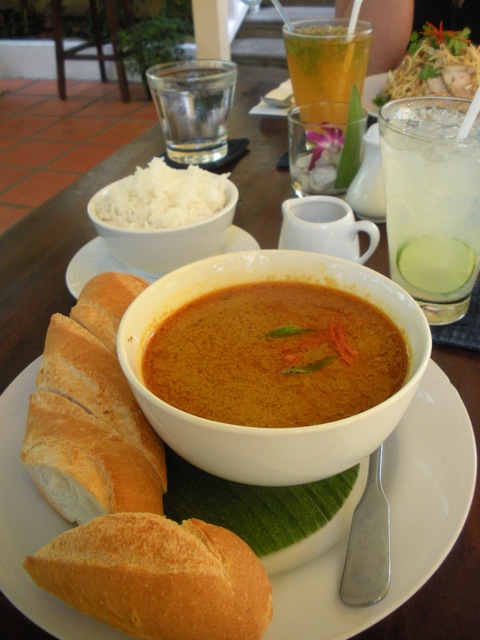
Grant's favorite meal
So when they say creative, they mean it! One of the most famous/infamous dishes on the menu is Fried Tarantulas. No, we didn’t order it (too many tasty sounding dishes on the menu to go for the shock factor), but the table next to us on our first night did. They had three young kids, and we were duly impressed with their willingness to try new foods. The oldest one (maybe seven years old?) seriously confided in me that he didn’t like spiders at all, but the littler ones were diving right in. No problem munching on the legs, which were apparently nice and crispy, but we all recoiled a little when the youngest who couldn’t have been more than four stuffed a whole body into her mouth. Gross. The next night (yup, twice in a row), a table near us tried to order them, only to be told that they were out of tarantulas, and only had one left…which they proceeded to bring out alive on a plate for us all to see. I prefer hanging out with the geckos, thank you!
Everything we did eat there was amazing, and we bought their cookbook to try to reproduce some of our favorite dishes: Banana Flower Salad with Cambodian Bacon, Khmer Muslim Beef Curry, and Fish Amok. They sell banana flowers in some of the local supermarkets here in KL, and I made that on Sunday – a pale imitation of the one we had here, but I think I’ll get there eventually and have a lot of fun trying!
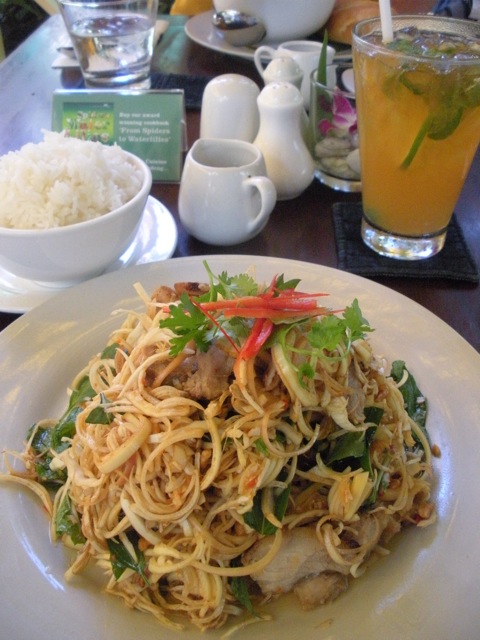
Banana Flower Salad at Romdeng
More to follow on Angkor, the cooking class I took in Siem Reap, and our time on the Cambodian coast…
Driving in Cambodia
We did not drive in Cambodia, not even a motorbike. No thank you.
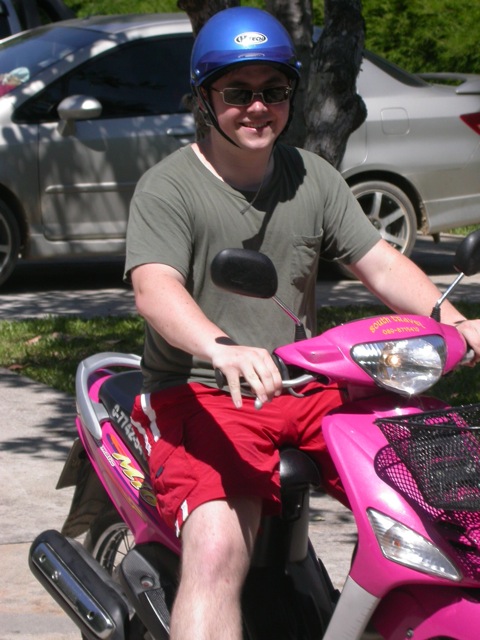
Grant in Thailand
I still remember our effort in Thailand that started with Grant steering up and down the driveway of our hotel and ended with us hailing a cab. We do have a moped at home, and I’m sure that given the time and inclination, Grant would be an excellent motorbike driver. The place to learn is NOT on the streets of Cambodia.
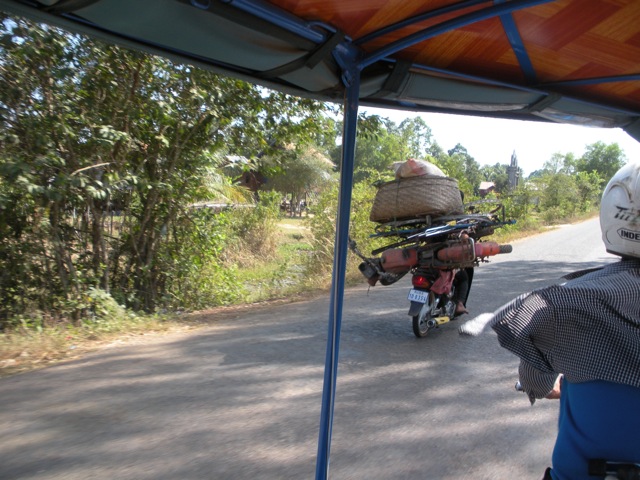
A basket on a bike on a motorbike on a motorbike
From the moment the taxi pulled away from the airport, announcing his merge with the horn, I knew I was going to be a nervous passenger. You see, they all drive with one hand on the wheel and one hand on the horn. I’m not sure what they were trying to say (I don’t speak horn or Khmer), but sometimes it had a bit of attitude and sometimes it was friendly. The basic rule of the road seems to be: I’m bigger, so I’m going first.
I’m not sure if there are any other rules, as it was common to run red lights, turn at will without signaling, and drive on the wrong side of the road. They have a very casual relationship to lane markers, including the central dividing one, and it wasn’t unusual to have three or four “lanes” of traffic moving where only two were marked.
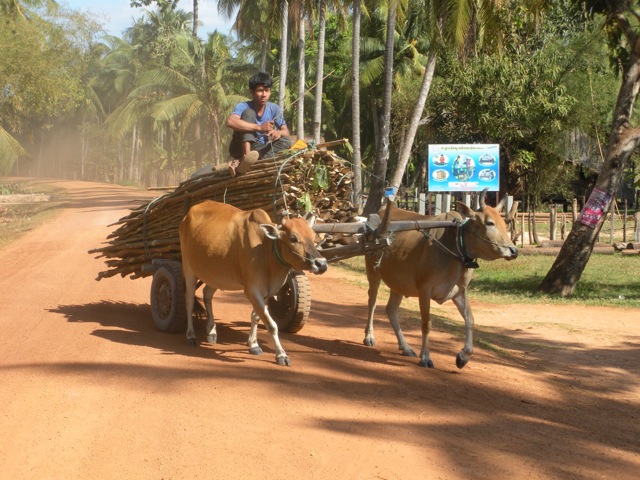
Two cowpower
Bigger is a relative term in a country where six people can ride on a motorbike together, and it’s not unusual to see an enormous load strapped to a tiny vehicle. Anything with wheels that can be propelled by horsepower, manpower, or cowpower goes, and we saw it all! Pigs and chickens headed to market, whole families on a single motorbike, vans stuffed to overflowing with luggage and so many passengers that even the driver was sharing his seat and there were people seated on the roofs!
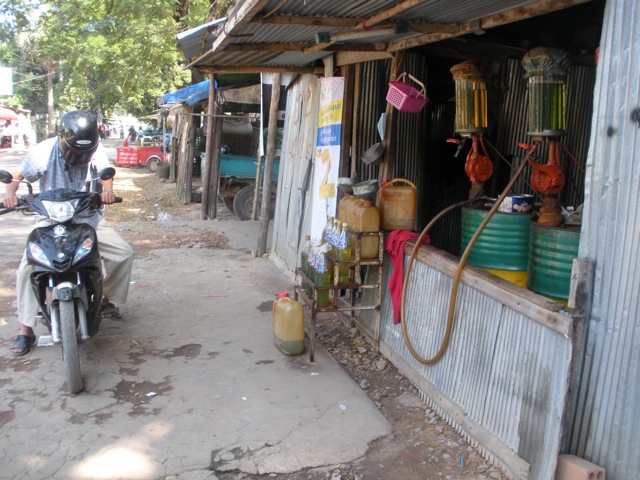
Typical gas station in Siem Reap
In the cities the roads were paved, but on the major country roads (like the road between Phnom Penh and Siem Reap) the pavement was a little intermittent. This made for some bumpy bus rides, but also added to the charm of the tuk-tuk rides around Siem Reap and Kampot.
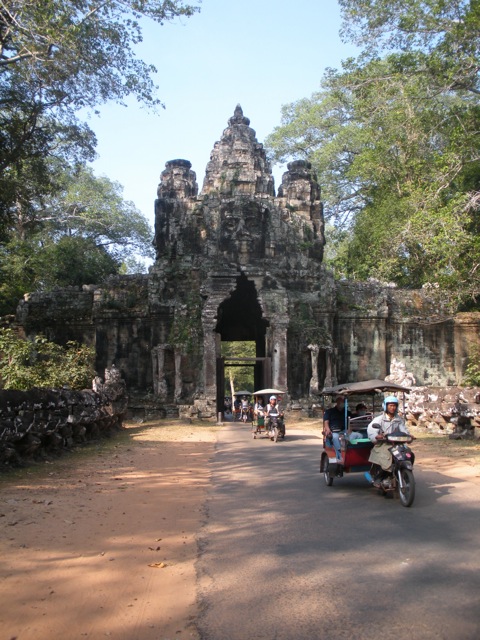
Tuk-tuks exiting the east gate at Angkor Thom
We had our own driver in Siem Reap, arranged through our guesthouse, and he really made the trip for us. His name was Ti, but we called him Mr. T or Speed Racer, affectionately. His vaguely British accented English was very precise, and he had great suggestions for trying to stay one step ahead of the Korean tour buses, as he put it. He was very enthusiastic about sharing his country with us, and on our last day we went exploring across the countryside and we all marveled at how beautiful it was: the emerald rice fields, the dusty red roads, and the huge smiles on the faces of all the kids we passed as we waved like maniacs at each other.
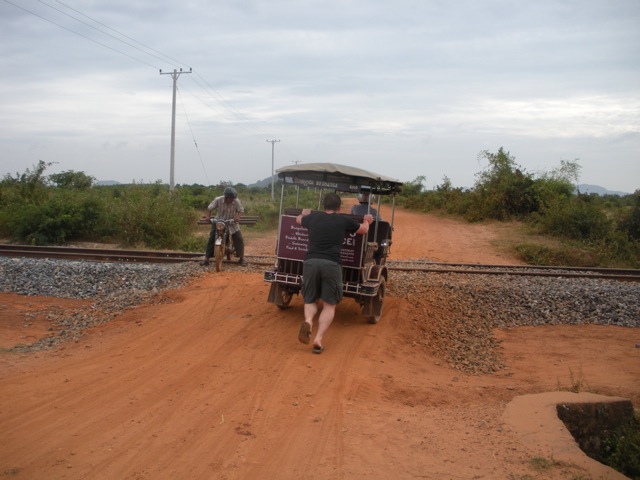
Grant lending a helping hand
In Kampot, we went on a countryside tour via tuk-tuk to the salt fields, limestone cave, the beach and Crab Market at Kep, and to a pepper plantation. Also an interesting drive, especially when we had to get out every time we crossed railroad tracks for Grant to help push the tuk-tuk over. Needless to say, we didn’t call this driver Speed Racer, and we were a little concerned about the amount of gas puddling below his bike when we stopped.
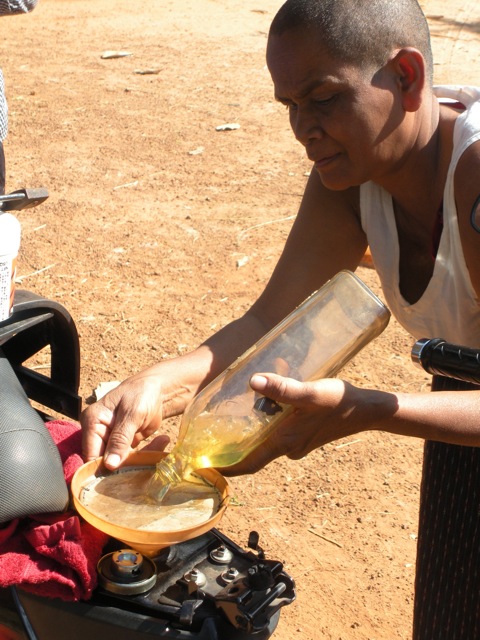
Topping off our tank with a little Johnny Walker
Luckily, there are gas stations everywhere, and they are a bit more informal that you might be used to. All you need is a wooden rack, and funnel, and a few bottles filled with gasoline. Soda bottles or Johnny Walker bottles were definitely preferred, and you pass one of these ad hoc gas stations every few minutes.
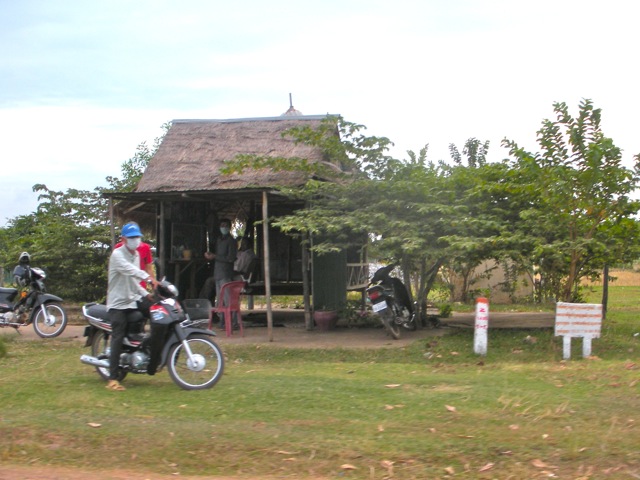
Shave and a haircut, two bits.
There were also lots of casual stores selling baskets, cold drinks and homemade food, but my personal favorite was the roadside barber shop. Only requirement is a roof and a chair, and there was usually someone in the chair either getting a trim or a shave!
We spent a fair amount of time on the road; since there is no passenger train service in Cambodia, bus travel is the primary way to get around. We enjoyed the bus ride on the 24th from Phnom Penh to Siem Reap, which took about five and a half hours. Lovely scenery, but the highlight of that trip for me was a skinny Asian Santa greeting me at the bus station with candy.
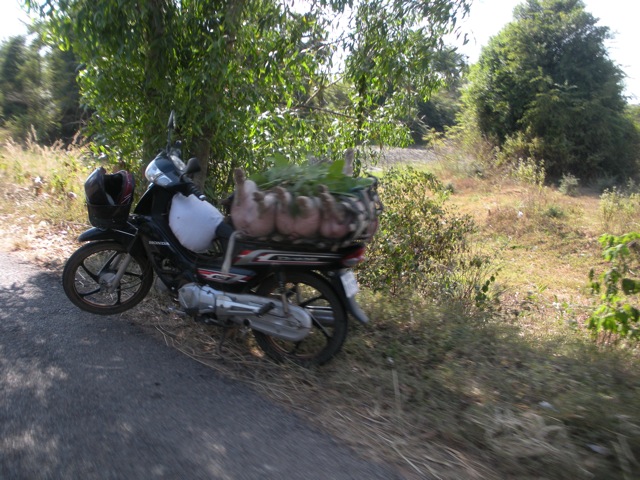
Pigs on their way to market
Slightly different experience on the trip from Siem Reap to Sihanoukville via the night bus: we’d reserved spots on the “sleeping bed” bus, and weren’t sure what to expect. There were three rows of bunkbeds, one against each wall of the bus and one down the middle, with permanently reclined seats. We were in top berths, and the roof of the bus was too low to sit up, so you had to lie down for the entire ten hour trip. It seemed popular with the backpacking crowd (for $18/person, I can see why), and it was a long, noisy, bumpy night. The upside was that I had a window next to me, and with so little light pollution, there were millions of bright stars to watch.
I’m glad we got to see so much of the country, and that transportation was so affordable and easily arranged. More importantly, I’m really happy that we didn’t have to drive ourselves!
Travel planning
If you know me, or my mother, you know that any vacation is prefaced by a lot of research and planning. My mother has done this my entire life, and a few of you have probably even seen the spreadsheets that she makes for trips to DisneyWorld. You might think that I’d rebel against this scientific approach, since I backed away from everything else scientific in life, but I have been on the bandwagon since I was 20 and they were coming to visit me in Paris, and I knew they (ok, mom) would expect a customized guide.
I dove headlong into planning this trip, since we bought our tickets just a couple of weeks in advance, and hadn’t really given much thought to Cambodia apart from wanting to visit someday. Someday came quickly, but don’t worry, I still had time to produce the condensed guidebook that the Blackstones (Creters?) can’t travel without. I kept it to ten pages, and Grant swears he read it. My favorite moments are when he tells me he read “somewhere” that ____. My usual response? Yes dear, that was in the book.
Why do I do this? There are a few reasons:
- I find it helpful to consolidate all of the sources I read prior to traveling, and handy to have a couple of pages highlighting the must-sees (and how to find them) to stick in my pocket when we’re on the road.
- I’ve reconciled to the fact that Grant will never read a whole guidebook, but at least this way he’ll have an idea of where he’s going (and the ability to veto/request stops). It actually makes me feel like less of a tour director.
- This is an easy way to show family and friends where we are going, and prior to this blog was the only way!
- It’s a great record of where we’ve been, and makes it easy to look back at previous trips and make suggestions to others visiting the same area.
That’s not to say that we do everything that is listed, or that our days are excessively scheduled. We certainly make time to hang out by the pool or have a drink or two, and just to wander the neighborhood that we’re staying in. I just wouldn’t want to miss out on the greatest “fill in the blank” right around the corner from us.
Anyway, if you’re curious, here’s the travel plan from Cambodia. Don’t be scared, and don’t laugh too loudly – it really is genetic.
“Home” from Cambodia
And the surprising thing is, KL does feel a bit like home. We had a wonderful trip to Cambodia and really fell in love with the people and the country. I’d go back in a heartbeat. I’ll share more stories and photos later, but for now here we are on Christmas morning.
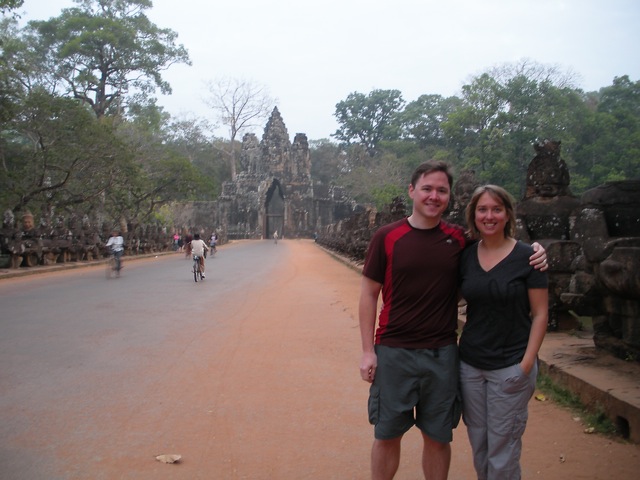
South Gate of Angkor Thom on Christmas morning
Recent Comments