
Catching up…
I know, it has been forever since I’ve updated this blog, but don’t worry – in the meantime we’ve done lots of things to share here! We’ve been hosting a steady stream of visitors since Krista kicked everything off in April/May, and now believe it or not, we’re in the final stretch of our time in KL. In fact, Grant is booking my return ticket to the US as I type. I’ll be headed back (first to Maryland) at the end of October, and Grant is expecting to return when his project ends around November 15th. I think everyone who reads this blog already knows, but we’re expecting our first child at the end of December, and it’s funny but the airlines don’t like the idea of a really pregnant lady on a 25+ hour flight! Honestly, I don’t really like the idea either, but what can I do.
Highlights from the past few months that I’ll work on posting about:
- Sabah and Bali with Krista in May
- Beijing and Sarawak with my parents in July
- KL & Singapore with Brenna and Mark in July
- Vietnam with Grant, his parents and Blythe in August
- Phuket with Blythe in September
- Singapore for the F1 race with Grant in September
Then there’s our last big trip while we’re here, which we just booked yesterday. We’re leaving on October 11th for five days in the Maldives and four days in Sri Lanka! Go big or go home, right? Or should it be go big and then go home? Bear with me, and I’ll put up as many stories and pictures as I can in the meantime.
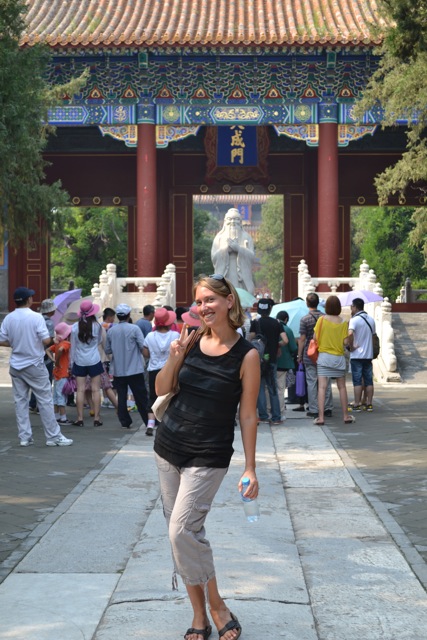
My favorite pose!
Climbing Kinabalu
Mount Kinabalu is an UNESCO World Heritage site, and the highest mountain in SouthEast Asia, reaching 4,095 meters or 13,435 feet at Low’s Peak. It’s located in the state of Sabah, on the island of Borneo about a two hour flight from KL. Grant and I had been interested in climbing it during our time in Malaysia, and when my friend Krista started planning her trip to visit us, we knew immediately that she’d be interested too!
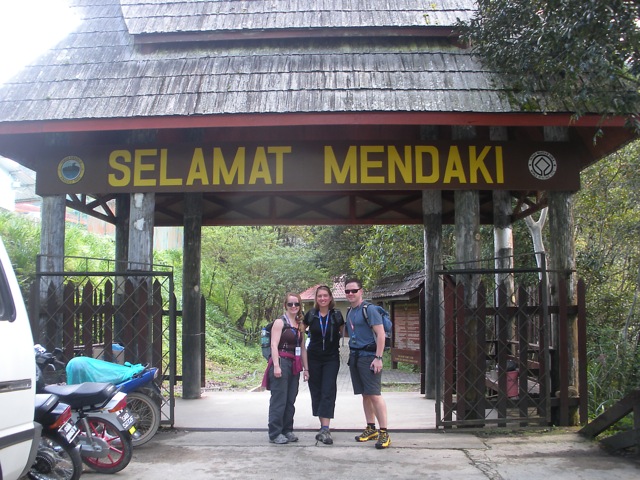
Timpohon Gate, smiles before the hike
In planning this, I’d gone my typical route in trying to book the pieces independently. This was a little tough to do, as there are a lot of components required: local guide, insurance and permits, and last but not least mid-peak lodging. Lodging was tough to come by, as most of it seems to be booked immediately by tour providers. Krista had the eminently logical (but entirely surprising to me) idea of trying to book through a tour company. Genius! We were limited to a weekend so Grant could go, and the only organization that had availability for our preferred dates was Mountain Torq.
Mountain Torq manages the world’s highest Via Ferrata. Grant was familiar with this concept, and I’d actually heard about it in relation to Kinabalu and written it off with my crippling fear of heights in mind: Via Ferrata means “iron road” and it’s a mountain route with fixed rungs, cables, and footholds. It’s superficially similar to rock climbing, but you don’t have to place any gear yourself or have any technical skills – in some places you’re actually just climbing down ladder rungs bolted into the side of the mountain while both roped on and clipped on to safety cables.
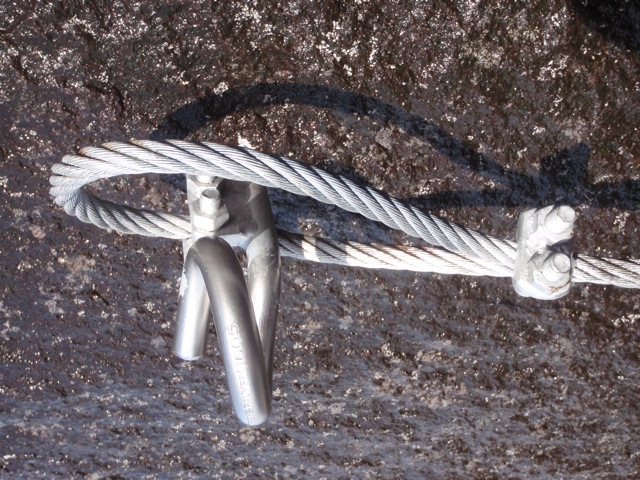
Hardware on the Via Ferrata
To book with Mountain Torq and to stay in their mid-mountain hut, you have to pay for a Via Ferrata segment (no obligation to actually do it, but you’re paying for it anyway). I wrapped my head around this, and decided that the shorter route sounded like something I could actually do: Walk the Torq, a 1-2 hour (430 meter) route starting at 3,521 meters and descending 109 meters towards the Laban Rata lodging area. The overall plan was to get to the area on Friday night, check in at the base of the mountain by 7:30 am on Saturday, April 21, hike for 6 km and get to our lodging by mid-afternoon in time for the safety briefing from Mountain Torq. Mandatory early bedtime that night for everyone with lights out by 8 pm, and a 1:45 am wake up call to get us up in time to summit for the sunrise, followed by a detour on the descent for the Via Ferrata routes, and then back down to the base of the mountain.
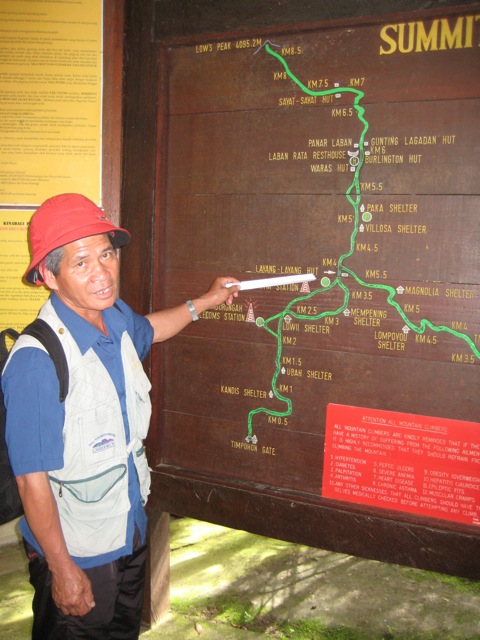
Gampat and the trail map
Everything actually went according to plan! We were so eager to get going that we were at the Mountain Torq office before they opened, and we quickly got all of the necessary paperwork completed and were assigned a guide, Gampat, who has summited more than a hundred times. A short drive took us to the trailhead of the Timpohon Gate trail, and we started off. We did the first three kilometers through a shady rainforest in an hour and a half, and we were surprised by the rest facilities present about every kilometer along the trail – roofed pavilions with flush toilets and a water supply! The next three kilometers were considerably steeper, and we certainly understood why they suggested training for this hike by doing lots of stairs. This part of the climb had scrubbier trees, and uneven stones that made for a tiring climb. We made it to Laban Rata at an elevation of 3273 meters and the Mountain Torq Pendant Hut at 1:15, after four hours and fifteen minutes of hiking. Perfect timing, since it started pouring rain shortly thereafter.
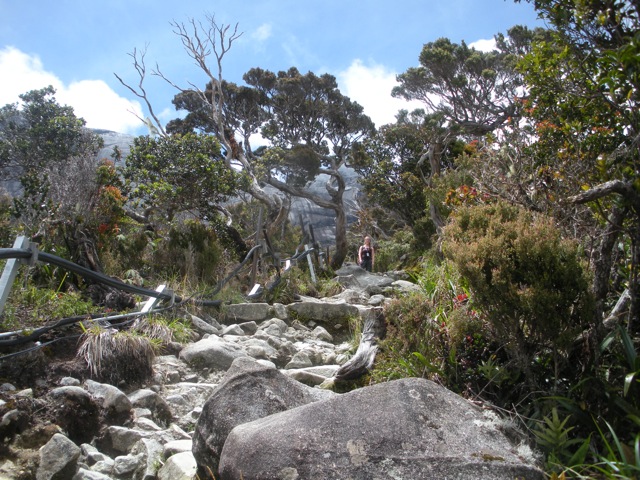
Krista on a typical section of the trail
We were thrilled to have hot showers and we sat around drinking plenty of tea to warm up, because it actually had gotten pretty chilly at that elevation. I was glad to have brought my fleece jacket to Malaysia! There were several dorm rooms, and I think each room had about eight people in it. It was a pretty congenial group overall, and we got a thorough safety briefing later that afternoon to prepare for the Via Ferrata, including a demonstration of how to safely transfer the rope and carabiners along the route. Krista is an adventure hungry thrill seeking cliff hanger (seriously, it says that on the official certificate that proves she lives life on the edge!), and decided to opt for the world-record setting Low’s Peak Circuit. Grant stuck with me on the Walk the Torq route; I’m pretty sure it says somewhere in those marriage vows that he can’t abandon me on the side of a mountain.
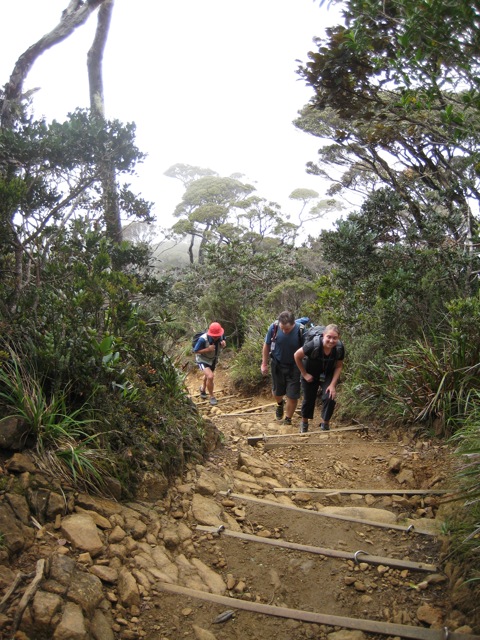
For better or for worse...
The rain finally let up briefly, and we were surprised to find legitimate waterfalls gushing down the exposed faces of the mountain, but we made it to the main hut for an early dinner and we were all sound asleep around 7 pm, resting up for the next big day. 1:45 came quickly, and we geared up with our headtorches (in the local parlance) in place. We’d heard rain throughout the night, but were lucky in that it was dry for our trek to the summit. The first stretch was wooden staircases built over the mountain, which gave way to the bare rock face with a white rope secured to it to help you pull yourself up some of the steeper sections.
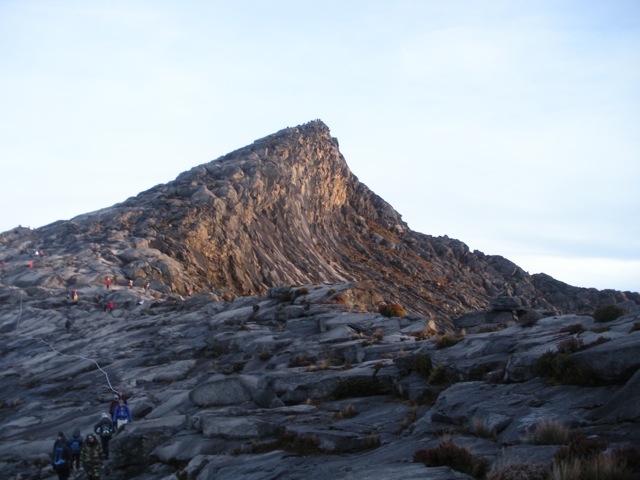
Summit of Low's Peak
My fear of heights and adrenaline kicked in together, and I felt like my heart would leap out of my chest for a lot of this. Gampat was my savior at this point and while Krista led the way, he held my hand tightly and steadily walked me up the slope. This was my first nighttime summit, and it was bizarre to only see within the scope of my headlamp which left me imagining the worst: steep dropoffs and who knows what else in the dark. The landscape was eerily lunar in nature, and we somehow managed to outpace almost everyone else on our way, so it was also pitch black. Looking behind us, we could see a bobbing line of lights following the trail, looking like monks on a pilgrimage. Shockingly, because I kept crouching down to pat the rocks and reassure myself that I was on solid granite and to try and get my heart back out of my throat, we were among the first to the summit – top ten out of the 150 or so to attempt the summit that day. We got there around 4:45, and had a little over an hour to wait for dawn.
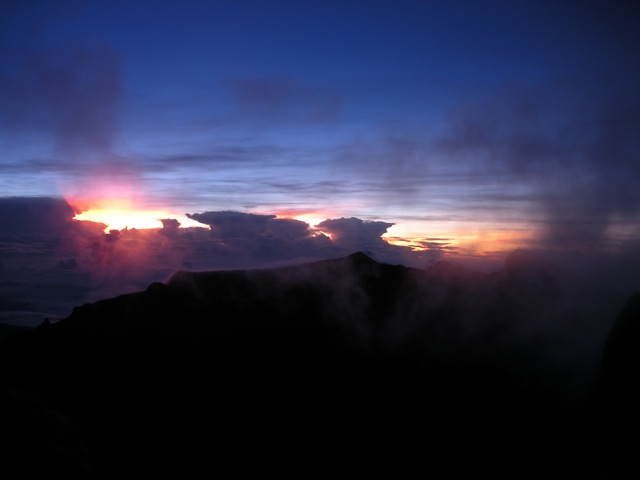
Sunrise from Mount Kinabalu
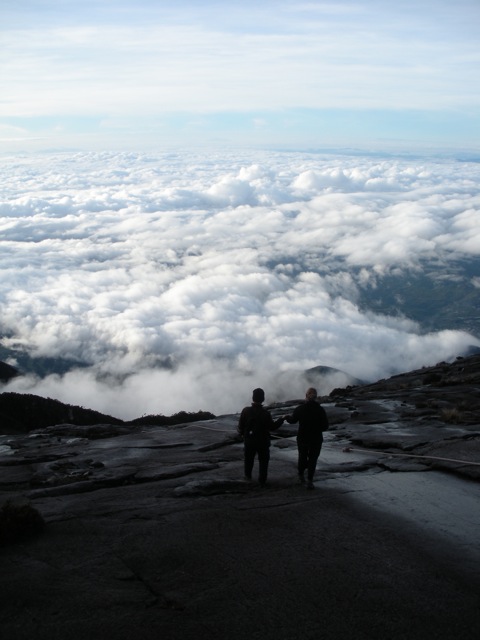
It was freezing up there, and we snugged down into the rocks for protection from the wind. Happily, the sunrise was inspiring, and the view above the clouds was worth every ounce of effort. The walk back down to our Via Ferrata meeting point was comparably a walk in the park, and we sauntered down the slope I had hesitatingly staggered up with Gampat. He really was my rock, and he still took my hand to help me through the tougher sections.
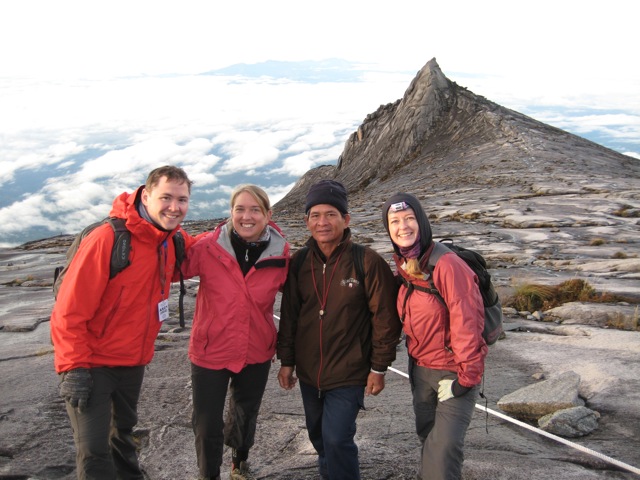
All smiles after the summit
We left Krista at the higher Via Ferrata, and Grant and I continued down to the lower meeting point to suit up in our harnesses. As we looked back up the slope, we could make out her group above us and while I was excited for her to have such a thrilling experience, I was really happy to be walking further down the mountain! Grant was the leader for our group, and set a good pace – slow enough for me to follow without feeling rushed, and fast enough for me to stay focused on the repetitive movement of moving my safety equipment along the cable.
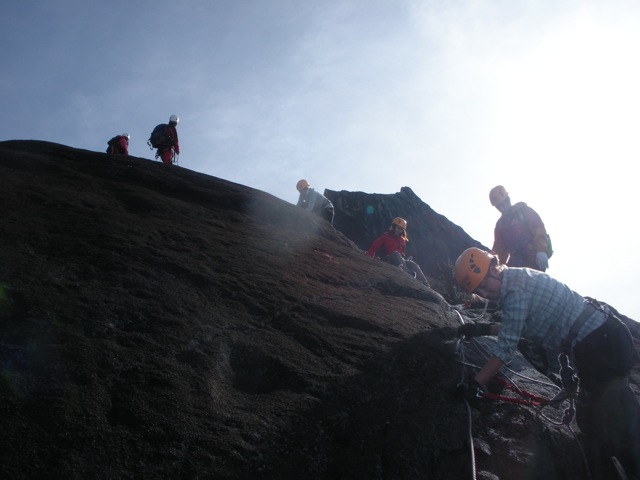
Me on the Via Ferrata
I actually liked the vertical descent better than the traverse, because the ladder rungs and footholds made it easy to relax into the mountain. The scariest part was a two wire bridge – one wire above your head to hold onto while you walked along the other like a tightrope. One deep breath, and I made it across, shaking and not looking down! Just as we finished our Via Ferrata it started to rain; Krista got hit with the rain while she was still on her route, and got soaked. Grant and I had plenty of time to dry out while we waited to meet her at the hut, and before long we packed up and set out to finish the descent.
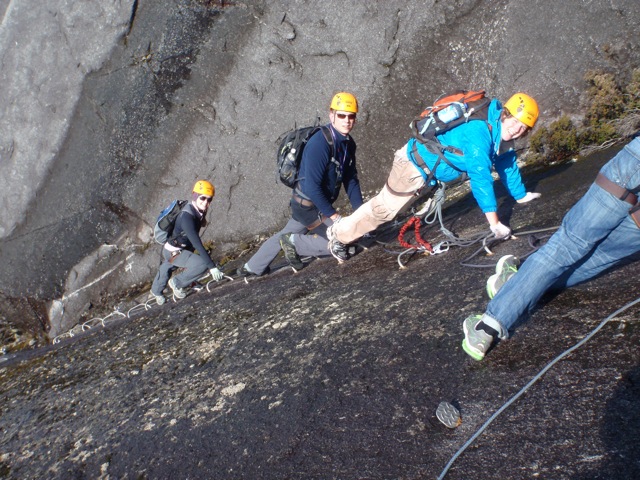
Krista leading her group down the Via Ferrata
It continued to rain lightly on us, but the bigger challenge was in navigating the rocky steps which were now wet and slippery, and in some places had turned into shallow waterfalls. It was a brutally slow climb down, and my knees were giving out before we reached the end. The last short stretch was actually uphill, and I’ve never been happier to change direction! We were all so achy and sore for the next few days that as Krista and I were sightseeing around Kota Kinabalu, we actually walked two blocks out of our way to avoid a particularly high curb. All in all, really tough climb, but extremely rewarding and we’re all happy we did it!
Me and my new boyfriend Gampat. It's a good thing Grant's not a jealous guy.
How to eat
How I eat is not something I typically consider; I’m usually much more focused on where, what, and when I eat.
Eating out here in KL, it is unusual to be given a knife; typically a fork and spoon fill your needs, and chopsticks are often an option as well. In food courts, hawker centers and casual restaurants you will rarely get a napkin, although usually a sink is available to wash your hands before and after eating.
I went to lunch with my Mandarin class last week, to celebrate passing level two and to welcome a new teacher to the staff. We went to Little Penang Cafe in the Suria mall, a place that is pretty reliable for decent food and is always hopping at mealtimes. There were six of us, and the ethnic mix was interesting: Chinese-Malaysian, Korean, Chinese Muslim, Laotian-Canadian, Libyan, and yours truly, the token American. Lin, our teacher who is Chinese-Malaysian, was encouraging everyone to try the different specialties, but most of the table ordered the fried rice (a halal dish). I went with a spicy noodle soup, and Lin had char kway teow, a stir fried noodle dish. Some forks and spoons were delivered to the table – at least in Malaysia, you’d normally eat fried rice with a fork and/or spoon, and eat noodle dishes with chopsticks. At one end of the table was a big canister of chopsticks, and Lin asked for a set, so I turned and asked for two: one for her and one for me. She was quite surprised that I was comfortable enough to tackle my noodle soup with chopsticks and a soup spoon, and jumped up to take a picture to document my immersion into the culture! I think for her it must have been a little like watching a monkey type.
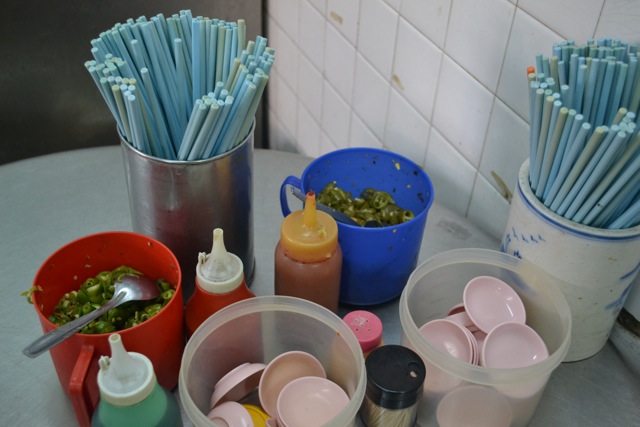
A typical table setting in KL
On the other end of the spectrum, I met Grant for lunch on Friday (no Mandarin class in observance of Good Friday, go ahead and try to figure that one out). It turned into lunch with him and two coworkers: one is a local and the other is his Indian colleague also here on contract for the project. We went to a mamak cafe looking for a good banana leaf meal. I loved this place, just a little corner space open to the air, crowded with small tables and people looking to enjoy a leisurely Friday lunch before heading back to the office to finish out the week. I never saw a printed menu, but once we had secured a table a smiling guy came over and told us the chicken briyani was very good, and we all agreed to try it. Our places were then laid with a large piece of banana leaf, and a quartet of dipping sauces were presented to the table. Individual stainless steel pots of briyani came out, filled with a chicken leg, a hard-boiled egg, and mounds of fluffy seasoned rice. We each had a small ladle to portion food out onto our leaves, and then…I realized there was no silverware. Ok, no problem. Grant’s coworkers were completely comfortable with this, and assured us that we’d figure it out and if we couldn’t get the hang of it could always ask for a fork and spoon. We’d washed our hands (handy, handy sinks!) and the short tutorial was to push the rice together into a little ball with your fingers, and then to bring it towards your mouth and sort of flick it in. My technique wasn’t quite that clean, more like smushing together a clump of rice that I balanced on my fingers and then leaning forward over the banana leaf to shove it off my fingers with my thumb into my mouth, but I was able to eat my fill and have a great time doing it. I think it counts as a success! And did I mention how handy the sinks were when I finished eating and had fingers covered in curry and saffron?
With eating methods like this, we’re entertaining everyone we dine with – talk about dinner and a show!
April Fools?
Crossing the street in Singapore, I noticed this sign:
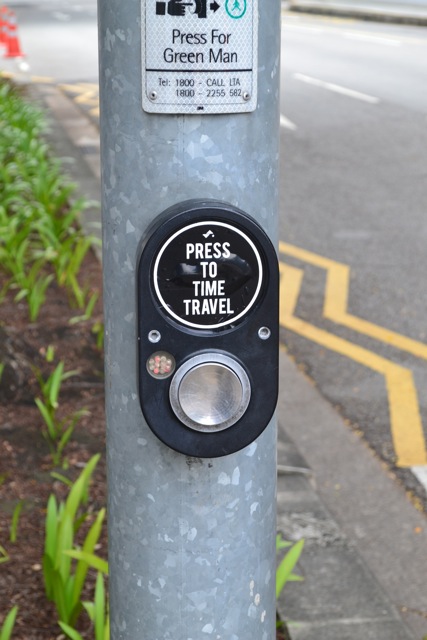
Singapore is very high tech.
Amazingly enough, it actually was about 12 seconds into the future by the time I got to the other side of the road! Happy April Fools’ Day!
Potato, Potahto
Melaka, Malacca, Melaqa…it seems you can spell it anyway you like! Melaka seems to be the most commonly found version here in Malaysia, so that’s what I’m going with. As with Georgetown in Penang, in 2008 Melaka was listed as a UNESCO World Heritage Site. Since it is only a two hour bus ride away from KL, it is a very popular weekend destination and has the reputation for being pretty touristy.
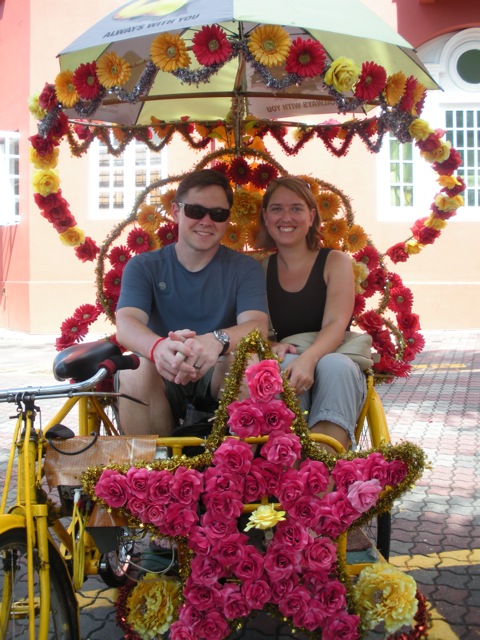
We may look like tourists, but who cares?We're having a great time!
Now I liked Georgetown a lot, but I loved Melaka. Loved it in that slightly giddy way that you love a guilty pleasure, because that’s exactly what it is. Melaka has a ton of history (ruled at one point or another by the Portuguese, Dutch, and British; major shipping port, rich Peranakan culture), and we did the typical tourist circuit of the sights to see, but what I loved about Melaka was the lack of pretension and the mellow vibe. It’s not apologetic about being a tourist draw, and it is hard not to have a good time here.
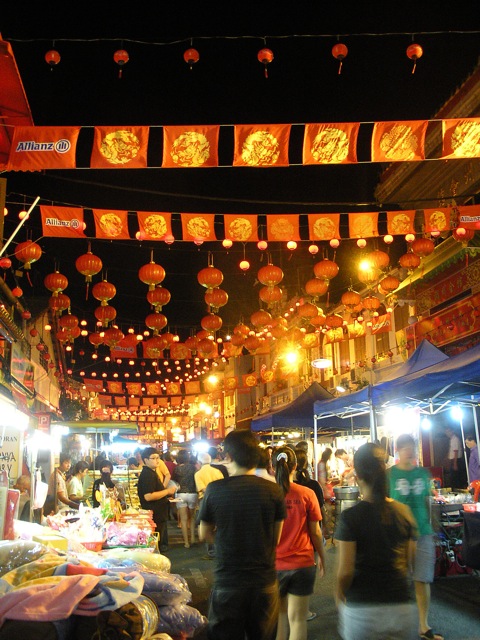
Jonker Walk Night Market
Take for instance Jonker Walk. The main drag in Chinatown, by day it is a narrow street with sidewalks packed full of sweaty tourists poking their heads into every souvenir and “antique” shop. On Friday and Saturday nights, it becomes a night market, with the same shopkeepers you’ve seen all day in the surrounding blocks setting up tables to sell their goods in the street, and with a big karaoke stage at one end. That’s right: karaoke in the street. And I don’t mean the “tentative, takes a few drinks to get going” kind of karaoke, we’re talking about the “singing your heart out with a random back up dancer” type. Now, I don’t have a photo of that performance, because I was too busy picking my jaw up off the ground, but below is a guy rocking a Chinese ballad. Try to look past the Mister Potato sign in the background.
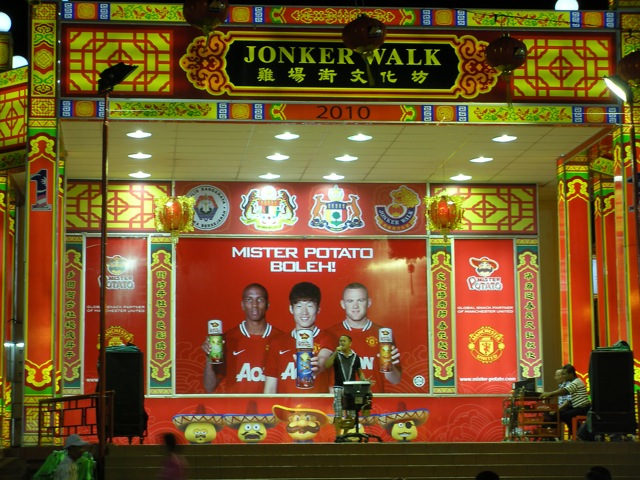
Karaoke at Jonker Walk Night Market
As you may have guessed from the first photo, trishaw rides are de rigueur here and they deck them out in spectacular ways. Fake flowers, ribbons, umbrellas, superhero logos, glittery tinsel, and a powerful sound system are all necessary. It’s difficult not to have a good time when your world view is edged with something sparkly, and the personal soundtrack that followed me around town wasn’t just in my head for once. The prices are fixed, so no haggling here, just sit back and relax while the driver takes you on a tour of the major sights in town. I loved every minute of it!
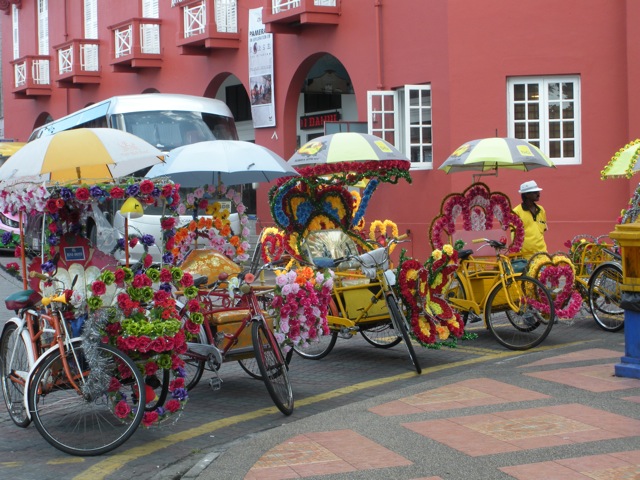
Trishaws galore!
I’m a fan of antique shops and Melaka is known for having lots of those, and also for not everything in the shops being true antiques. As long as you go into it knowing that you’re probably not making the find of a century, you’ll be fine. It was fun to wander through them, but unfortunately we found the best one only shortly before we had to head back to KL. Maybe that was actually a good thing, because it was more of an architectural salvage shop (think huge carved arches from Chinese shophouses, leaded windows, etc), and I don’t think we could have carried anything home with us! Of course, they can ship anywhere…something I’ll be keeping in mind for my next visit. We did get a carved dragon mask from Melaqa House, and his bug-eyed stare is something I’ll enjoy looking at and remembering Melaka for years to come.
My favorite souvenir that we’ve bought thus far in SE Asia is also from Melaka. Across the street from the guesthouse we were staying in, I had noticed a sign for an art gallery and a smaller sign that said: 15 Minute Seal Engraving. In my previous life with the bank, I’d become familiar with the necessity of having a seal or “chop” in doing business in China (often required for signing official documents), and here was a shop making them? Definitely worth checking out! The artwork in the gallery was beautiful, and after we’d looked around a young guy popped his head out of the glassed-in central office and asked if we’d be interested in looking at the seals that they carve.
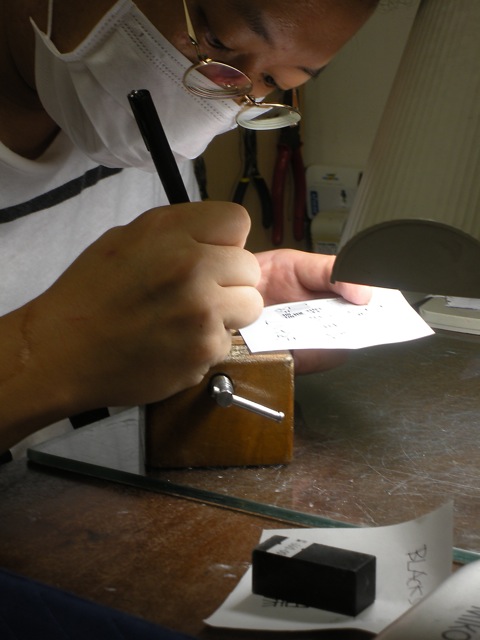
Carving Grant's seal
King’s Seal Engraving is a two man operation (brothers, and their father is the artist-owner of the gallery), and they took their time chatting with us about what they do, and showing us lots of examples of their work. They are artists in their own right, and an do anything from carving your name, your signature, an image or a portrait onto a block of stone – and there’s a lot of customization possible. With your name, they usually (for non-Chinese names) will figure out the phonetic equivalent in Chinese, and create your seal with those characters.
As you may know, I think I have a super cool last name, and I proposed doing a literal translation instead. They liked that idea and drew out the characters for black and stone, and I started looking through the dozens of pieces of stone that they had to pick the perfect one…a black stone. Yes, I’m rather pleased with myself, thank you. Grant decided to have his last name literally translated too, and had his first name phonetically done. He chose complementary stones with small lions carved out of the tops that face each other: one a reddish-brown with tan streaks for Brown and the other mostly tan with reddish-brown streaks for Grant. He also had them carved in opposing manners: for Grant, the characters are carved into the stone (resulting in a red stamp with white characters), but for Brown, the stone around the characters was carved away so the characters stand in relief as red stamped against a white background.
Of course, they also sell the paste needed to stamp these, and they were explaining the different types (darker/lighter, longer lasting). They made the comment that the longer lasting one is also known as the pretty one, since it has the Chinese word for beautiful in its name. After only a week of Mandarin lessons, I casually threw out, “Oh, mei? Like Meiguo?” and managed to impress them with my Chinese! Meiguo is Chinese for America and literally means beautiful country. After one week of Mandarin, I was pretty confident with a couple of sentences: Ni hao, wo shi Chris. Wo shi mei guo ren. (Hi, I’m Chris. I’m american.) It’s all about practical application!
In any case, we now have our own seals, and you might be wondering what on earth we’re going to do with them, since I can’t imagine walking into a bank back home and stamping paperwork. Well, we do have a few books (ok, maybe 25 boxes of books in storage in Massachusetts), and they suggested using the stamps in lieu of a bookplate. Brilliant! We’ve stamped the books we have here in Malaysia, and that’ll be a project to look forward to when we’re eventually unpacking back home.
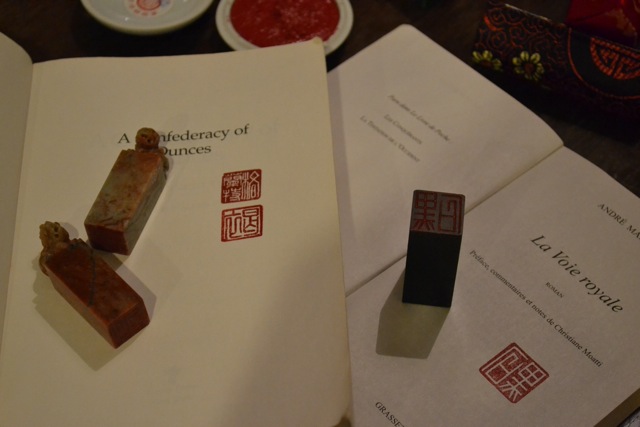
Ta-da!
Recent Comments