
Potato, Potahto
Melaka, Malacca, Melaqa…it seems you can spell it anyway you like! Melaka seems to be the most commonly found version here in Malaysia, so that’s what I’m going with. As with Georgetown in Penang, in 2008 Melaka was listed as a UNESCO World Heritage Site. Since it is only a two hour bus ride away from KL, it is a very popular weekend destination and has the reputation for being pretty touristy.
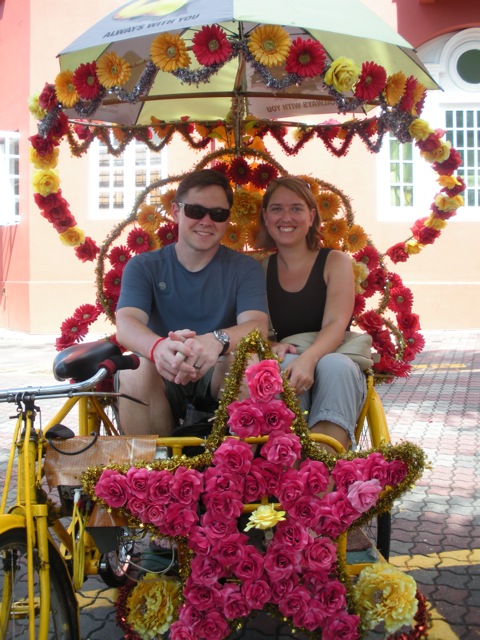
We may look like tourists, but who cares?We're having a great time!
Now I liked Georgetown a lot, but I loved Melaka. Loved it in that slightly giddy way that you love a guilty pleasure, because that’s exactly what it is. Melaka has a ton of history (ruled at one point or another by the Portuguese, Dutch, and British; major shipping port, rich Peranakan culture), and we did the typical tourist circuit of the sights to see, but what I loved about Melaka was the lack of pretension and the mellow vibe. It’s not apologetic about being a tourist draw, and it is hard not to have a good time here.
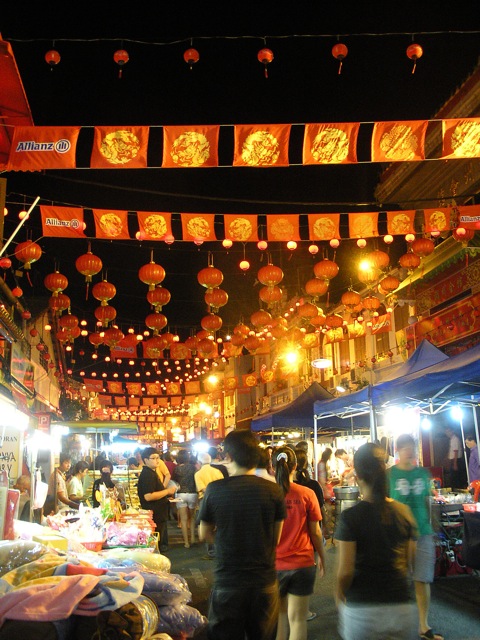
Jonker Walk Night Market
Take for instance Jonker Walk. The main drag in Chinatown, by day it is a narrow street with sidewalks packed full of sweaty tourists poking their heads into every souvenir and “antique” shop. On Friday and Saturday nights, it becomes a night market, with the same shopkeepers you’ve seen all day in the surrounding blocks setting up tables to sell their goods in the street, and with a big karaoke stage at one end. That’s right: karaoke in the street. And I don’t mean the “tentative, takes a few drinks to get going” kind of karaoke, we’re talking about the “singing your heart out with a random back up dancer” type. Now, I don’t have a photo of that performance, because I was too busy picking my jaw up off the ground, but below is a guy rocking a Chinese ballad. Try to look past the Mister Potato sign in the background.
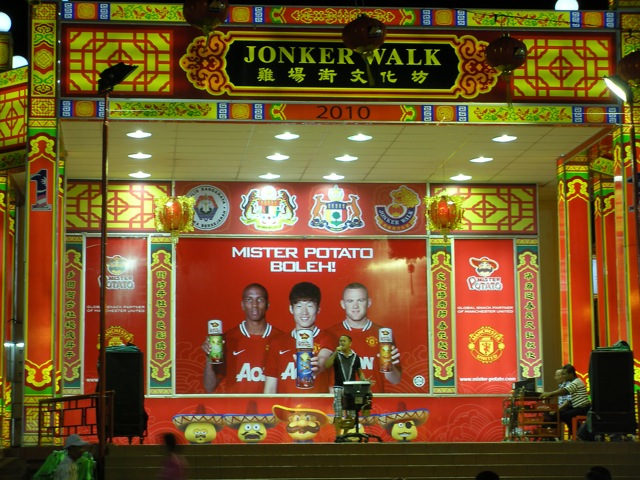
Karaoke at Jonker Walk Night Market
As you may have guessed from the first photo, trishaw rides are de rigueur here and they deck them out in spectacular ways. Fake flowers, ribbons, umbrellas, superhero logos, glittery tinsel, and a powerful sound system are all necessary. It’s difficult not to have a good time when your world view is edged with something sparkly, and the personal soundtrack that followed me around town wasn’t just in my head for once. The prices are fixed, so no haggling here, just sit back and relax while the driver takes you on a tour of the major sights in town. I loved every minute of it!
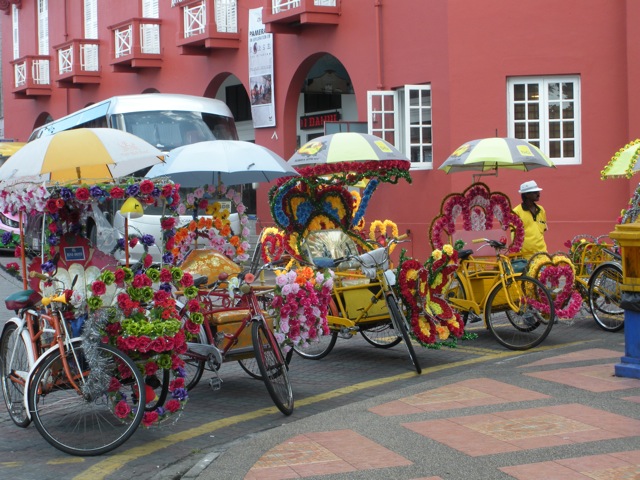
Trishaws galore!
I’m a fan of antique shops and Melaka is known for having lots of those, and also for not everything in the shops being true antiques. As long as you go into it knowing that you’re probably not making the find of a century, you’ll be fine. It was fun to wander through them, but unfortunately we found the best one only shortly before we had to head back to KL. Maybe that was actually a good thing, because it was more of an architectural salvage shop (think huge carved arches from Chinese shophouses, leaded windows, etc), and I don’t think we could have carried anything home with us! Of course, they can ship anywhere…something I’ll be keeping in mind for my next visit. We did get a carved dragon mask from Melaqa House, and his bug-eyed stare is something I’ll enjoy looking at and remembering Melaka for years to come.
My favorite souvenir that we’ve bought thus far in SE Asia is also from Melaka. Across the street from the guesthouse we were staying in, I had noticed a sign for an art gallery and a smaller sign that said: 15 Minute Seal Engraving. In my previous life with the bank, I’d become familiar with the necessity of having a seal or “chop” in doing business in China (often required for signing official documents), and here was a shop making them? Definitely worth checking out! The artwork in the gallery was beautiful, and after we’d looked around a young guy popped his head out of the glassed-in central office and asked if we’d be interested in looking at the seals that they carve.
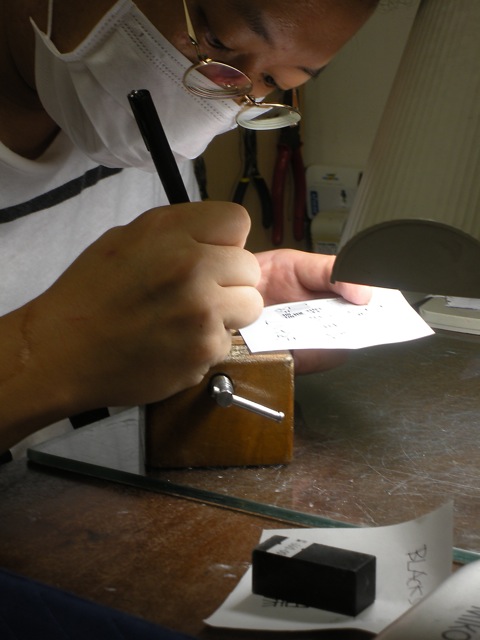
Carving Grant's seal
King’s Seal Engraving is a two man operation (brothers, and their father is the artist-owner of the gallery), and they took their time chatting with us about what they do, and showing us lots of examples of their work. They are artists in their own right, and an do anything from carving your name, your signature, an image or a portrait onto a block of stone – and there’s a lot of customization possible. With your name, they usually (for non-Chinese names) will figure out the phonetic equivalent in Chinese, and create your seal with those characters.
As you may know, I think I have a super cool last name, and I proposed doing a literal translation instead. They liked that idea and drew out the characters for black and stone, and I started looking through the dozens of pieces of stone that they had to pick the perfect one…a black stone. Yes, I’m rather pleased with myself, thank you. Grant decided to have his last name literally translated too, and had his first name phonetically done. He chose complementary stones with small lions carved out of the tops that face each other: one a reddish-brown with tan streaks for Brown and the other mostly tan with reddish-brown streaks for Grant. He also had them carved in opposing manners: for Grant, the characters are carved into the stone (resulting in a red stamp with white characters), but for Brown, the stone around the characters was carved away so the characters stand in relief as red stamped against a white background.
Of course, they also sell the paste needed to stamp these, and they were explaining the different types (darker/lighter, longer lasting). They made the comment that the longer lasting one is also known as the pretty one, since it has the Chinese word for beautiful in its name. After only a week of Mandarin lessons, I casually threw out, “Oh, mei? Like Meiguo?” and managed to impress them with my Chinese! Meiguo is Chinese for America and literally means beautiful country. After one week of Mandarin, I was pretty confident with a couple of sentences: Ni hao, wo shi Chris. Wo shi mei guo ren. (Hi, I’m Chris. I’m american.) It’s all about practical application!
In any case, we now have our own seals, and you might be wondering what on earth we’re going to do with them, since I can’t imagine walking into a bank back home and stamping paperwork. Well, we do have a few books (ok, maybe 25 boxes of books in storage in Massachusetts), and they suggested using the stamps in lieu of a bookplate. Brilliant! We’ve stamped the books we have here in Malaysia, and that’ll be a project to look forward to when we’re eventually unpacking back home.
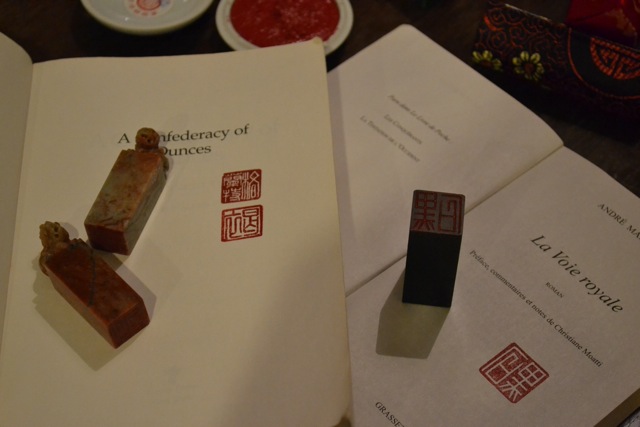
Ta-da!
Pearl of the Orient
We spent most of January in KL, partially because my Mandarin lessons were supposed to begin in mid-January, but also to avoid traveling during Chinese New Year when lots of locals take to the roads. Don’t worry, we’ve spent February making up for lost time!
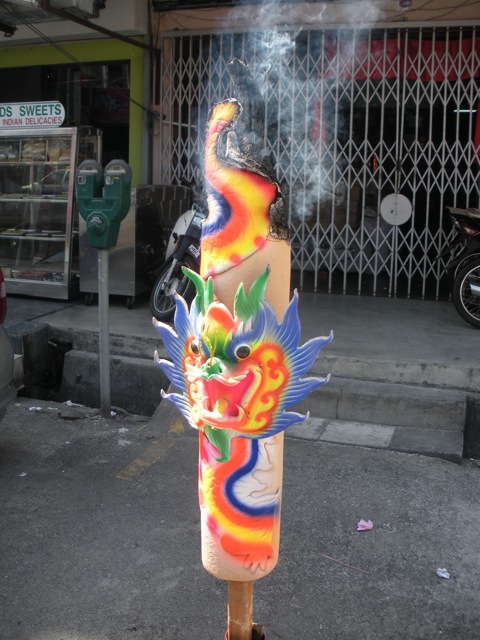
Giant dragon incense in the streets of Penang
Public holidays here have been sneaking up on us, and we learned at the beginning of February that Grant would have two days off in a row: Feb 6 to observe the Prophet Mohammed’s birthday (which fell on Feb 5, a Sunday), and Feb 7 for Thaipusam. Since our Thaipusam outing was early on Sunday morning, we decided at the last minute to take advantage of the bonus weekend and rented a car to drive up to Penang.
Penang is a small state in the northwest part of peninsular Malaysia, made up of a small strip of land on the peninsula itself, and the island of Penang in the Straits of Malacca. It’s a four hour drive north of KL, and can be reached either by bus/train to a ferry or by driving and crossing a 13.5 km bridge – one of the longest bridges in Asia. We wanted to set our own schedule, so this meant enjoying Grant’s first experience driving in Malaysia.
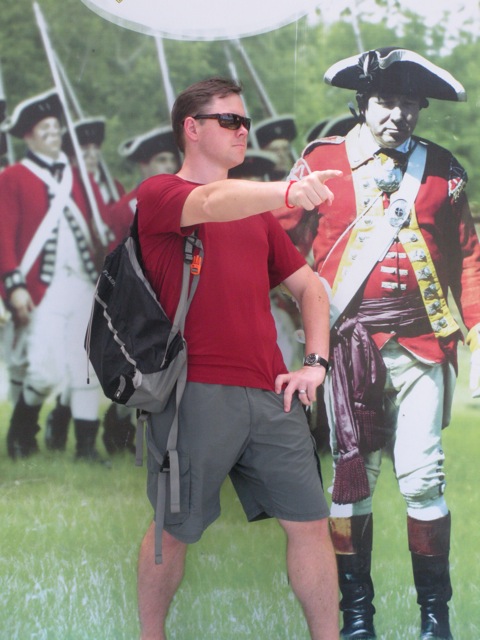
Yes, he drove with this much confidence.
He did an excellent job, especially taking into consideration the fact that we picked the rental car up in downtown KL and spent the first twenty minutes circling in dense traffic while I tried to set up the GPS to get us out of town. Luckily, driving on the wrong side of the road is pretty easy to get used to when there are lots of other cars surrounding you or you’re on a highway!
It was really nice to get out of KL and see more of Malaysia – the only stretch we’d seen before this was the road to/from the airport which is surrounded by palm plantations. Turns out, a lot of Malaysia is covered in palm plantations, but about two hours north near Ipoh we found ourselves driving through a gorgeous valley. Misty limestone hills blanketed with emerald jungles rose up and reminded us that this sure wasn’t Massachusetts!
Four short hours later, I’d reread the guidebook to Penang, and we were ready to explore. Penang is called the “Pearl of the Orient,” and is widely acknowledged as having some of the best food in Southeast Asia. The main town in Penang is Georgetown, which was added to the list of UNESCO World Heritage Sites in 2008. As you can imagine, the main draw here is the heritage zone, and the shophouses that line the streets there.
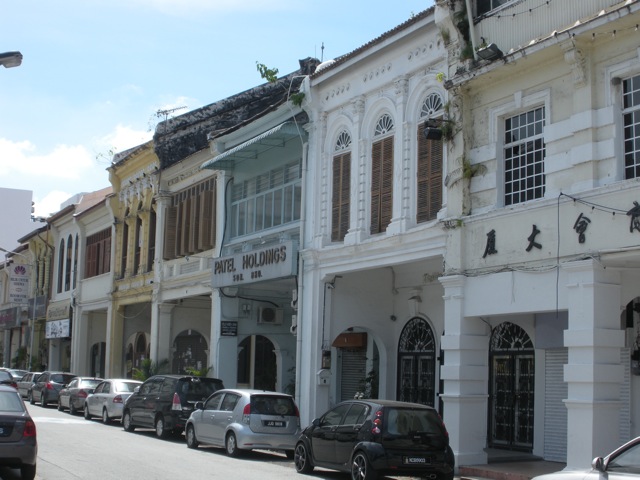
Shophouses in Penang
There are a fair number of “heritage” hotels in some of these shophouses, but the first half dozen I called were fully booked so we opted for an easy budget option: the Tune Hotel. You may not be familiar with the name, but you’re certainly familiar with the concept – it’s owned by AirAsia, the major budget airline in this region, and the same tenets apply: you get only what you pay for. The base rate (about $30/night) gives you a comfortable bed with an adjoining private bathroom with a shower, then you pay additional fees depending on which amenities you select. We added on 24 hour air-conditioning, but skipped the towel rental fee (seriously?) and brought our own stuff. All in all, it was a decent place to stay in a good location, but I’d rather search a little more next time for some personality or charm in a historic setting.
Penang has the largest Straits Chinese population in SE Asia, and in Penang and Melaka they use the terms Peranakan Chinese or Baba-Nonya (literally, gentlemen-ladies) to talk about their culture. It’s a mix of Chinese religion and Malay language and culture, combined through assimilation and marriage. Today, you can delve into the culture mainly in restaurants and museums preserving the intricacies of the pre-war way of life, as modernization and government policies (like 1Malaysia) blur the lines and assimilate Peranakans into mainstream culture.
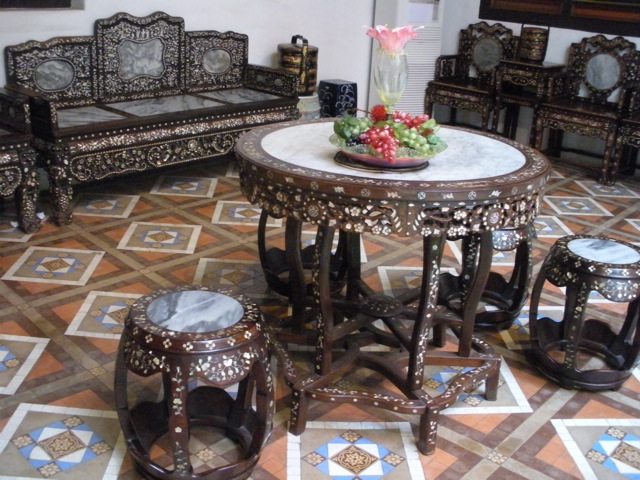
Peranakan furniture inlaid with mother of pearl designs
We began our stay in Penang with dinner at Nonya Baba Cuisine, just a few blocks away from the hotel. What a way to start! The restaurant was almost full when we arrived, but they seated us immediately and brought out the menus. The lovely owner came out to talk about the menu and the type of food we like to eat, and we put ourselves in her hands ending up with four dishes for the two of us. Everything was good, but the appetizers were fantastic – the otak-otak was heavenly, much more of a custard than we’d experienced before and bursting with flavor, and the spring roll and pork roll were yummy too.
What really made this dinner special to us was the atmosphere and interaction with the owners. They chatted with all of their patrons, and we found common interests with Tony, the owner’s husband, and we felt like old friends by the time we left. Actually, I think Grant may have found a soul mate; they talked about watches and cars the whole night! There’s great food everywhere in Penang – is this the best? No, probably not, but we enjoyed the atmosphere and the experience here very much and will definitely be back on future trips to Penang.
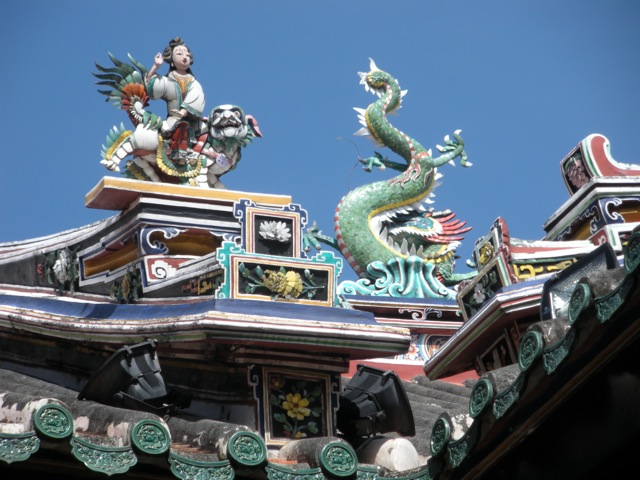
Rooftop decorations at Han Jiang Temple
The next day, we set out to walk the heritage zone, and had a long hot day filled with museums and temples. We started off in the Penang Museum, which was really well curated and a steal at RM1 (about US$0.30). Well worth it for the air conditioning alone, but also interesting as it had different galleries focused on the different ethnic groups of Penang and specific historic events (like WWII). My personal favorite was the wall of old postcards, showing how unchanged many scenes are today.
We strolled along the Esplanade, where they were setting up for fireworks to celebrate the last day of the Chinese New Year celebration – SO many fireworks over the past few weeks – and wandered into the old British Fort Cornwallis. It only took about 10 minutes to walk around the walls, and we poked our heads into the creepiest old chapel and looked at some archeological artifacts that were unearthed during restoration efforts, including… an old bicycle chain?
Little India was only a block or so away and as always, filled with color and sparkle in the form of sari and jewelry shops. We wound our way through the streets towards Chinatown, where we were blown away by the temples and clanhouses (called Kongsi).
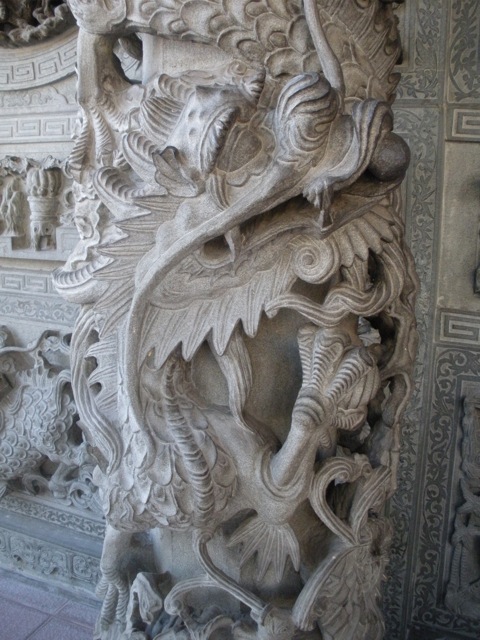
Elaborate carvings at Yap Kongsi
This is heart of the heritage zone. There are many good reasons for Georgetown to be designated as a UNESCO World Heritage Site, but in my opinion these carefully restored temples stole the show. We probably visited five or six within a few blocks radius, and each was unique in its own way: from the detailed dragons of Choo Chay Keong Temple at Yap Kongsi, to the geometric roof beams at Hang Jiang, and last but not least, the ornately decorated Khoo Kongsi.
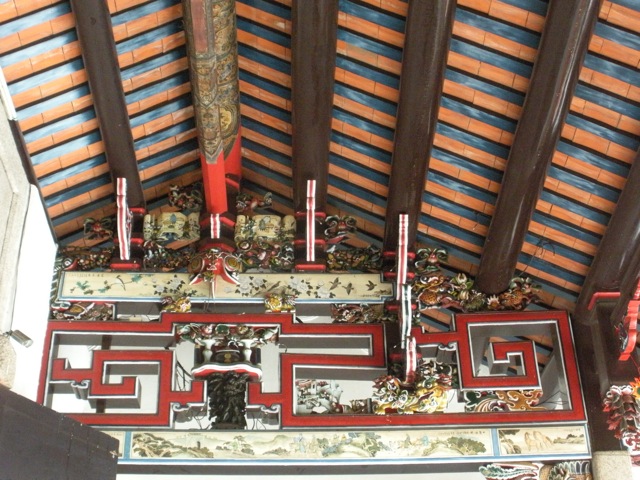
Roof beams at Hang Jiang
Tucked away down a small alley is the entrance to Khoo Kongsi. Don’t let the approach fool you, this is the most impressive clanhouse in Georgetown. The roof explodes in a riot of carvings and inside is just as richly decorated.
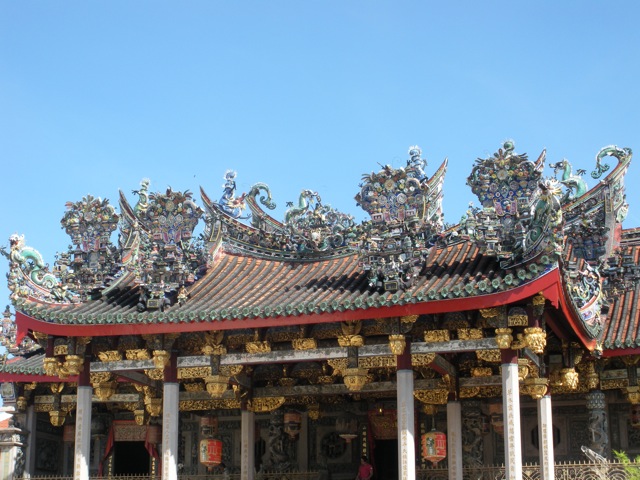
Ornate roofline of the Khoo Kongsi temple
Ancestral worship is a core tenet of Chinese religious beliefs, and inside the temples gilded ancestral tablets are arranged according to the ancestors’ positions in the clan hierarchy.
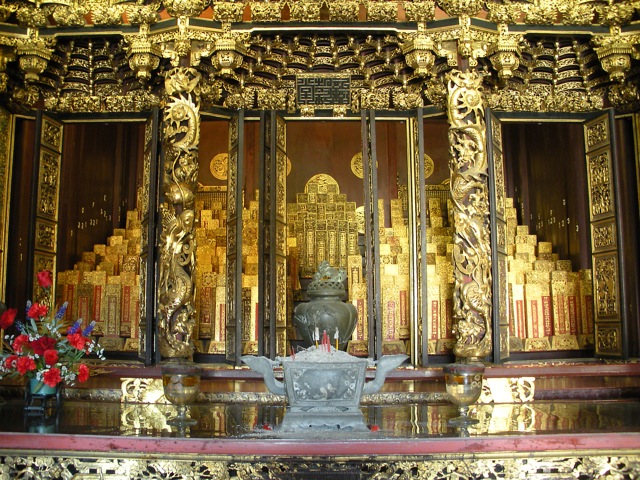
Ancestor tablets displayed for worship at Khoo Kongsi
On the advice of our new friend Tony we also visited the Pinang Peranakan Mansion, which recreates a typical home of a rich Baba from the early part of the 20th century.
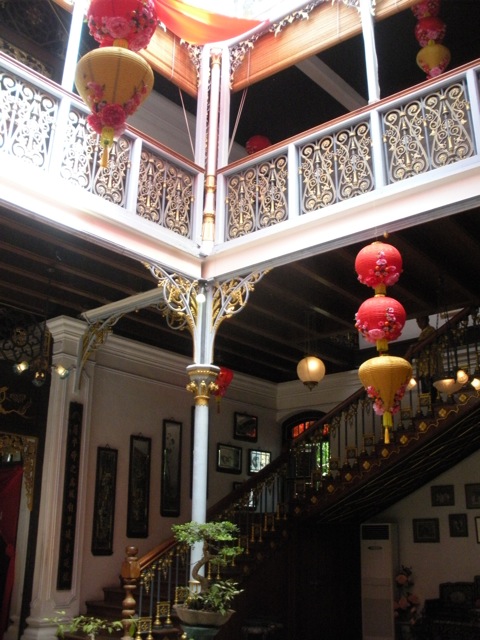
Interior courtyard at the Pinang Peranakan Mansion
The house was full of natural light thanks to the large central courtyard, and the wood carvings on the stairs and walls were gorgeous. There wasn’t a tour, so we were free to wander at will and it was so much fun to imagine life there! I would have fit right in…
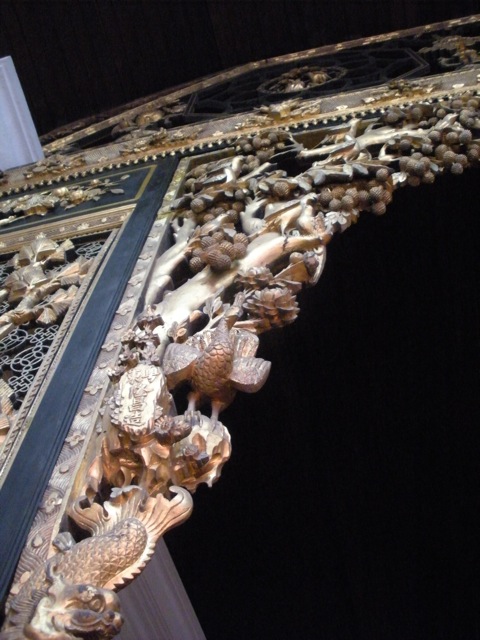
Carved wood panels separating rooms
We spent the evening at the New Lane Hawker Center, stuffing ourselves silly. We started with pork satay, which you don’t often see in KL as many restaurants here are halal, had some delicious char kway teow (a Malaysian fried noodle dish), a big bowl of assam laksa, and finished the night off with a gigantic shaved ice concoction called ABC. ABC is short for Air Batu Campur which is shaved ice topped with tapioca noodles, sweet corn, red beans, sweet syrup and condensed milk – Grant loves it, I’d leave it.
The next day, we circumnavigated the island to make good use of the rental car. The rest of the island isn’t nearly as developed, and we passed through a few small towns, but the most vivid memories are of the twisty and narrow roads on the hilly western side. Lots of sharp switchbacks, and occasionally you’d make a turn and come upon a car stopped in the road while the driver visited a fruit stand! Again, very thankful it was Grant driving and not me. We ended up taking a walk on the beach at Batu Ferringhi. It’s a narrow beach and the water was a bit cloudy, so we weren’t overly impressed. I know, I know, how can I complain about this? I guess I’ve been throughly spoiled by the gorgeous beaches of Southeast Asia!
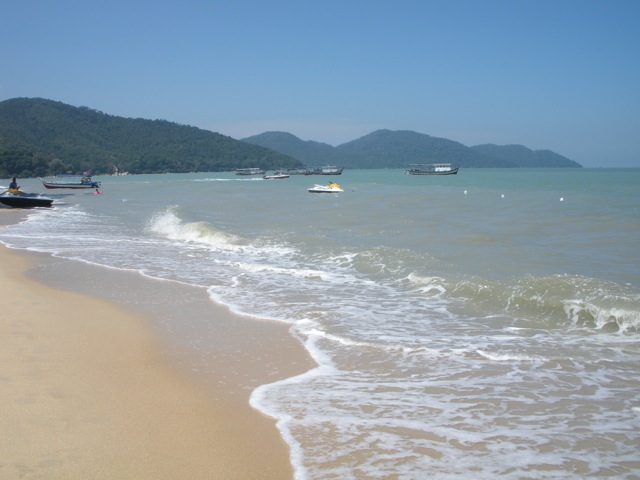
Beach at Batu Ferringhi on Penang
All in all, Penang was a great weekend trip, and I will happily go back and work on eating my way across the city. I think next time I’ll take it a little slower in Georgetown, and spend more time exploring the heritage zone. Since we were there on a long weekend, the main market and many shops were closed, and I’d like to see it at its vibrant best!
Thaipusam
Thaipusam is a Hindu festival, and in KL the celebration occurs mainly at the Batu Caves. We’d visited the Batu Caves before (remember Monkey Nirvana?), and I wanted to come back to see everything in full swing. I had gone to a lecture in January held by the Malaysian Culture Group, and they mentioned they were arranging a photography focused outing for Thaipusam – sounded perfect! The Malaysian Culture Group is just what it sounds like: a non-profit group made up of all sorts of people (although mostly women who don’t seem to be working) who want to learn more about local culture. They offer a monthly lecture, that oh-so-conveniently happens to be held in my apartment building, and other events and sub-groups like book clubs and eating clubs. My kind of stuff!
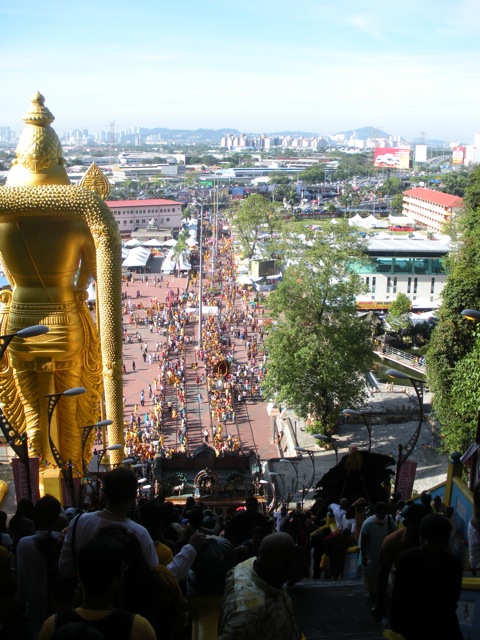
Looking down the steps at the Batu Caves
Over a million devotees attend the festival at the Batu Caves each year, and we were going along with an expert. Cheryl, our guide on this outing, is an expat photographer based here in KL and she’s been attending and photographing all sorts of festivals around Asia for years. We got together a few days before the actual event to chat about what to expect and how to shoot it, and then met at 6:15 am on Sunday morning at the site, ready for the experience.
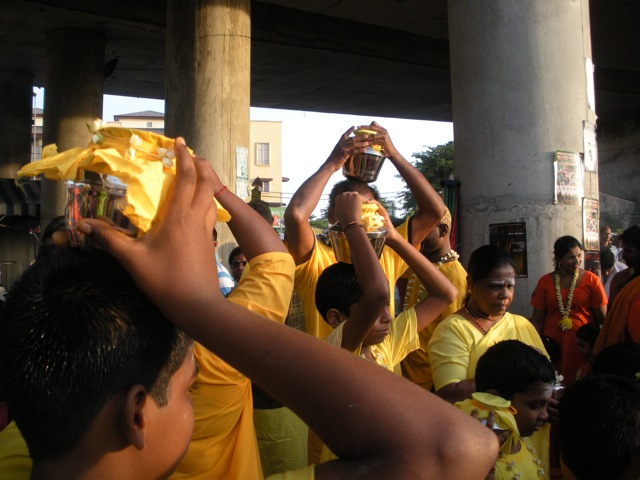
Devotees preparing for the day
The festival honors Lord Murugan and commemorates the occasion when Parvati gave Murugan a “vel” (meaning spear, pronounced veil) to vanquish a demon. This is essentially a time for his followers to say thank you for their prayers being answered in the previous year, for things like recovery from illness or a new baby. Although the focus is on individual sacrifice, it is very much a community event, including lots of children.
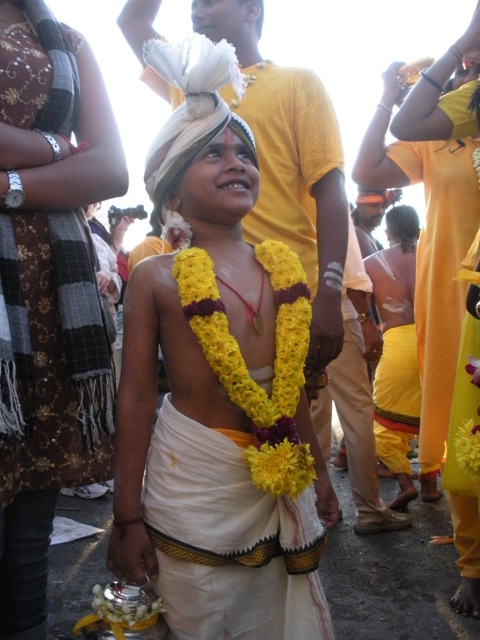
Puffed up with pride
To prepare to observe this holiday, devotees may fast for up to 48 days, sleep on mats on the floor near altars instead of in comfortable beds, and on the day they make their pilgrimage many shave their heads indicating humility before Murugan.
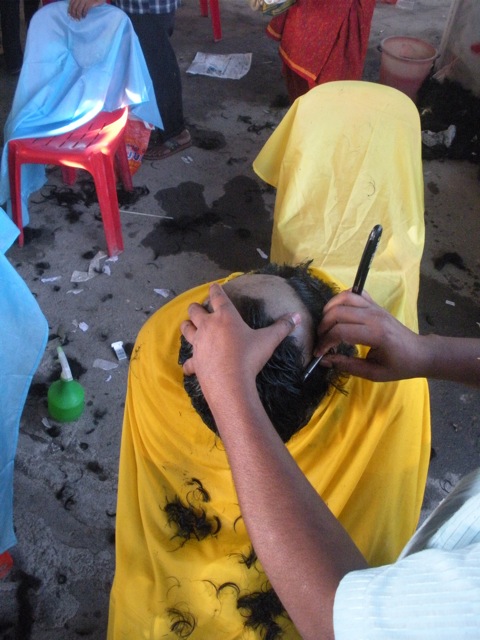
Shaving his head with a straight razor
They dress in yellow, bathe by the river and make their procession bearing a “kavadi.” Kavadi means a burden or something that you carry, and it is represented by many things ranging from a simple jug of milk to enormous 70 kg altars. Although these huge altars are eye-catching, I was most impressed by the long poles carried by a husband and wife, with their new baby suspended from the middle in a yellow sling.
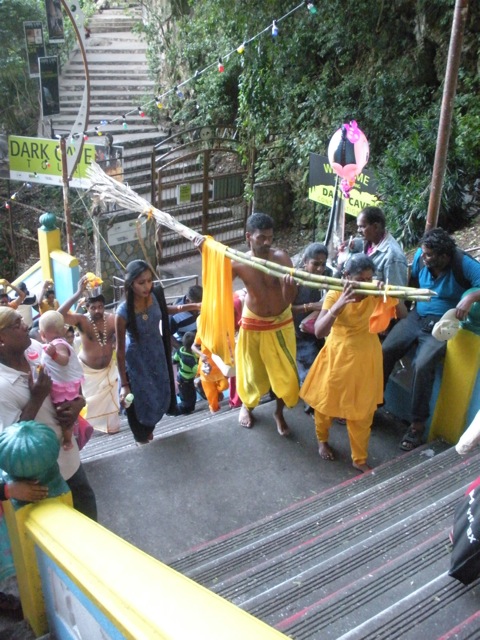
That's one carefully balanced baby!
The air is filled rhythmic drumming and the chant “vel, vel” and some devotees enter a trance state. It’s mostly young men, and once in the trance they take on the characteristics of different deities which involves shouting, dancing, rocking, and jumping around. The more intense practitioners take vows of silence with the visible reminder of a spear pierced through their tongue or through their cheeks. Several men also had their backs covered in hooks from which hung tiny jugs, bells or limes.
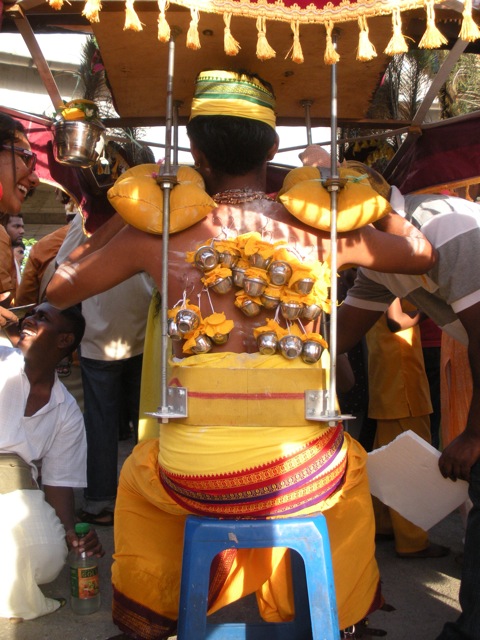
Balancing a 70 kg altar with lots of tiny jugs of milk hooked to his back, and he was still smiling!
The whole atmosphere was electric, and I was really surprised at how welcoming the community was. There we were, clearly outsiders with cameras, and they would not only allow us to take photos of them but would beckon us forward, move their friends out of the way and actively instruct their kids to pose for us. I really enjoyed the scene down by the river (and wouldn’t have known about it without Cheryl’s guidance): seeing grown men and small children having their heads shaved, watching people gathering quietly as a small group before their makeshift banana leaf altars, splashing in the cold showers as the sun was coming up, and swaying around the drum circles.
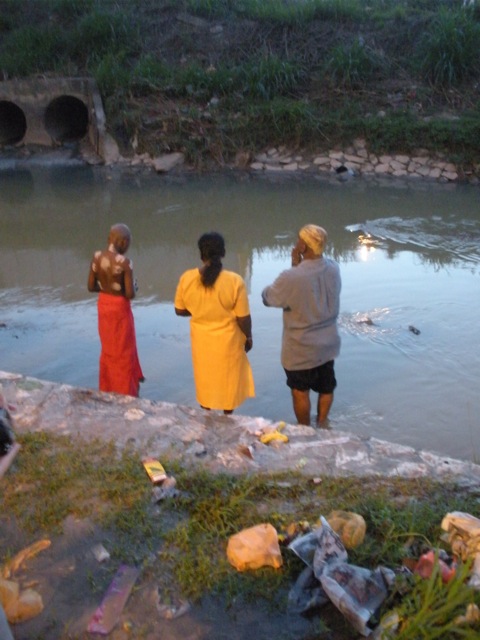
Praying and cleansing down by the river
Once prepared, people proceeded across the street from the river, and along the walkway to the foot of the stairs up to the caves themselves. Some walked, some staggered, some danced, and believe it or not, some rolled. They all were completely absorbed in the task at hand and made their way at their own pace up the steep steps to queue in the cave and await their turn to present their kavadi to Murugan. The greater their pain, the greater their glory.
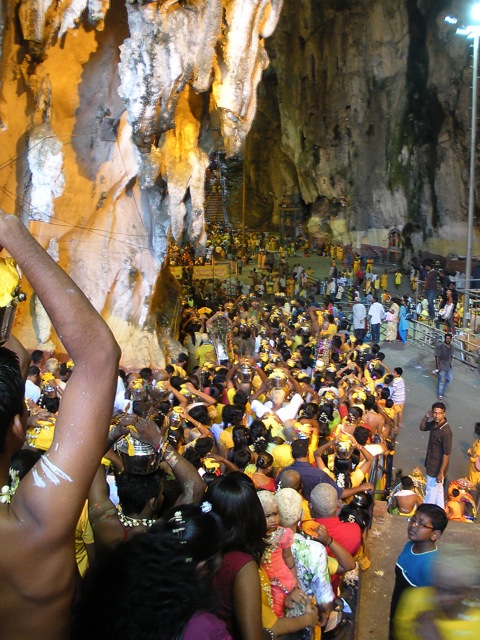
Inside the cave, waiting to present their offerings
The photography focus of this outing was interesting, and Cheryl gave great advice on how to capture the chaos. Everyone else had nice DSLR cameras, and I’m thinking about upgrading. Grant used our basic Nikon Coolpix S550, and I was using my ten year old Nikon Coolpix 4500. I can take the 4500 out of automatic mode, so I played around a bit with the settings on it, but you won’t see any of my photos posted here. Out of all the cables and whatnot I’ve brought, I managed to omit anything related to this camera except for the battery charger! It really is an “ancient” camera, and I can’t plug the compact flash card into anything here, since everything is built for SD cards these days. Luckily, Mom has the same camera, so I’ll remedy the situation in March when we’re back in the US, and we’ll see if the pictures are actually in focus. Anyway, Grant took these great photos, so we hope you enjoy!
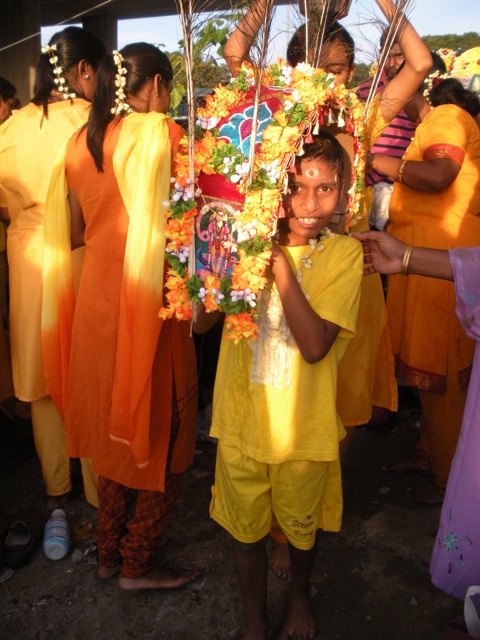
Oh happy day!
Gong Xi Fa Cai!
So I don’t speak Mandarin…yet, but I believe that means “Wishing you will be prosperous” in the New Year. Chinese New Year is January 23rd, and we’re welcoming the year of the dragon.
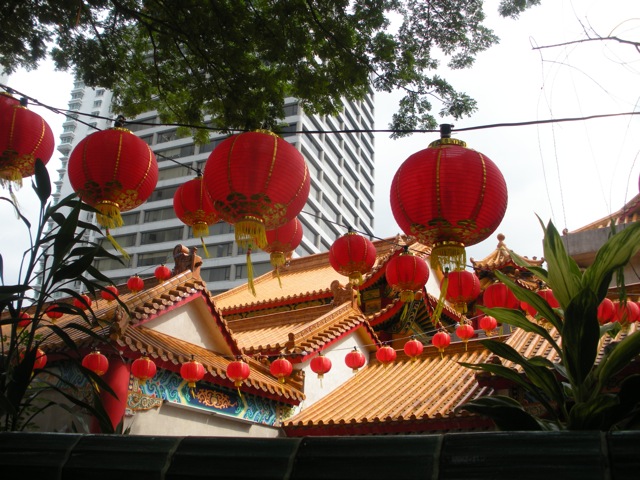
Lanterns at Temple Kun Yam Thong, down the street from our apartment
The only time the Chinese zodiac had crossed my mind was in Chinese restaurants when the placemat would help you figure out what your sign was (1980, year of the monkey). It’s impossible to miss it here! I’d thought they went all out for Christmas, but apparently that was just a warm up.
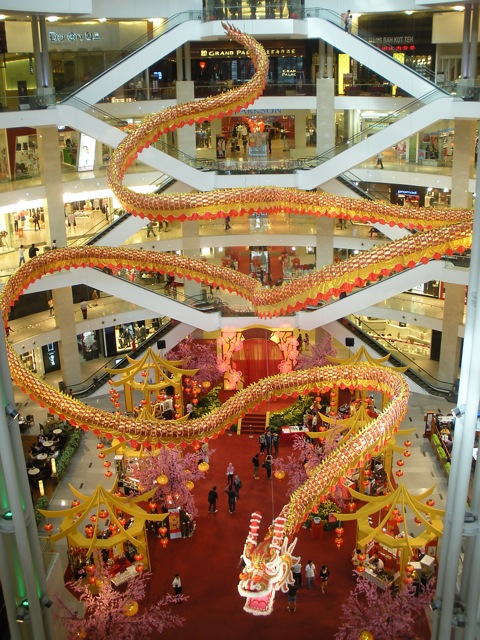
Huge 600 foot long dragon at Pavilion
Both religious and commericial temples are bedecked with red lanterns, and giant dragons swirl in the middle of the malls. We asked if there would be any big celebrations for the holiday, but most people (even Malay and Indian ones) go home to visit family. Since there are so many people traveling, we’re planning to stick around here. There are dragon and lion dances in Chinatown and in some of the malls, and apparently the God of Prosperity will be wandering around so we’re off to look for him.
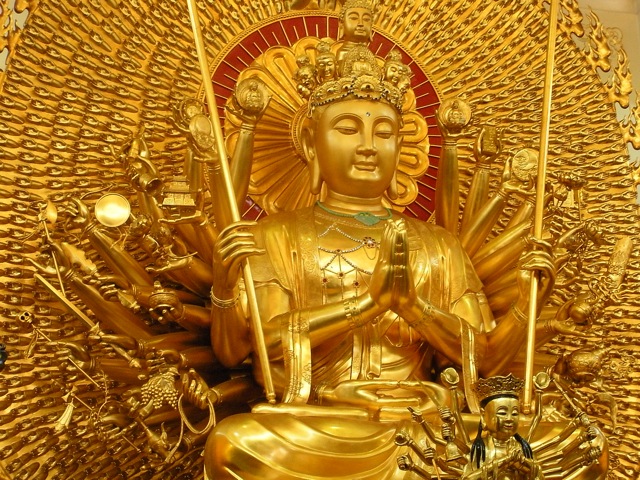
Thousand Hand Buddha at Temple Kun Yam Thong
Special menus are on offer at many restaurants, and there are some unique traditions found in Malaysia and Singapore like “yee sang”. It’s often described as a raw fish salad, but I think that’s oversimplifying it. It’s presented as several small heaps of shredded vegetables on a platter with a small dish of (usually) salmon sashimi on the side and several dishes of toppings: oil, plum sauce, crackers, and whatever else has inspired the chef. Once it is served, the waiter (or someone at the table) adds the ingredients on the side to the main platter, and then everyone joins in to toss the ingredients together while saying auspicious things in Chinese. The higher you toss, the higher your fortunes will grow in the new year, so you’re really supposed to go for it. Grant got to partake in this during a holiday lunch for the team he’s working with, and now I’m jealous so we’ll be seeking this out this weekend.
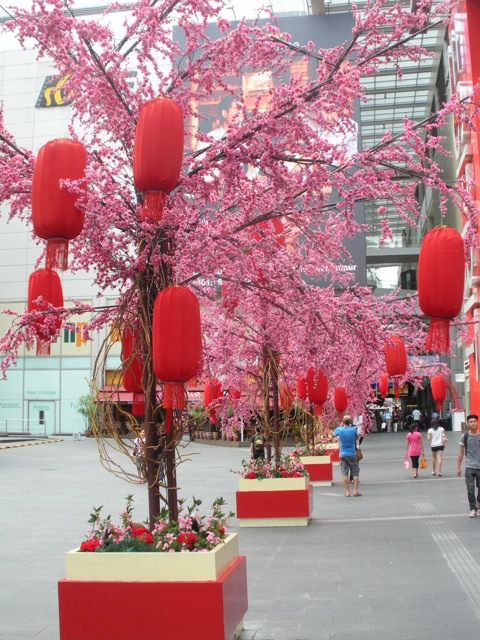
(Fake) cherry blossom trees and lanterns
Actually, he may be a little jealous of me and my new endeavor. I’ve signed up for Mandarin lessons, and will be taking an intensive course starting on February 6th. It meets every weekday from 9 – 1 for a month, so I might be spending more time hearing and speaking (or trying to speak) Mandarin than English. Wish me luck – I’m really excited…and a little bit nervous!
United Buddy Bears in KL
Shortly before Christmas we were walking past Pavilion, one of the upscale malls here, and were surprised to find lots of bears.
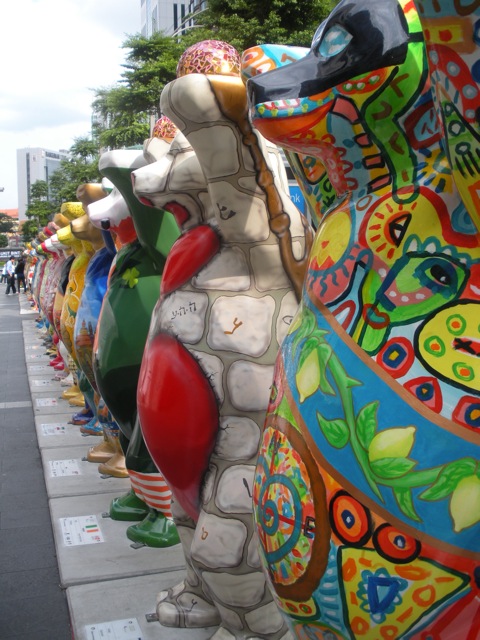
United Buddy Bears
These are particularly well traveled bears; they’ve been on the road since 2002 covering five continents, and Malaysia is the 23rd stop on their world tour.
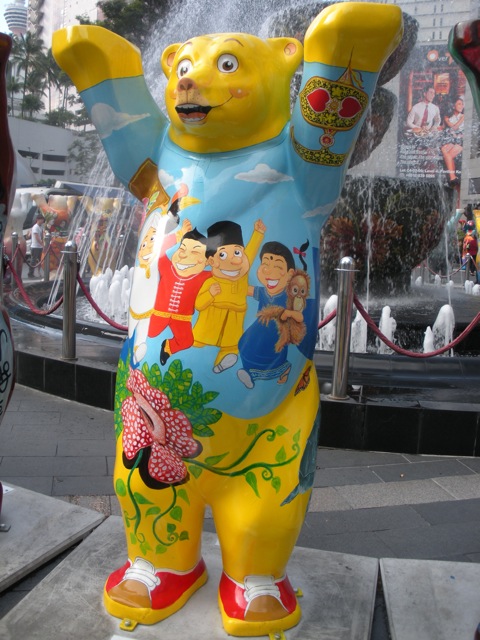
Malaysia's Buddy Bear
There are about 140 bears, one for each country recognized by the United Nations. Each is two meters tall (yes, I’m working on getting used to the metric system again), and they stand in a circle with their arms upraised, “hand in hand” to promote tolerance and living in peace and harmony. These begin with identical fiberglass casts, and each country has chosen artists to decorate the bear in a manner to represent that country. The US went with a pretty iconic choice:
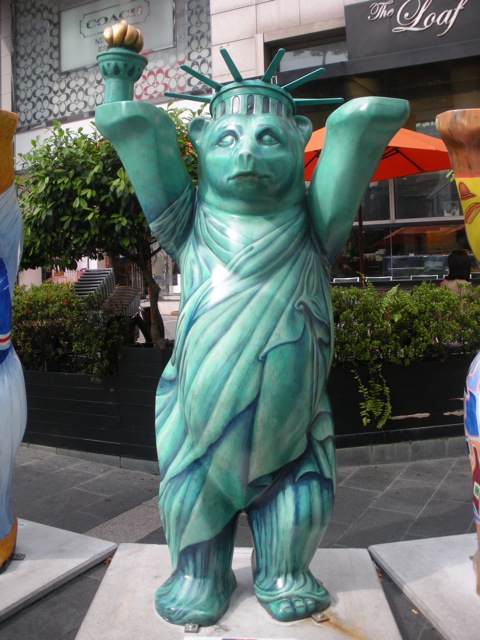
Lady Liberty
But my favorites are usually the lesser known countries, like Moldova.
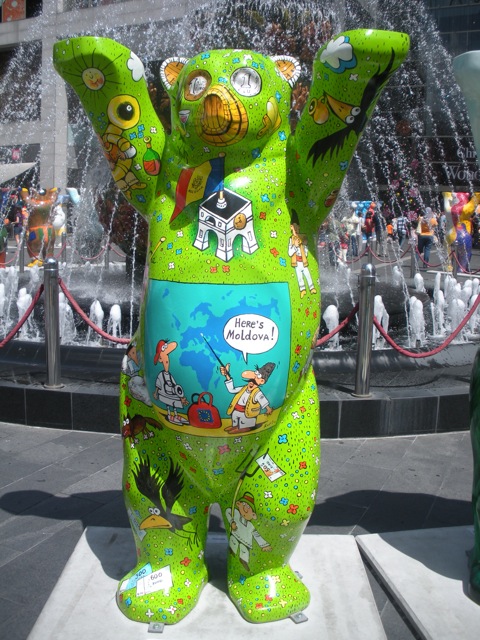
The helpful Moldovan Buddy Bear
They are visiting here until February 15th, and it’s quite a sight to see!
Grocery shopping
I love grocery shopping. Wherever I travel, I always end up in a grocery store whether or not I need anything; I just think it’s neat to see what is sold in different countries.
One of the biggest surprises when we got to KL was how much from home is easily found here, even my favorite brand of apple cider vinegar is here. Lots of fruits and veggies, and even some organic choices are usually available. I had been shopping mostly at the grocery stores in Suria (the nearest mall, the one under the Petronas towers). One of them is a British chain, Cold Storage, and the other is a Japanese one, Isetan, so depending on what I’m looking for I head to one or the other.
That is, until I discovered my new favorite grocery store just steps from my front door.
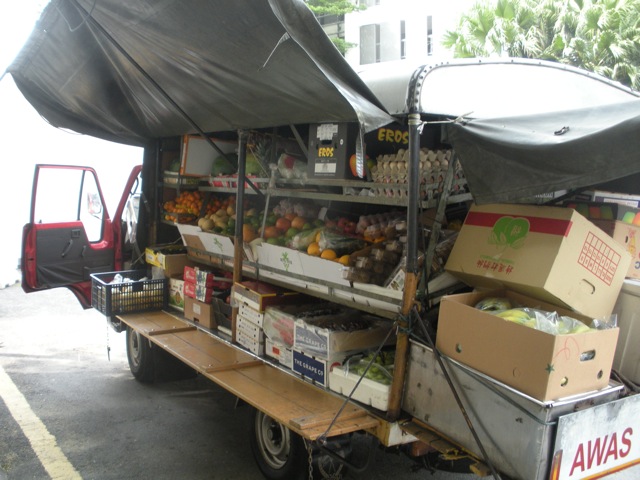
My favorite grocery store in KL
He shows up once a week, Wednesday afternoons around 2:30, and unpacks his scale onto the sidewalk to weigh your purchases. There are several condo buildings in a little cluster here, and I see the same people show up at this truck each week. His produce is fresher than the grocery stores, and it’s a much more social experience with everyone recommending what they got last week and helping each other select the perfect pineapple or whatever.
Next week he’s on vacation for Chinese New Year, and I’ll be missing him!
Southern Cambodia
After touring all of those temples, Grant wanted a relaxing end to our vacation. We had searched for an island getaway in Cambodia, but since it is the high season everything we looked at was already booked. We decided to head to Sihanoukville for two days, and then to find peace and quiet in Kampot and Kep for the final two days.
Sihanoukville is a more modern town than the others we visited, having just been built in the 1960s. We had heard it was a popular stop on backpackers’ itineraries and could be a bit of a scene. After the 10 hour overnight bus ride to get there, we were pleased to find our hotel perched on top of the highest hill around, next to a temple. Peace and quiet! Unfortunately, we woke up the staff with our 6 am arrival but they graciously checked us into a bungalow right away. We slept off the bus ride for a couple of hours, and then were ready to hit the beach.
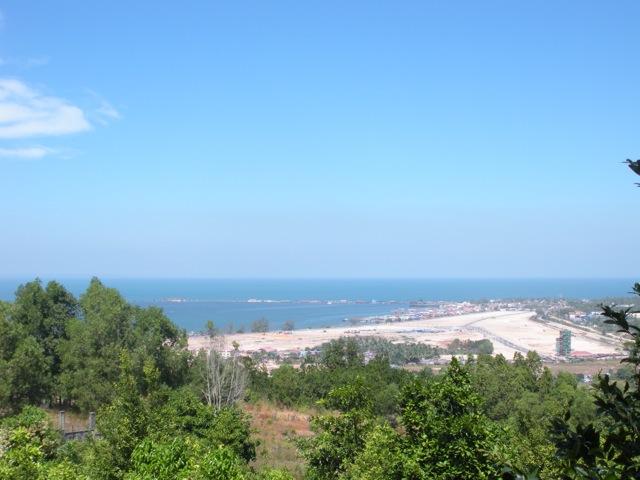
View from Pagoda Rocks in Sihanoukville
We have no pictures apart from the one above of Sihanoukville, but we had a great, very low-key time. I don’t doubt that if you’re looking for the party scene you could easily find it here, and there certainly are tons of guesthouses, bars and restaurants near the beaches. The beaches themselves were like powdered sugar, and we enjoyed just strolling down them. We spent most of our time at Ochheuteal Beach, which is one of the more popular ones. It’s lined with beachfront restaurants that set up lounge chairs and papasan chairs in the sand, and the purchase of a drink will buy you a whole lazy afternoon just steps from the water. Draft beer was super cheap, just fifty cents for a pint, and I was surprised at how laid back they were about coming out to take your order. No pressure here, we sat around for at least half an hour before anyone working for the bar came out.
There were plenty of local entrepreneurs passing by, most carrying fruit or grilled seafood on a tray on their heads, happy to squat down and prepare something fresh for you. We had green mango with chili/lime salt, and Cambodian lobster (looked like giant prawns) with a squeeze of lime. Yum! There were some kids selling pirated books and jewelry, and plenty of women asking if you wanted massages or mani/pedis on the beach, but a simple no was usually enough to get them to leave saying “Maybe later!”
On to Kampot, a sleepy little town located on a river and best known for producing pepper. We stayed in a “bungaroom” here, a tiny shack on stilts with just a bed, a mosquito net, and a fan. What more do you need? There really wasn’t much to do in Kampot itself, which was just fine by us. We did spend one day on a countryside tour, seeing limestone caves, salt fields, pepper plantations, and visiting the Crab Market at Kep, eating crab drenched in local green peppercorn sauce, and seeing the beach in Kep. What a day!
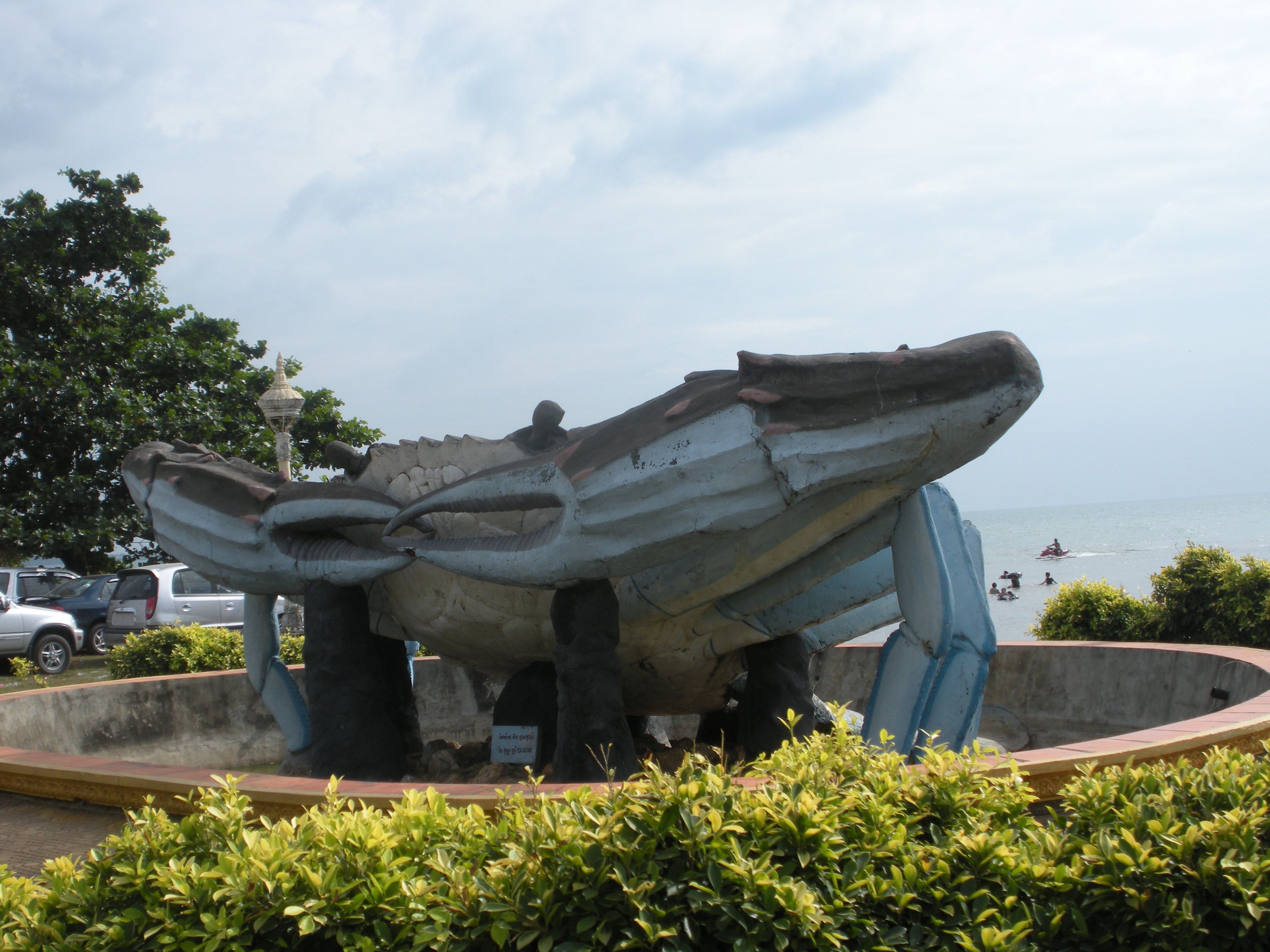
Crab is big in Kep!
The caves were neat, but the highlight of that stop was our tour guide entourage. As the tuk-tuk slowed to a stop, it was surrounded by kids chattering at us in English. Five of them appointed themselves as our tour guides, and they talked our ears off in perfect English as we walked through the fields (carefully marked as being de-mined). They were excited that I spoke more than just English, and so we chatted a little in French and spoke basic Spanish to each other too. It turns out that they learn English in school, but the only other languages they know they’ve learned from tourists, so they can say the same ten phrases in many languages. Then it was time for my Khmer lesson! Ok, now it’s your turn:
Hello = Sues dei
Goodbye = Leah sen heuy
Let’s go = Tuk tao
Thank you = Aw khun
Now you know as much as I do! They shepherded us up to a small booth, where we each paid a dollar, and then we followed them up 200 steps to the mouth of a cave. While they pointed out every rock formation that looked remotely like an animal, they delighted in playing jokes on us and using their favorite catchphrases: “I believe I can fly”, “Lovely jubblies”, “Same same but different”, and “You talkin’ to me? Bada bing bada boom!” They took us into a dark shrine, pinched my leg in the dark, then hysterically warned me to watch out for ghosts.
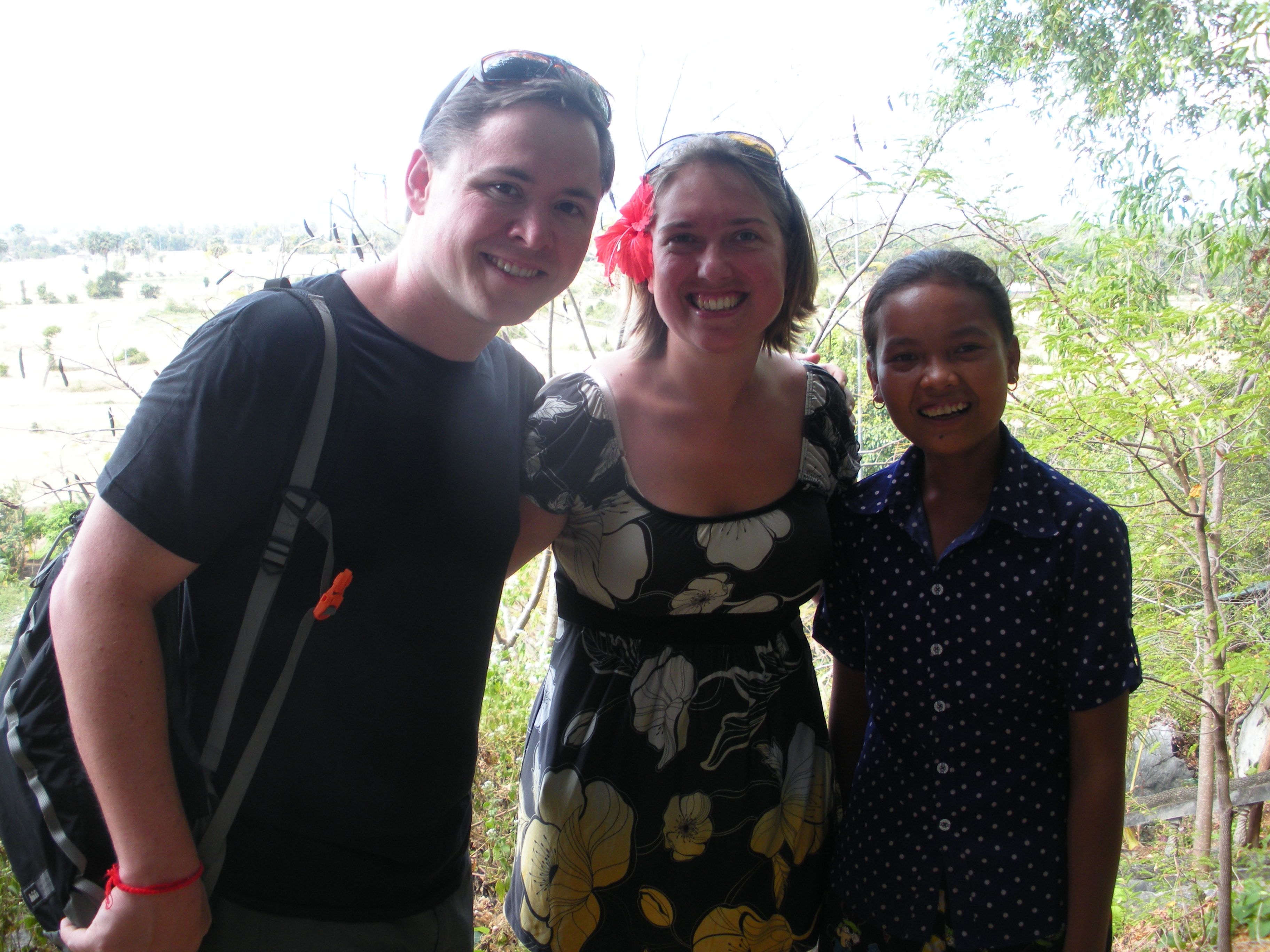
Posing with one of our tour guides
There were a couple of exits from the cave: through a small, pitch-black hole, back down the stairs outside, or a literal middle ground, climbing down into another cave and winding around and through it. We went with the latter, and these mountain goat kids swarmed down over the rocks. They carefully pointed out each step to me with a flashlight, only to grab at our legs as we shifted our weight onto a new rock and then warn us to watch out for cobras. The final stretch was a surprise wade through an icy pond, and we ended up back at the ticket booth. We laughed a lot with those kids, and they bedecked me with flowers and made me practice my Khmer words all the way back to the tuk-tuk.
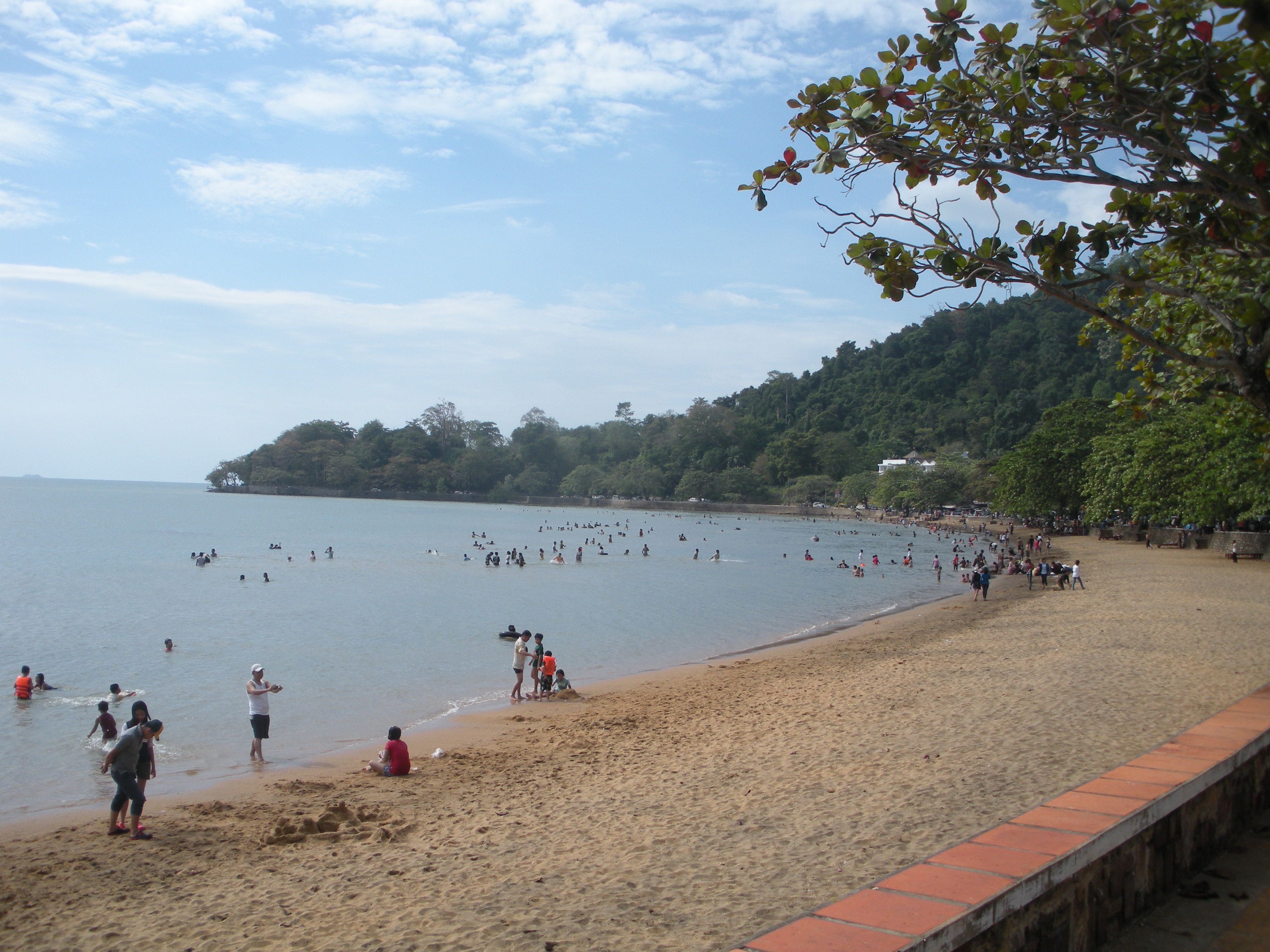
Beach at Kep
Kep was great fun too, and it was interesting to see how different the local beach experience is from the tourist show. The beach here was yellow and much coarser, and packed with locals. They were picnicking all along the beach, on the sidewalks, and on raised roofed platforms. These platforms were really popular, and everyone had at least four hammocks strung up to relax in and a small mountain of food in the middle. I think we should adopt this idea back in the US!
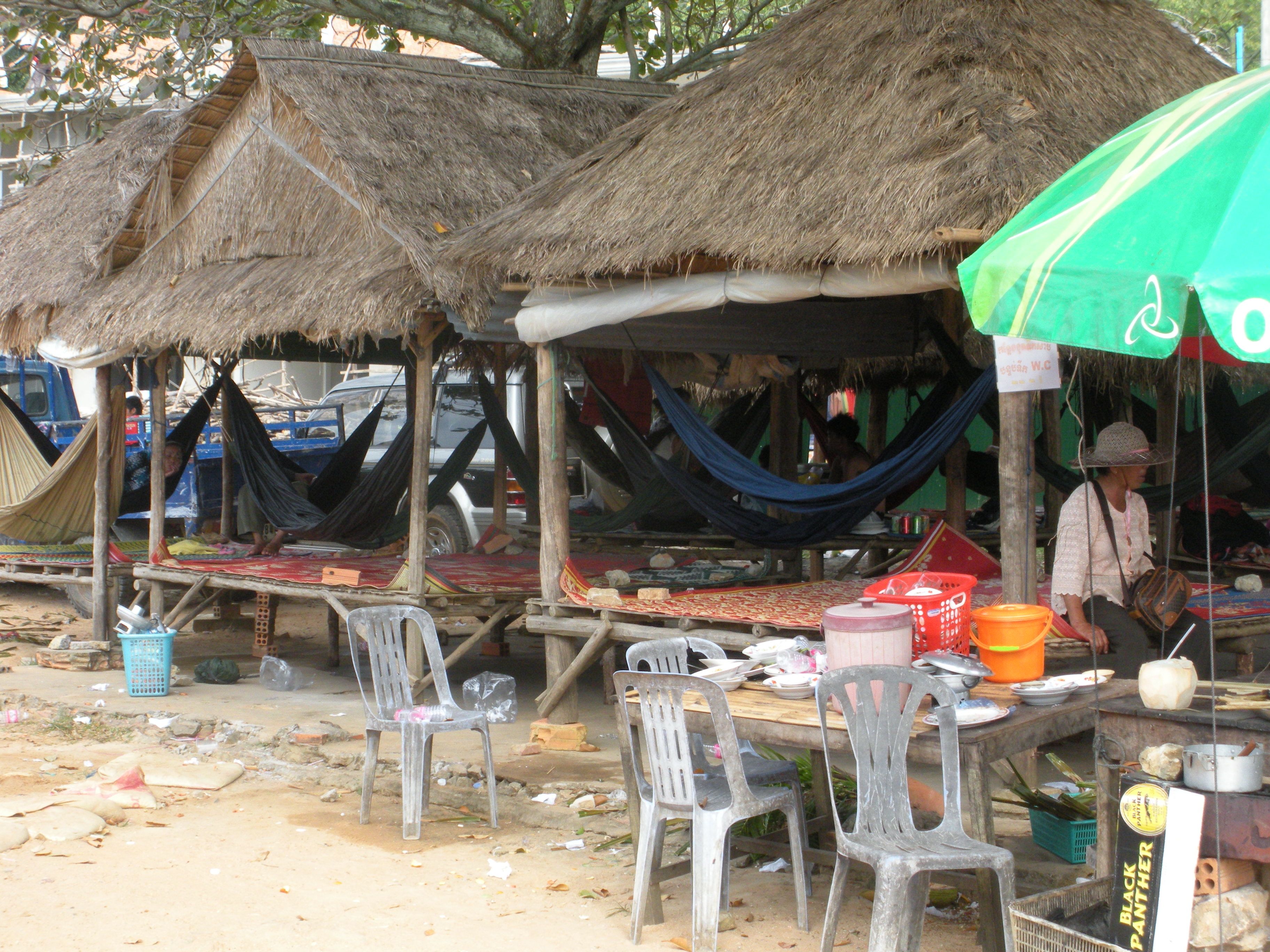
Hanging out at the beach
The last stop of the day was a pepper plantation, where our driver walked us through the fields and encouraged us to try everything we saw.
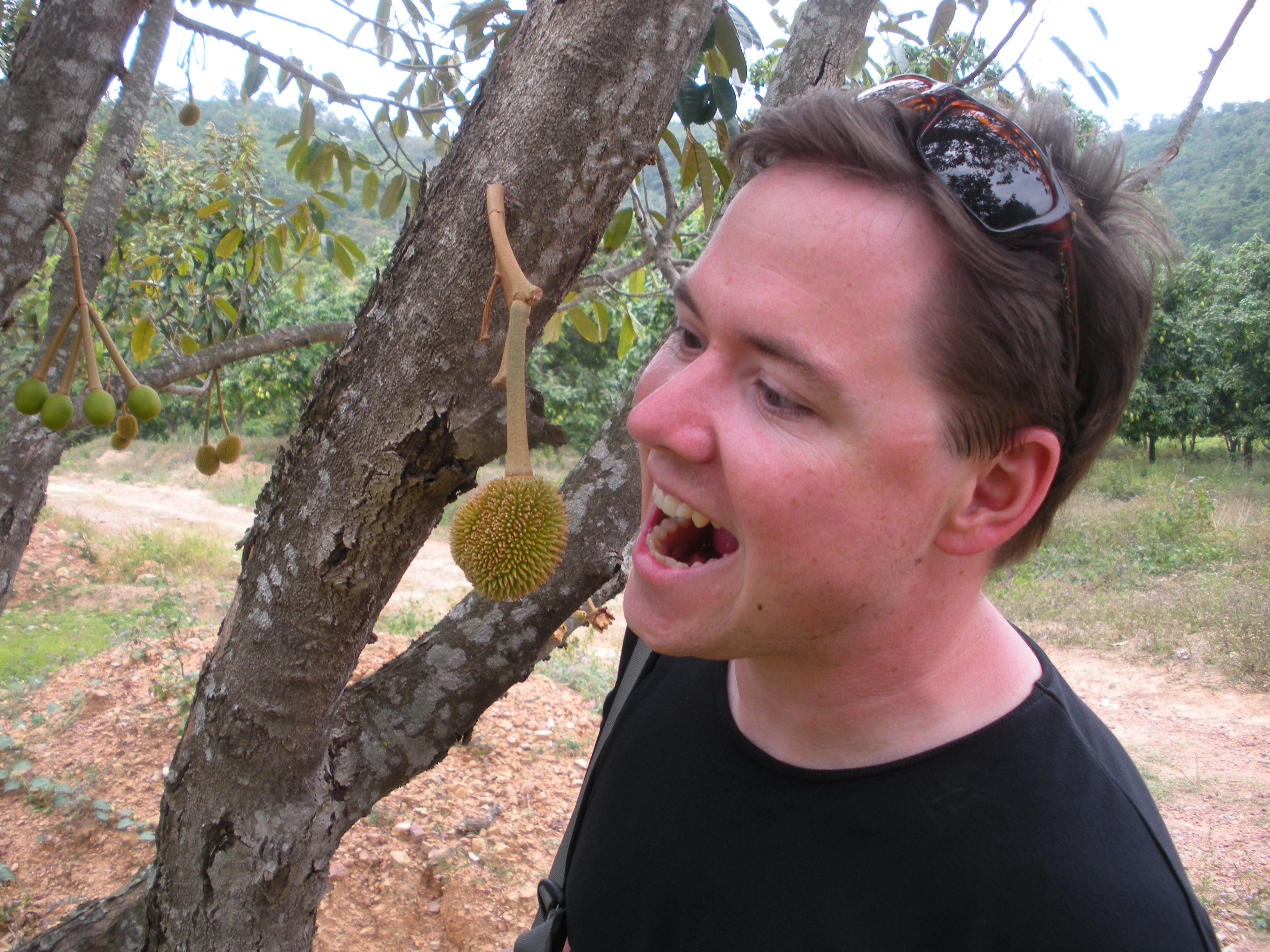
Baby durian!
This is where I learned that Grant will eat anything that anyone hands to him; another driver walked up to him and handed him something and told him to take a bite of the top of it. He did, said “hmm, astringent”, and handed it to me to try. I asked what it was before I would eat it, and it turned out to be a cashew nut. I guess they grow with a soft fruit on top? I’m still not sure if that’s commonly eaten or if they just wanted to see if we’d eat it. I was looking this up while I was writing this post, and I found an article online saying that the reason cashews aren’t sold in their shell is that they are in the same family as poison ivy and poison sumac and there is an irritant in the shell oil. Well, we survived with no ill effects!
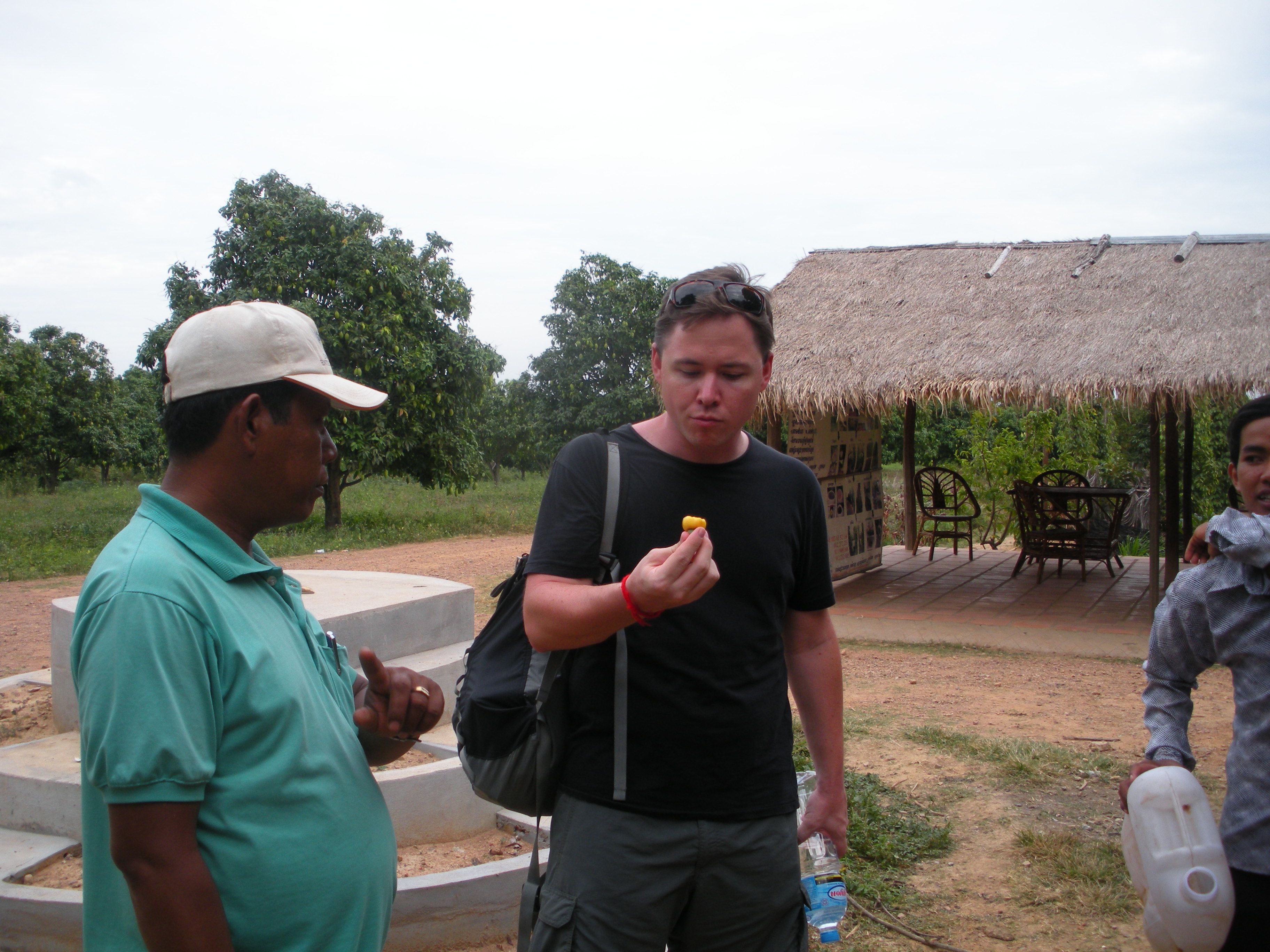
Grant will eat anything.
The fresh peppercorns were spicy in a floral way, and we bought big bags of black, white, and red peppercorns to take home in an effort to extend the memories of this trip as long as we can. I guess when they run out, I’ll have a good excuse to go back to Cambodia!
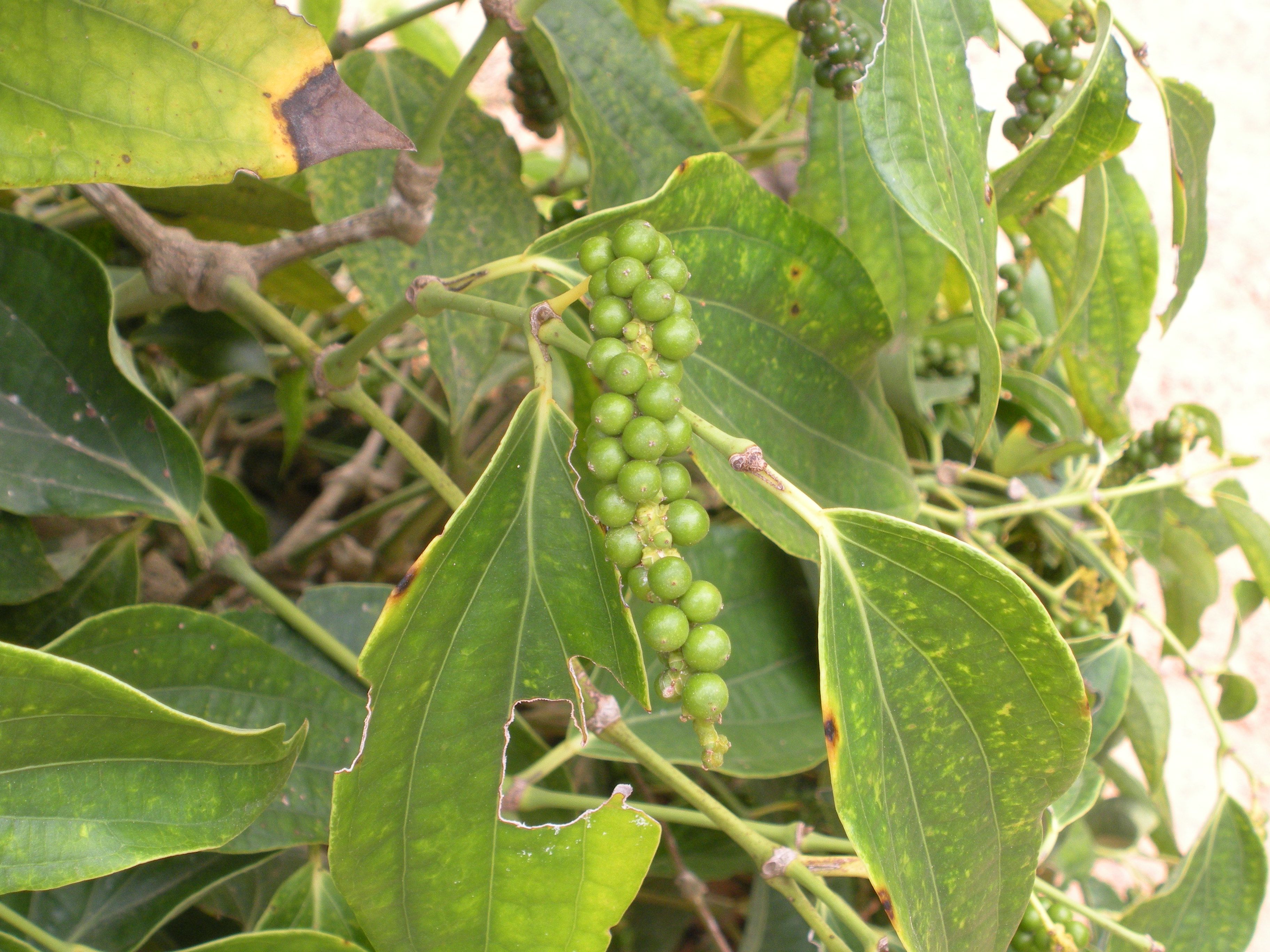
Kampot pepper
Recent Comments