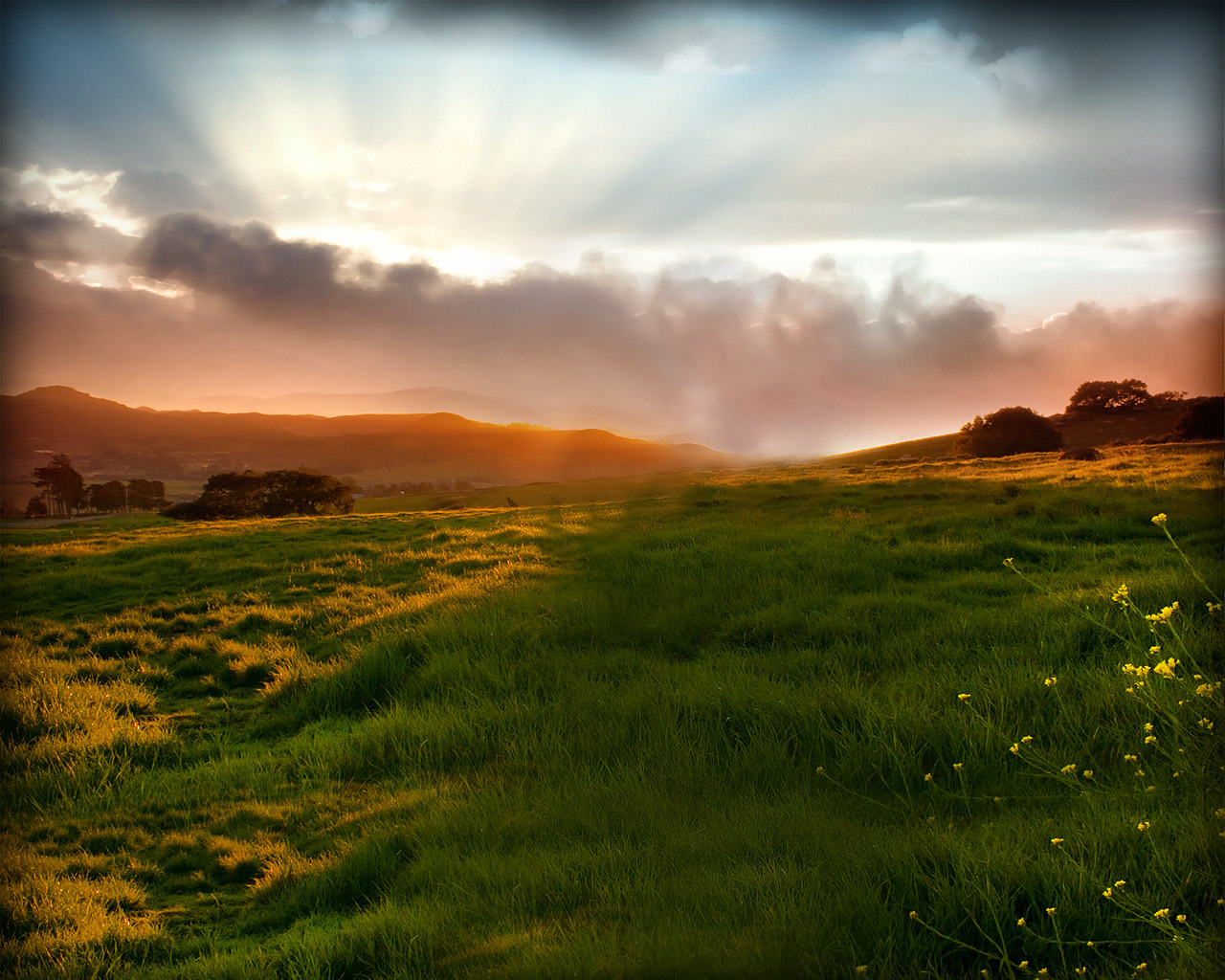

Konnichiwa!
That’s right, we are in Japan!
We’ve done a little travel since Ren was born: Vancouver, most of the East Coast from Maine to North Carolina in several trips back east, and Hawaii. Hawaii was like a dream, and we spent a week on Maui in November 2014, so when the opportunity arose to join Grant on a business trip to Tokyo, we jumped at it. Literally, since we bought our tickets just over a week ago, and now here we are! We are loving Japan, and Japan loves…Ren.
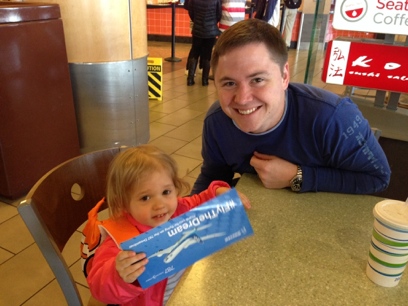
Ready for our first Dreamliner flight!
The flight yesterday went really well, and she charmed everyone on the plane and in the airport yesterday with her clownfish backpack. She was consistently greeted with “Nemo…kawaii!” She was in great spirits. Today she’s been making friends with her Hello Kitty hat on. I think Japan was made for adorable two year olds.
The hardest part of yesterday was the final 1.5 hours on the bus from Narita to Tokyo, Ren started strong but about 40 minutes into the ride (perhaps not coincidentally as the sun was setting) she started to crash hard. Can’t blame her as it was around 1 AM Seattle time and she had a normal nap on the plane around 4 PM Seattle time, so she was zonked. We were all very relieved to reach the hotel and get Ren into her crib, where she crashed around 7PM local time/2AM Seattle time. The grown ups stuck it out until around 8:30.
This morning we were up bright and early (around 4:15AM)! We decided to strike while the iron was hot (while the kid was energetic), and head to Tsujiki Fish Market. It’s a 10-15 minute walk to the actual subway station (Ebisu) closest to us, but luckily it was a straight shot on that line to the market. Ren dozed off on the subway, even though she had been really excited to take the “choo-choo”. We had her in the Beco carrier, which she was delighted to ride in again (it has been a few months since we’ve used it at home).
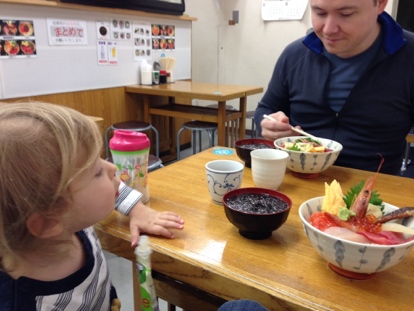
Yum!
Strolled around in a drizzle, dodging carts and trucks (it is a very busy area, and clearly a hard working market!), and spent most of our time in the Outside Market, which is stall after stall of fish, vegetables, restaurant supply stores, and tiny restaurants serving the freshest sushi. Had to take advantage of that, so once Ren woke up, we headed back to the one that had seemed the friendliest. The ground floor was packed, but the man outside waved us in, shouting orders to the people inside. They whisked us up a flight of stairs, to a tiny room with four tables. Very friendly people, colorful picture menu, and we both ordered miso soup and a chirashi bowl (rice with sashimi on top). Grant stuck to tamago, tuna, salmon, and minced fatty tuna (which Ren declared yummy), and I got a bit more adventurous with salmon,albacore, tuna, shrimp, sea cucumber?, and salmon roe (ikura). The biggest surprise and hit of the day for Ren was ikura, aka bubbles. She ate almost all of them (probably 3-4 healthy spoonfuls), along with a nice amount of the fatty tuna and two-thirds of my salmon. The restaurant loved her, and brought her a little teddy on a stick, and several people stopped by to say hi to her. She must feel like a rock star.
A little more wandering around, and we headed back to the hotel by 10, with a stop on the way for bunny bread – a little roll shaped like a bunny with chocolate chip eyes and chocolate pudding inside. That may become a regular treat!
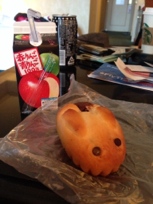
Bunny bread
We’re certainly getting our exercise, walking around and carrying Ren in turns in the Beco! We’re working on our Japanese, and are saying Ohio (good morning), Arigato (thank you), and Sayonara (good bye), and trying to get Ren to say it too. The funniest thing she’s doing is responding to our requests for her to say Ohio with Ni hao! I guess the Mandarin stuck! It’s an extremely consistent response.
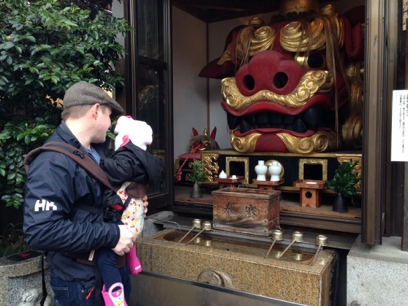
Namiyoke-jinja, Shinto shrine next to the market
Post nap, we headed to Harajuku to visit KiddyLand, a huge toy store. Something for us in the morning, something for her in the afternoon! We strolled down Omotesando, a broad avenue apparently sometimes referred to as Tokyo’s Champs-Élysées, and dodged the crowds until we found the store. We worked our way from the top floor down, since the top floor was Hello Kitty central, and Ren has a close, personal relationship with Ms. Kitty. Sure enough, we now own a Hello Kitty doll in a kimono, and a plate, washcloth, and toothbrush adorned with the cat. And, we have a very happy little girl currently snuggled up to the doll in her crib.
We were aiming for gyoza for a mid-afternoon meal (Dinner? My stomach has no idea where it is.), but at 2:15 PM there was quite a line at the restaurant that had been recommended, so we wandered the small side streets and made our way back to the JR station and on to Ebisu figuring that our quieter neighborhood might have some good choices around here. In Yebisu Garden Place, there were plenty of options, and Ren’s request was “bubbles”! Ok, more chirashi, and she ate almost all of my tuna, avocado, ikura bowl.
Not satiated, we detoured through Mitsukoshi, a big department store with food halls in the basement, on a quest for more bubbles. We found them, along with cherry blossom shaped rice crackers and an assortment of other kid approved treats including a teddy bear shaped bun. They were showing a film made in the plaza that we were walking through, and Ren watched a little and ran around to get her wiggles out before we headed back to the hotel by 5. She made it to 6:45 tonight, and has really been a trooper. She’s already looking forward to another choo-choo ride tomorrow.
It’s so much fun to see the world through her eyes. The silence in a Japanese subway car isn’t oppressive or intimidating to her, but a great opportunity to make funny noises and tell everyone that the train is going fast!
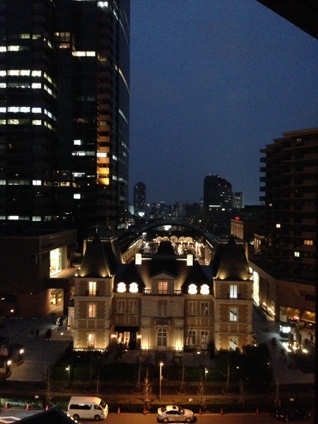
Evening view from our hotel room
How to eat
How I eat is not something I typically consider; I’m usually much more focused on where, what, and when I eat.
Eating out here in KL, it is unusual to be given a knife; typically a fork and spoon fill your needs, and chopsticks are often an option as well. In food courts, hawker centers and casual restaurants you will rarely get a napkin, although usually a sink is available to wash your hands before and after eating.
I went to lunch with my Mandarin class last week, to celebrate passing level two and to welcome a new teacher to the staff. We went to Little Penang Cafe in the Suria mall, a place that is pretty reliable for decent food and is always hopping at mealtimes. There were six of us, and the ethnic mix was interesting: Chinese-Malaysian, Korean, Chinese Muslim, Laotian-Canadian, Libyan, and yours truly, the token American. Lin, our teacher who is Chinese-Malaysian, was encouraging everyone to try the different specialties, but most of the table ordered the fried rice (a halal dish). I went with a spicy noodle soup, and Lin had char kway teow, a stir fried noodle dish. Some forks and spoons were delivered to the table – at least in Malaysia, you’d normally eat fried rice with a fork and/or spoon, and eat noodle dishes with chopsticks. At one end of the table was a big canister of chopsticks, and Lin asked for a set, so I turned and asked for two: one for her and one for me. She was quite surprised that I was comfortable enough to tackle my noodle soup with chopsticks and a soup spoon, and jumped up to take a picture to document my immersion into the culture! I think for her it must have been a little like watching a monkey type.
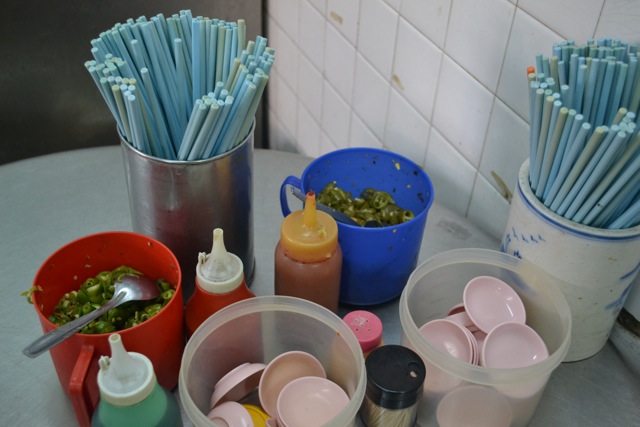
A typical table setting in KL
On the other end of the spectrum, I met Grant for lunch on Friday (no Mandarin class in observance of Good Friday, go ahead and try to figure that one out). It turned into lunch with him and two coworkers: one is a local and the other is his Indian colleague also here on contract for the project. We went to a mamak cafe looking for a good banana leaf meal. I loved this place, just a little corner space open to the air, crowded with small tables and people looking to enjoy a leisurely Friday lunch before heading back to the office to finish out the week. I never saw a printed menu, but once we had secured a table a smiling guy came over and told us the chicken briyani was very good, and we all agreed to try it. Our places were then laid with a large piece of banana leaf, and a quartet of dipping sauces were presented to the table. Individual stainless steel pots of briyani came out, filled with a chicken leg, a hard-boiled egg, and mounds of fluffy seasoned rice. We each had a small ladle to portion food out onto our leaves, and then…I realized there was no silverware. Ok, no problem. Grant’s coworkers were completely comfortable with this, and assured us that we’d figure it out and if we couldn’t get the hang of it could always ask for a fork and spoon. We’d washed our hands (handy, handy sinks!) and the short tutorial was to push the rice together into a little ball with your fingers, and then to bring it towards your mouth and sort of flick it in. My technique wasn’t quite that clean, more like smushing together a clump of rice that I balanced on my fingers and then leaning forward over the banana leaf to shove it off my fingers with my thumb into my mouth, but I was able to eat my fill and have a great time doing it. I think it counts as a success! And did I mention how handy the sinks were when I finished eating and had fingers covered in curry and saffron?
With eating methods like this, we’re entertaining everyone we dine with – talk about dinner and a show!
Potato, Potahto
Melaka, Malacca, Melaqa…it seems you can spell it anyway you like! Melaka seems to be the most commonly found version here in Malaysia, so that’s what I’m going with. As with Georgetown in Penang, in 2008 Melaka was listed as a UNESCO World Heritage Site. Since it is only a two hour bus ride away from KL, it is a very popular weekend destination and has the reputation for being pretty touristy.
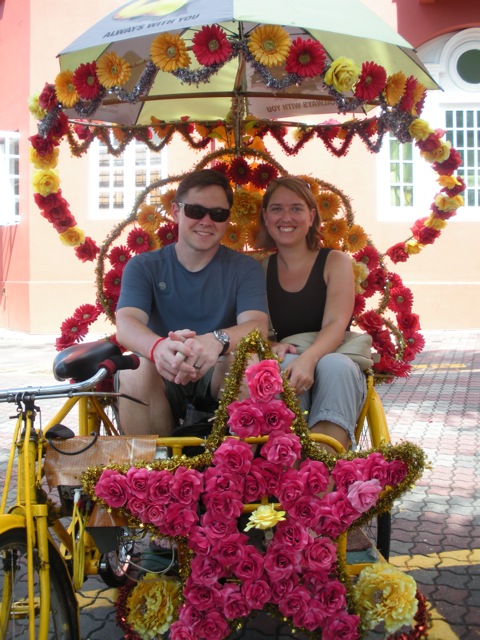
We may look like tourists, but who cares?We're having a great time!
Now I liked Georgetown a lot, but I loved Melaka. Loved it in that slightly giddy way that you love a guilty pleasure, because that’s exactly what it is. Melaka has a ton of history (ruled at one point or another by the Portuguese, Dutch, and British; major shipping port, rich Peranakan culture), and we did the typical tourist circuit of the sights to see, but what I loved about Melaka was the lack of pretension and the mellow vibe. It’s not apologetic about being a tourist draw, and it is hard not to have a good time here.
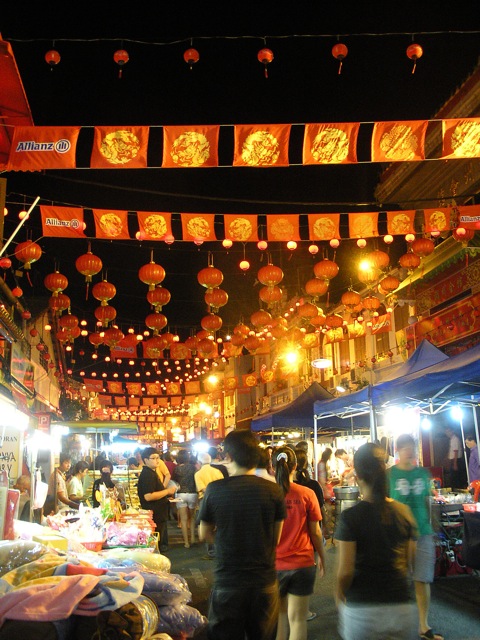
Jonker Walk Night Market
Take for instance Jonker Walk. The main drag in Chinatown, by day it is a narrow street with sidewalks packed full of sweaty tourists poking their heads into every souvenir and “antique” shop. On Friday and Saturday nights, it becomes a night market, with the same shopkeepers you’ve seen all day in the surrounding blocks setting up tables to sell their goods in the street, and with a big karaoke stage at one end. That’s right: karaoke in the street. And I don’t mean the “tentative, takes a few drinks to get going” kind of karaoke, we’re talking about the “singing your heart out with a random back up dancer” type. Now, I don’t have a photo of that performance, because I was too busy picking my jaw up off the ground, but below is a guy rocking a Chinese ballad. Try to look past the Mister Potato sign in the background.
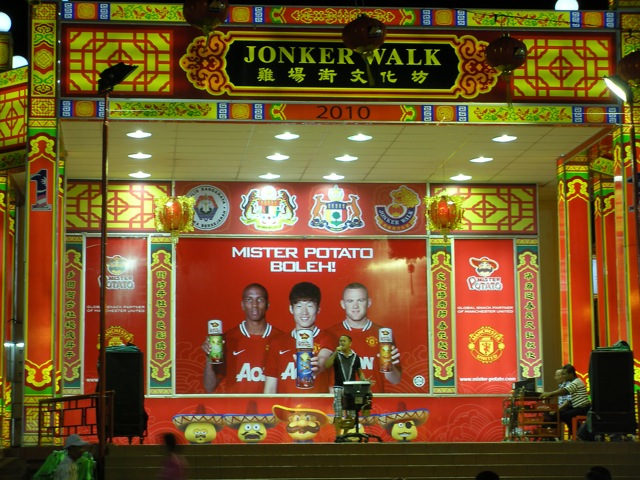
Karaoke at Jonker Walk Night Market
As you may have guessed from the first photo, trishaw rides are de rigueur here and they deck them out in spectacular ways. Fake flowers, ribbons, umbrellas, superhero logos, glittery tinsel, and a powerful sound system are all necessary. It’s difficult not to have a good time when your world view is edged with something sparkly, and the personal soundtrack that followed me around town wasn’t just in my head for once. The prices are fixed, so no haggling here, just sit back and relax while the driver takes you on a tour of the major sights in town. I loved every minute of it!
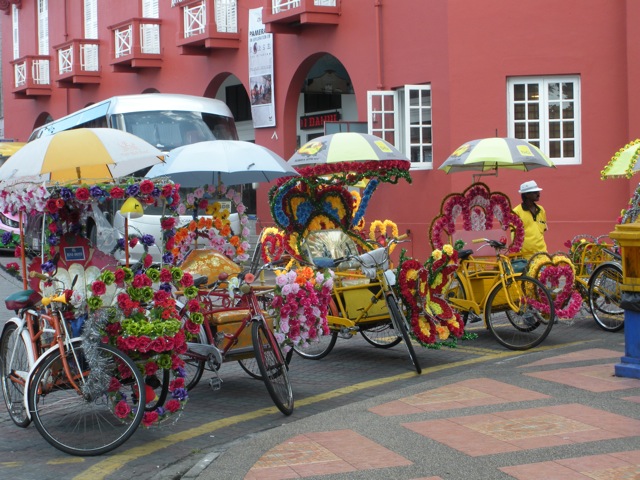
Trishaws galore!
I’m a fan of antique shops and Melaka is known for having lots of those, and also for not everything in the shops being true antiques. As long as you go into it knowing that you’re probably not making the find of a century, you’ll be fine. It was fun to wander through them, but unfortunately we found the best one only shortly before we had to head back to KL. Maybe that was actually a good thing, because it was more of an architectural salvage shop (think huge carved arches from Chinese shophouses, leaded windows, etc), and I don’t think we could have carried anything home with us! Of course, they can ship anywhere…something I’ll be keeping in mind for my next visit. We did get a carved dragon mask from Melaqa House, and his bug-eyed stare is something I’ll enjoy looking at and remembering Melaka for years to come.
My favorite souvenir that we’ve bought thus far in SE Asia is also from Melaka. Across the street from the guesthouse we were staying in, I had noticed a sign for an art gallery and a smaller sign that said: 15 Minute Seal Engraving. In my previous life with the bank, I’d become familiar with the necessity of having a seal or “chop” in doing business in China (often required for signing official documents), and here was a shop making them? Definitely worth checking out! The artwork in the gallery was beautiful, and after we’d looked around a young guy popped his head out of the glassed-in central office and asked if we’d be interested in looking at the seals that they carve.
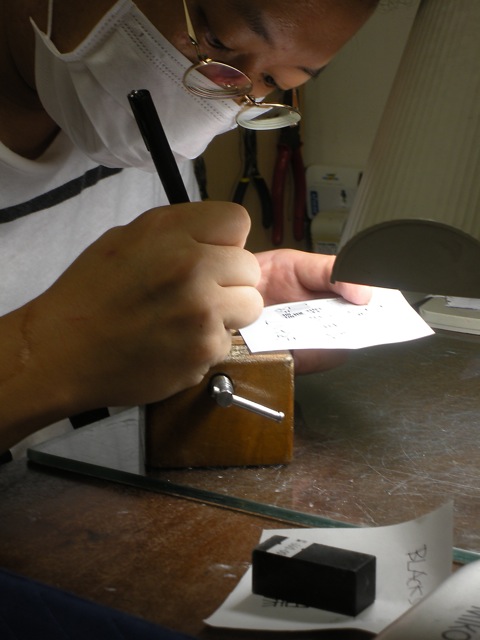
Carving Grant's seal
King’s Seal Engraving is a two man operation (brothers, and their father is the artist-owner of the gallery), and they took their time chatting with us about what they do, and showing us lots of examples of their work. They are artists in their own right, and an do anything from carving your name, your signature, an image or a portrait onto a block of stone – and there’s a lot of customization possible. With your name, they usually (for non-Chinese names) will figure out the phonetic equivalent in Chinese, and create your seal with those characters.
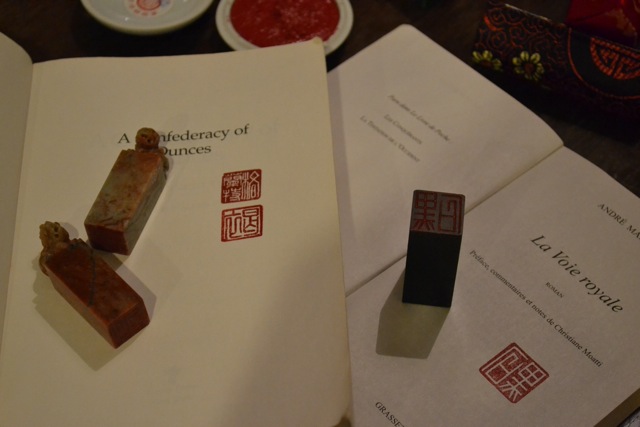
As you may know, I think I have a super cool last name, and I proposed doing a literal translation instead. They liked that idea and drew out the characters for black and stone, and I started looking through the dozens of pieces of stone that they had to pick the perfect one…a black stone. Yes, I’m rather pleased with myself, thank you. Grant decided to have his last name literally translated too, and had his first name phonetically done. He chose complementary stones with small lions carved out of the tops that face each other: one a reddish-brown with tan streaks for Brown and the other mostly tan with reddish-brown streaks for Grant. He also had them carved in opposing manners: for Grant, the characters are carved into the stone (resulting in a red stamp with white characters), but for Brown, the stone around the characters was carved away so the characters stand in relief as red stamped against a white background.
Of course, they also sell the paste needed to stamp these, and they were explaining the different types (darker/lighter, longer lasting). They made the comment that the longer lasting one is also known as the pretty one, since it has the Chinese word for beautiful in its name. After only a week of Mandarin lessons, I casually threw out, “Oh, mei? Like Meiguo?” and managed to impress them with my Chinese! Meiguo is Chinese for America and literally means beautiful country. After one week of Mandarin, I was pretty confident with a couple of sentences: Ni hao, wo shi Chris. Wo shi mei guo ren. (Hi, I’m Chris. I’m american.) It’s all about practical application!
In any case, we now have our own seals, and you might be wondering what on earth we’re going to do with them, since I can’t imagine walking into a bank back home and stamping paperwork. Well, we do have a few books (ok, maybe 25 boxes of books in storage in Massachusetts), and they suggested using the stamps in lieu of a bookplate. Brilliant! We’ve stamped the books we have here in Malaysia, and that’ll be a project to look forward to when we’re eventually unpacking back home.
Ta-da!
Pearl of the Orient
We spent most of January in KL, partially because my Mandarin lessons were supposed to begin in mid-January, but also to avoid traveling during Chinese New Year when lots of locals take to the roads. Don’t worry, we’ve spent February making up for lost time!
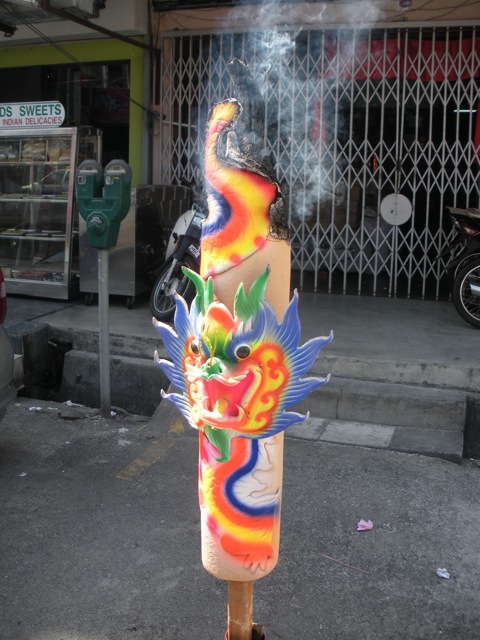
Giant dragon incense in the streets of Penang
Public holidays here have been sneaking up on us, and we learned at the beginning of February that Grant would have two days off in a row: Feb 6 to observe the Prophet Mohammed’s birthday (which fell on Feb 5, a Sunday), and Feb 7 for Thaipusam. Since our Thaipusam outing was early on Sunday morning, we decided at the last minute to take advantage of the bonus weekend and rented a car to drive up to Penang.
Penang is a small state in the northwest part of peninsular Malaysia, made up of a small strip of land on the peninsula itself, and the island of Penang in the Straits of Malacca. It’s a four hour drive north of KL, and can be reached either by bus/train to a ferry or by driving and crossing a 13.5 km bridge – one of the longest bridges in Asia. We wanted to set our own schedule, so this meant enjoying Grant’s first experience driving in Malaysia.
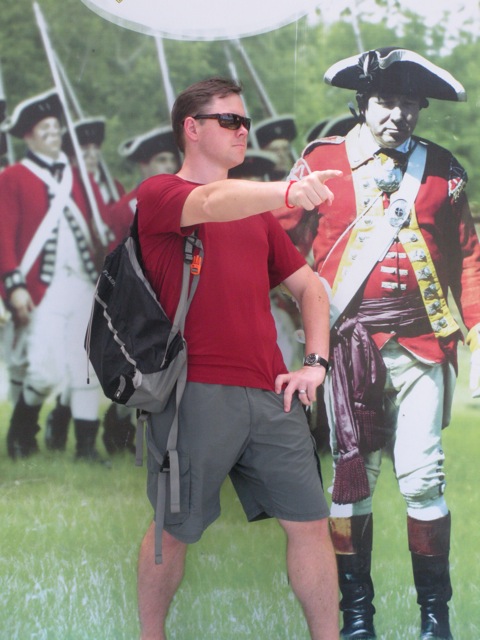
Yes, he drove with this much confidence.
He did an excellent job, especially taking into consideration the fact that we picked the rental car up in downtown KL and spent the first twenty minutes circling in dense traffic while I tried to set up the GPS to get us out of town. Luckily, driving on the wrong side of the road is pretty easy to get used to when there are lots of other cars surrounding you or you’re on a highway!
It was really nice to get out of KL and see more of Malaysia – the only stretch we’d seen before this was the road to/from the airport which is surrounded by palm plantations. Turns out, a lot of Malaysia is covered in palm plantations, but about two hours north near Ipoh we found ourselves driving through a gorgeous valley. Misty limestone hills blanketed with emerald jungles rose up and reminded us that this sure wasn’t Massachusetts!
Four short hours later, I’d reread the guidebook to Penang, and we were ready to explore. Penang is called the “Pearl of the Orient,” and is widely acknowledged as having some of the best food in Southeast Asia. The main town in Penang is Georgetown, which was added to the list of UNESCO World Heritage Sites in 2008. As you can imagine, the main draw here is the heritage zone, and the shophouses that line the streets there.
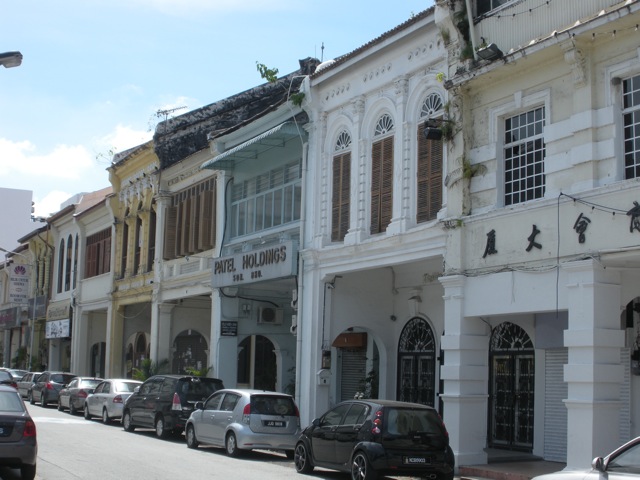
Shophouses in Penang
There are a fair number of “heritage” hotels in some of these shophouses, but the first half dozen I called were fully booked so we opted for an easy budget option: the Tune Hotel. You may not be familiar with the name, but you’re certainly familiar with the concept – it’s owned by AirAsia, the major budget airline in this region, and the same tenets apply: you get only what you pay for. The base rate (about $30/night) gives you a comfortable bed with an adjoining private bathroom with a shower, then you pay additional fees depending on which amenities you select. We added on 24 hour air-conditioning, but skipped the towel rental fee (seriously?) and brought our own stuff. All in all, it was a decent place to stay in a good location, but I’d rather search a little more next time for some personality or charm in a historic setting.
Penang has the largest Straits Chinese population in SE Asia, and in Penang and Melaka they use the terms Peranakan Chinese or Baba-Nonya (literally, gentlemen-ladies) to talk about their culture. It’s a mix of Chinese religion and Malay language and culture, combined through assimilation and marriage. Today, you can delve into the culture mainly in restaurants and museums preserving the intricacies of the pre-war way of life, as modernization and government policies (like 1Malaysia) blur the lines and assimilate Peranakans into mainstream culture.
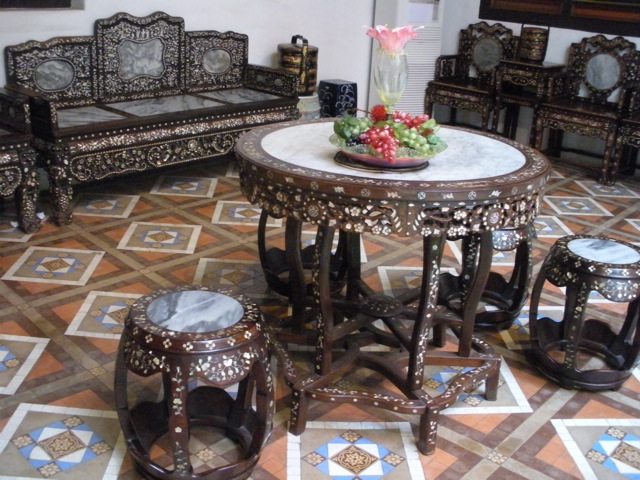
Peranakan furniture inlaid with mother of pearl designs
We began our stay in Penang with dinner at Nonya Baba Cuisine, just a few blocks away from the hotel. What a way to start! The restaurant was almost full when we arrived, but they seated us immediately and brought out the menus. The lovely owner came out to talk about the menu and the type of food we like to eat, and we put ourselves in her hands ending up with four dishes for the two of us. Everything was good, but the appetizers were fantastic – the otak-otak was heavenly, much more of a custard than we’d experienced before and bursting with flavor, and the spring roll and pork roll were yummy too.
What really made this dinner special to us was the atmosphere and interaction with the owners. They chatted with all of their patrons, and we found common interests with Tony, the owner’s husband, and we felt like old friends by the time we left. Actually, I think Grant may have found a soul mate; they talked about watches and cars the whole night! There’s great food everywhere in Penang – is this the best? No, probably not, but we enjoyed the atmosphere and the experience here very much and will definitely be back on future trips to Penang.
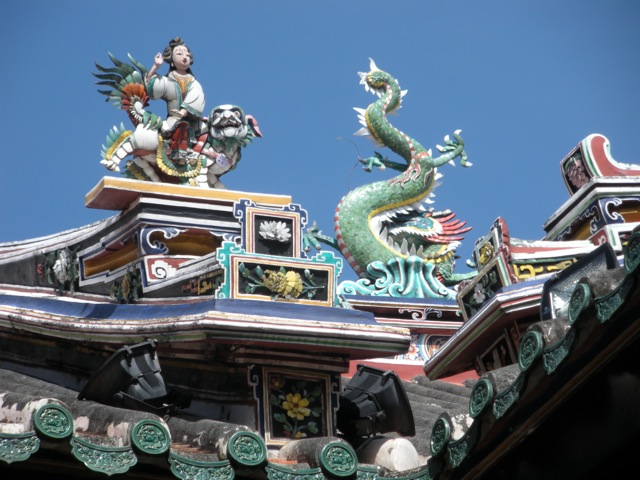
Rooftop decorations at Han Jiang Temple
The next day, we set out to walk the heritage zone, and had a long hot day filled with museums and temples. We started off in the Penang Museum, which was really well curated and a steal at RM1 (about US$0.30). Well worth it for the air conditioning alone, but also interesting as it had different galleries focused on the different ethnic groups of Penang and specific historic events (like WWII). My personal favorite was the wall of old postcards, showing how unchanged many scenes are today.
We strolled along the Esplanade, where they were setting up for fireworks to celebrate the last day of the Chinese New Year celebration – SO many fireworks over the past few weeks – and wandered into the old British Fort Cornwallis. It only took about 10 minutes to walk around the walls, and we poked our heads into the creepiest old chapel and looked at some archeological artifacts that were unearthed during restoration efforts, including… an old bicycle chain?
Little India was only a block or so away and as always, filled with color and sparkle in the form of sari and jewelry shops. We wound our way through the streets towards Chinatown, where we were blown away by the temples and clanhouses (called Kongsi).
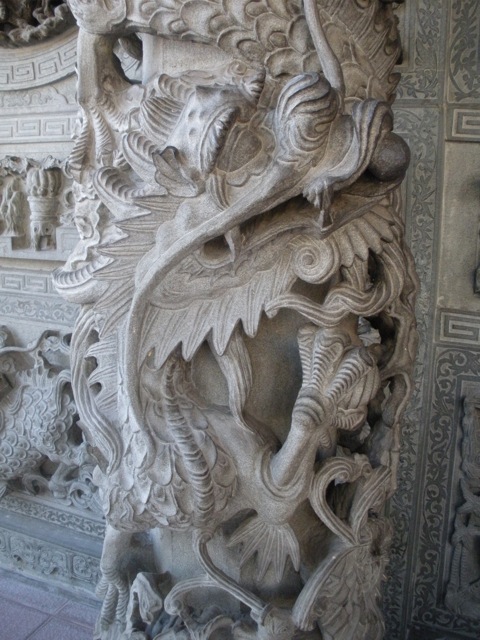
Elaborate carvings at Yap Kongsi
This is heart of the heritage zone. There are many good reasons for Georgetown to be designated as a UNESCO World Heritage Site, but in my opinion these carefully restored temples stole the show. We probably visited five or six within a few blocks radius, and each was unique in its own way: from the detailed dragons of Choo Chay Keong Temple at Yap Kongsi, to the geometric roof beams at Hang Jiang, and last but not least, the ornately decorated Khoo Kongsi.
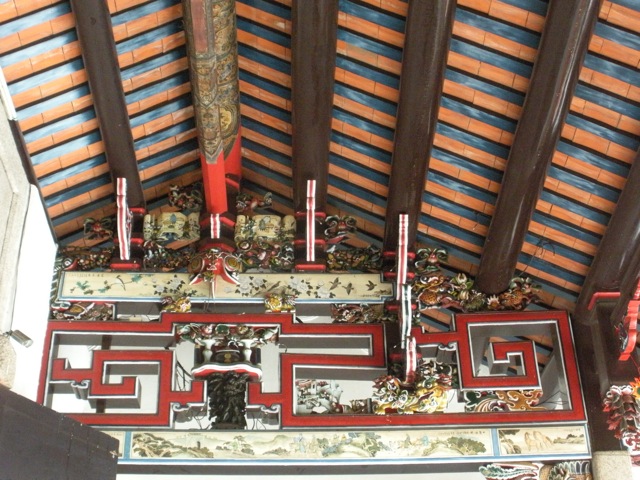
Roof beams at Hang Jiang
Tucked away down a small alley is the entrance to Khoo Kongsi. Don’t let the approach fool you, this is the most impressive clanhouse in Georgetown. The roof explodes in a riot of carvings and inside is just as richly decorated.
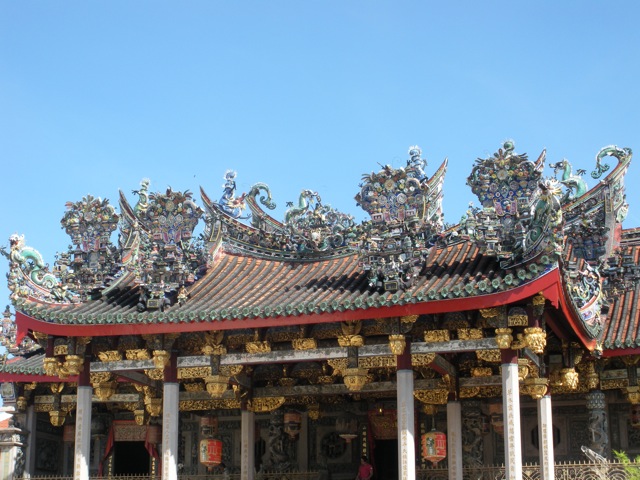
Ornate roofline of the Khoo Kongsi temple
Ancestral worship is a core tenet of Chinese religious beliefs, and inside the temples gilded ancestral tablets are arranged according to the ancestors’ positions in the clan hierarchy.
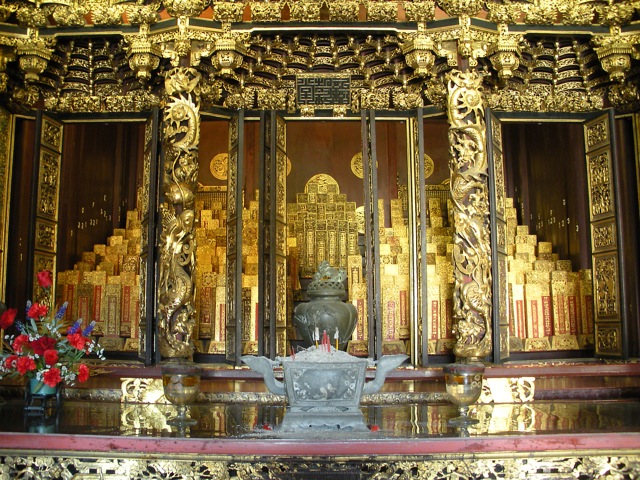
Ancestor tablets displayed for worship at Khoo Kongsi
On the advice of our new friend Tony we also visited the Pinang Peranakan Mansion, which recreates a typical home of a rich Baba from the early part of the 20th century.
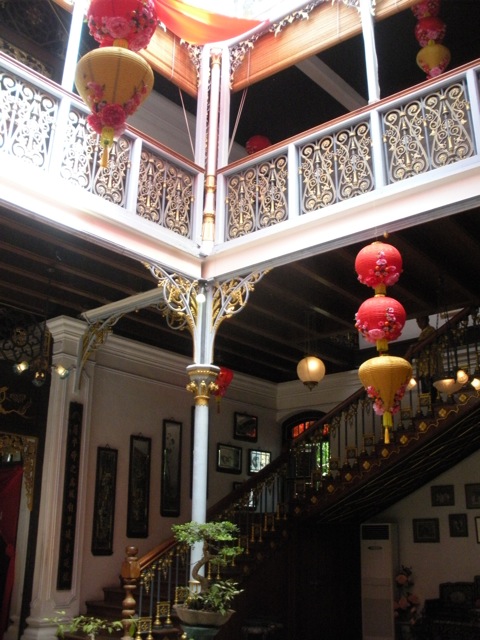
Interior courtyard at the Pinang Peranakan Mansion
The house was full of natural light thanks to the large central courtyard, and the wood carvings on the stairs and walls were gorgeous. There wasn’t a tour, so we were free to wander at will and it was so much fun to imagine life there! I would have fit right in…
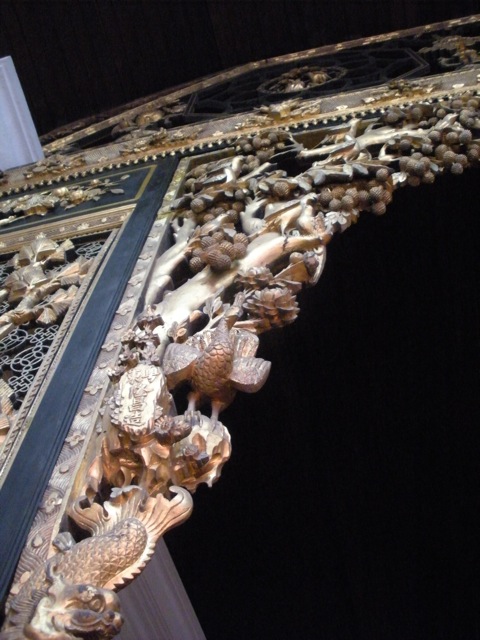
Carved wood panels separating rooms
We spent the evening at the New Lane Hawker Center, stuffing ourselves silly. We started with pork satay, which you don’t often see in KL as many restaurants here are halal, had some delicious char kway teow (a Malaysian fried noodle dish), a big bowl of assam laksa, and finished the night off with a gigantic shaved ice concoction called ABC. ABC is short for Air Batu Campur which is shaved ice topped with tapioca noodles, sweet corn, red beans, sweet syrup and condensed milk – Grant loves it, I’d leave it.
The next day, we circumnavigated the island to make good use of the rental car. The rest of the island isn’t nearly as developed, and we passed through a few small towns, but the most vivid memories are of the twisty and narrow roads on the hilly western side. Lots of sharp switchbacks, and occasionally you’d make a turn and come upon a car stopped in the road while the driver visited a fruit stand! Again, very thankful it was Grant driving and not me. We ended up taking a walk on the beach at Batu Ferringhi. It’s a narrow beach and the water was a bit cloudy, so we weren’t overly impressed. I know, I know, how can I complain about this? I guess I’ve been throughly spoiled by the gorgeous beaches of Southeast Asia!
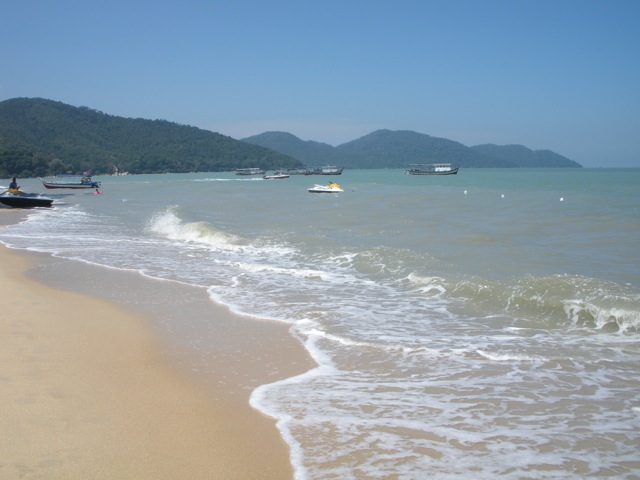
Beach at Batu Ferringhi on Penang
All in all, Penang was a great weekend trip, and I will happily go back and work on eating my way across the city. I think next time I’ll take it a little slower in Georgetown, and spend more time exploring the heritage zone. Since we were there on a long weekend, the main market and many shops were closed, and I’d like to see it at its vibrant best!
Grocery shopping
I love grocery shopping. Wherever I travel, I always end up in a grocery store whether or not I need anything; I just think it’s neat to see what is sold in different countries.
One of the biggest surprises when we got to KL was how much from home is easily found here, even my favorite brand of apple cider vinegar is here. Lots of fruits and veggies, and even some organic choices are usually available. I had been shopping mostly at the grocery stores in Suria (the nearest mall, the one under the Petronas towers). One of them is a British chain, Cold Storage, and the other is a Japanese one, Isetan, so depending on what I’m looking for I head to one or the other.
That is, until I discovered my new favorite grocery store just steps from my front door.
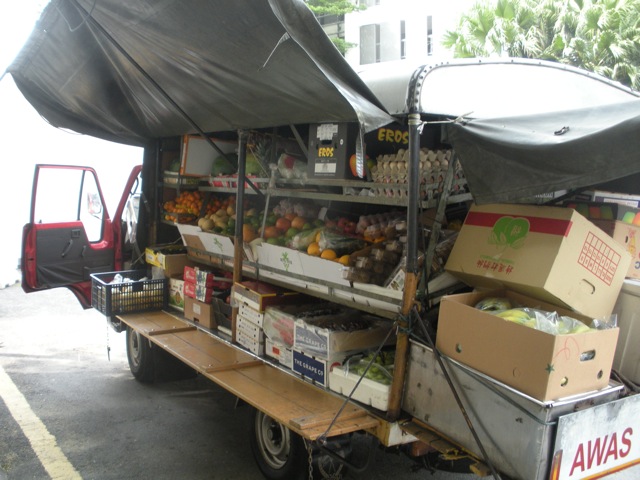
My favorite grocery store in KL
He shows up once a week, Wednesday afternoons around 2:30, and unpacks his scale onto the sidewalk to weigh your purchases. There are several condo buildings in a little cluster here, and I see the same people show up at this truck each week. His produce is fresher than the grocery stores, and it’s a much more social experience with everyone recommending what they got last week and helping each other select the perfect pineapple or whatever.
Next week he’s on vacation for Chinese New Year, and I’ll be missing him!
Recent Comments