

How to eat
How I eat is not something I typically consider; I’m usually much more focused on where, what, and when I eat.
Eating out here in KL, it is unusual to be given a knife; typically a fork and spoon fill your needs, and chopsticks are often an option as well. In food courts, hawker centers and casual restaurants you will rarely get a napkin, although usually a sink is available to wash your hands before and after eating.
I went to lunch with my Mandarin class last week, to celebrate passing level two and to welcome a new teacher to the staff. We went to Little Penang Cafe in the Suria mall, a place that is pretty reliable for decent food and is always hopping at mealtimes. There were six of us, and the ethnic mix was interesting: Chinese-Malaysian, Korean, Chinese Muslim, Laotian-Canadian, Libyan, and yours truly, the token American. Lin, our teacher who is Chinese-Malaysian, was encouraging everyone to try the different specialties, but most of the table ordered the fried rice (a halal dish). I went with a spicy noodle soup, and Lin had char kway teow, a stir fried noodle dish. Some forks and spoons were delivered to the table – at least in Malaysia, you’d normally eat fried rice with a fork and/or spoon, and eat noodle dishes with chopsticks. At one end of the table was a big canister of chopsticks, and Lin asked for a set, so I turned and asked for two: one for her and one for me. She was quite surprised that I was comfortable enough to tackle my noodle soup with chopsticks and a soup spoon, and jumped up to take a picture to document my immersion into the culture! I think for her it must have been a little like watching a monkey type.
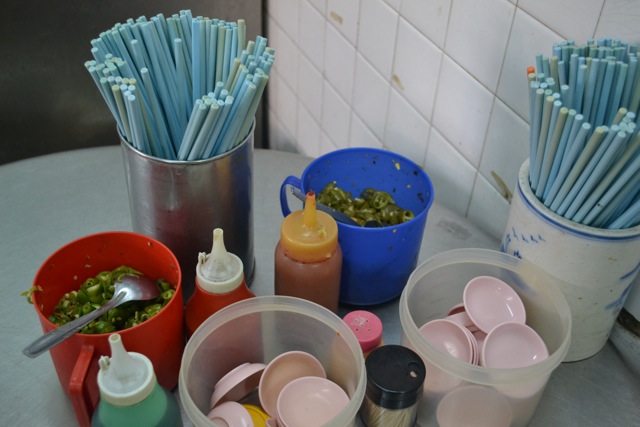
A typical table setting in KL
On the other end of the spectrum, I met Grant for lunch on Friday (no Mandarin class in observance of Good Friday, go ahead and try to figure that one out). It turned into lunch with him and two coworkers: one is a local and the other is his Indian colleague also here on contract for the project. We went to a mamak cafe looking for a good banana leaf meal. I loved this place, just a little corner space open to the air, crowded with small tables and people looking to enjoy a leisurely Friday lunch before heading back to the office to finish out the week. I never saw a printed menu, but once we had secured a table a smiling guy came over and told us the chicken briyani was very good, and we all agreed to try it. Our places were then laid with a large piece of banana leaf, and a quartet of dipping sauces were presented to the table. Individual stainless steel pots of briyani came out, filled with a chicken leg, a hard-boiled egg, and mounds of fluffy seasoned rice. We each had a small ladle to portion food out onto our leaves, and then…I realized there was no silverware. Ok, no problem. Grant’s coworkers were completely comfortable with this, and assured us that we’d figure it out and if we couldn’t get the hang of it could always ask for a fork and spoon. We’d washed our hands (handy, handy sinks!) and the short tutorial was to push the rice together into a little ball with your fingers, and then to bring it towards your mouth and sort of flick it in. My technique wasn’t quite that clean, more like smushing together a clump of rice that I balanced on my fingers and then leaning forward over the banana leaf to shove it off my fingers with my thumb into my mouth, but I was able to eat my fill and have a great time doing it. I think it counts as a success! And did I mention how handy the sinks were when I finished eating and had fingers covered in curry and saffron?
With eating methods like this, we’re entertaining everyone we dine with – talk about dinner and a show!
Thaipusam
Thaipusam is a Hindu festival, and in KL the celebration occurs mainly at the Batu Caves. We’d visited the Batu Caves before (remember Monkey Nirvana?), and I wanted to come back to see everything in full swing. I had gone to a lecture in January held by the Malaysian Culture Group, and they mentioned they were arranging a photography focused outing for Thaipusam – sounded perfect! The Malaysian Culture Group is just what it sounds like: a non-profit group made up of all sorts of people (although mostly women who don’t seem to be working) who want to learn more about local culture. They offer a monthly lecture, that oh-so-conveniently happens to be held in my apartment building, and other events and sub-groups like book clubs and eating clubs. My kind of stuff!
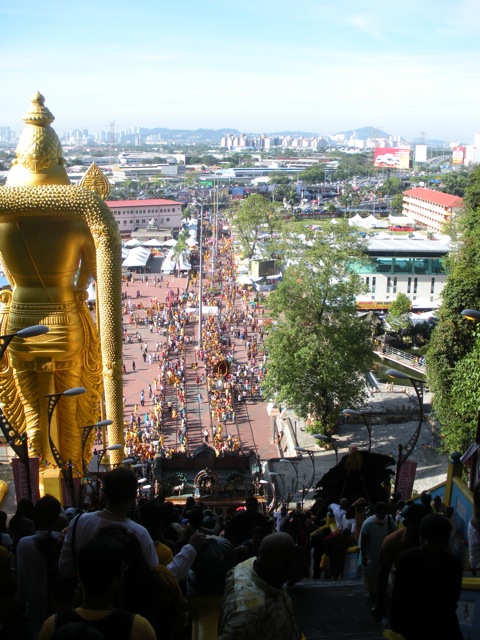
Looking down the steps at the Batu Caves
Over a million devotees attend the festival at the Batu Caves each year, and we were going along with an expert. Cheryl, our guide on this outing, is an expat photographer based here in KL and she’s been attending and photographing all sorts of festivals around Asia for years. We got together a few days before the actual event to chat about what to expect and how to shoot it, and then met at 6:15 am on Sunday morning at the site, ready for the experience.
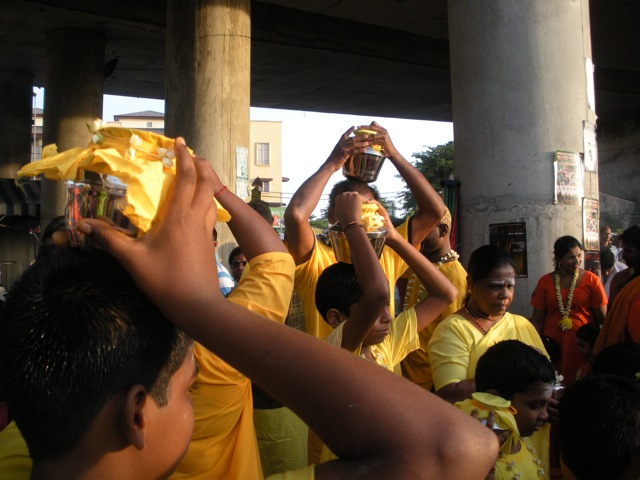
Devotees preparing for the day
The festival honors Lord Murugan and commemorates the occasion when Parvati gave Murugan a “vel” (meaning spear, pronounced veil) to vanquish a demon. This is essentially a time for his followers to say thank you for their prayers being answered in the previous year, for things like recovery from illness or a new baby. Although the focus is on individual sacrifice, it is very much a community event, including lots of children.
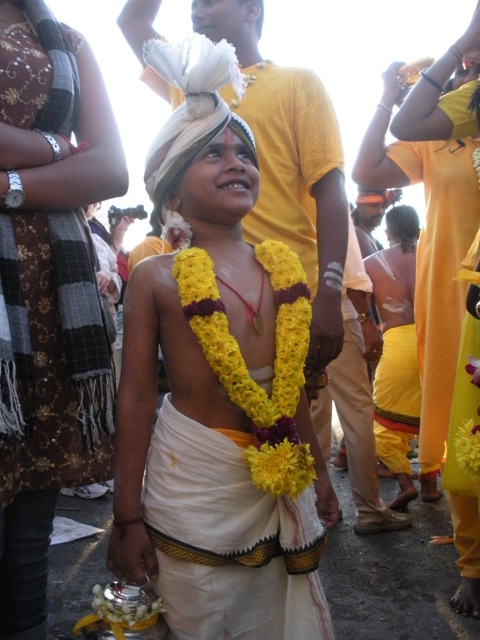
Puffed up with pride
To prepare to observe this holiday, devotees may fast for up to 48 days, sleep on mats on the floor near altars instead of in comfortable beds, and on the day they make their pilgrimage many shave their heads indicating humility before Murugan.
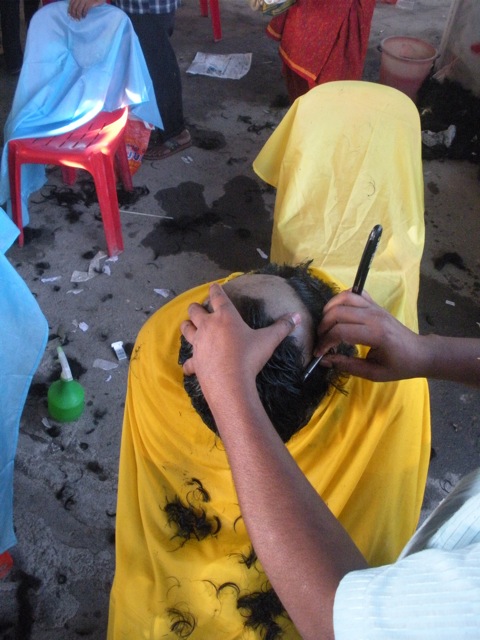
Shaving his head with a straight razor
They dress in yellow, bathe by the river and make their procession bearing a “kavadi.” Kavadi means a burden or something that you carry, and it is represented by many things ranging from a simple jug of milk to enormous 70 kg altars. Although these huge altars are eye-catching, I was most impressed by the long poles carried by a husband and wife, with their new baby suspended from the middle in a yellow sling.
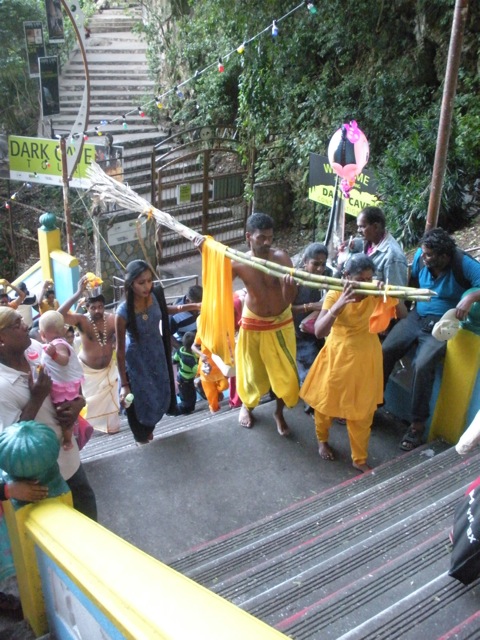
That's one carefully balanced baby!
The air is filled rhythmic drumming and the chant “vel, vel” and some devotees enter a trance state. It’s mostly young men, and once in the trance they take on the characteristics of different deities which involves shouting, dancing, rocking, and jumping around. The more intense practitioners take vows of silence with the visible reminder of a spear pierced through their tongue or through their cheeks. Several men also had their backs covered in hooks from which hung tiny jugs, bells or limes.
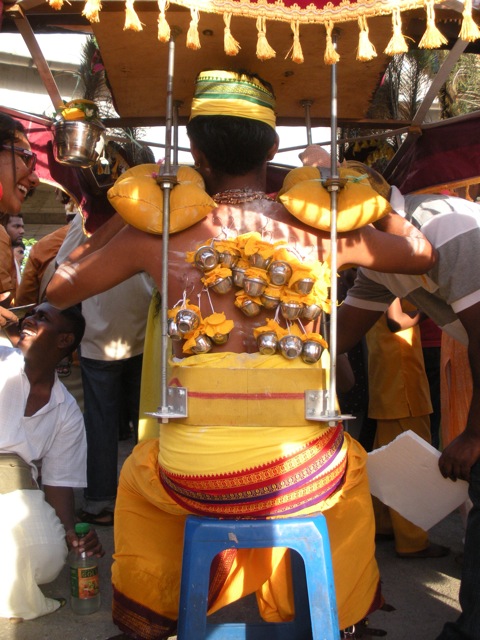
Balancing a 70 kg altar with lots of tiny jugs of milk hooked to his back, and he was still smiling!
The whole atmosphere was electric, and I was really surprised at how welcoming the community was. There we were, clearly outsiders with cameras, and they would not only allow us to take photos of them but would beckon us forward, move their friends out of the way and actively instruct their kids to pose for us. I really enjoyed the scene down by the river (and wouldn’t have known about it without Cheryl’s guidance): seeing grown men and small children having their heads shaved, watching people gathering quietly as a small group before their makeshift banana leaf altars, splashing in the cold showers as the sun was coming up, and swaying around the drum circles.
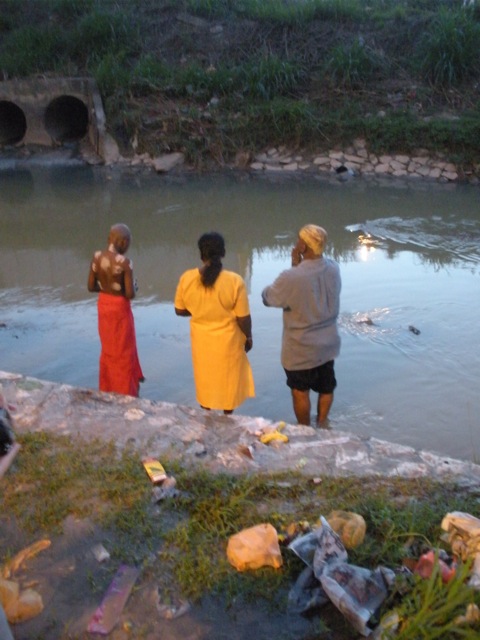
Praying and cleansing down by the river
Once prepared, people proceeded across the street from the river, and along the walkway to the foot of the stairs up to the caves themselves. Some walked, some staggered, some danced, and believe it or not, some rolled. They all were completely absorbed in the task at hand and made their way at their own pace up the steep steps to queue in the cave and await their turn to present their kavadi to Murugan. The greater their pain, the greater their glory.
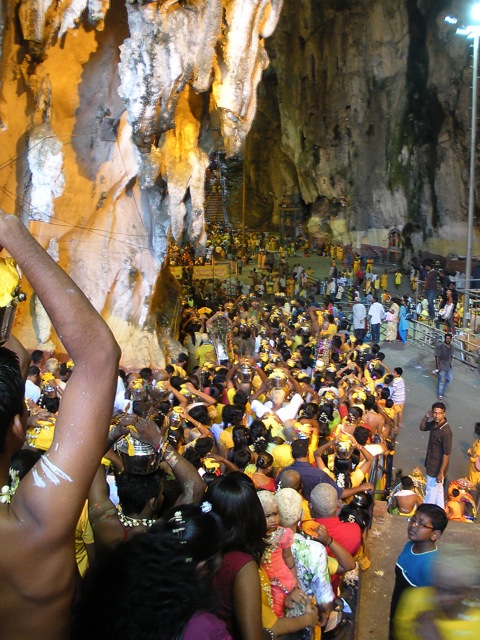
Inside the cave, waiting to present their offerings
The photography focus of this outing was interesting, and Cheryl gave great advice on how to capture the chaos. Everyone else had nice DSLR cameras, and I’m thinking about upgrading. Grant used our basic Nikon Coolpix S550, and I was using my ten year old Nikon Coolpix 4500. I can take the 4500 out of automatic mode, so I played around a bit with the settings on it, but you won’t see any of my photos posted here. Out of all the cables and whatnot I’ve brought, I managed to omit anything related to this camera except for the battery charger! It really is an “ancient” camera, and I can’t plug the compact flash card into anything here, since everything is built for SD cards these days. Luckily, Mom has the same camera, so I’ll remedy the situation in March when we’re back in the US, and we’ll see if the pictures are actually in focus. Anyway, Grant took these great photos, so we hope you enjoy!
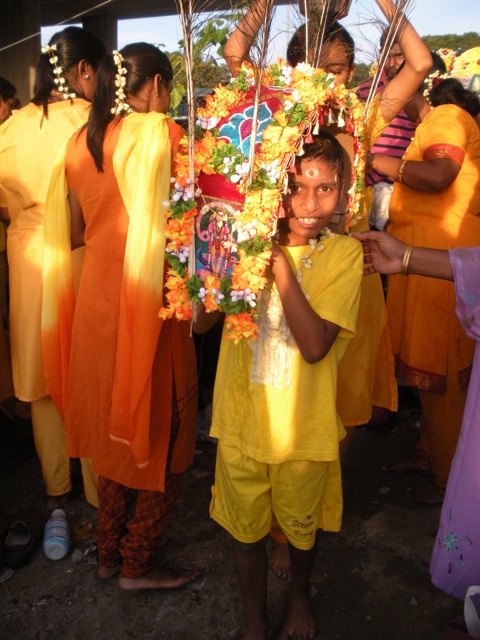
Oh happy day!
Gong Xi Fa Cai!
So I don’t speak Mandarin…yet, but I believe that means “Wishing you will be prosperous” in the New Year. Chinese New Year is January 23rd, and we’re welcoming the year of the dragon.
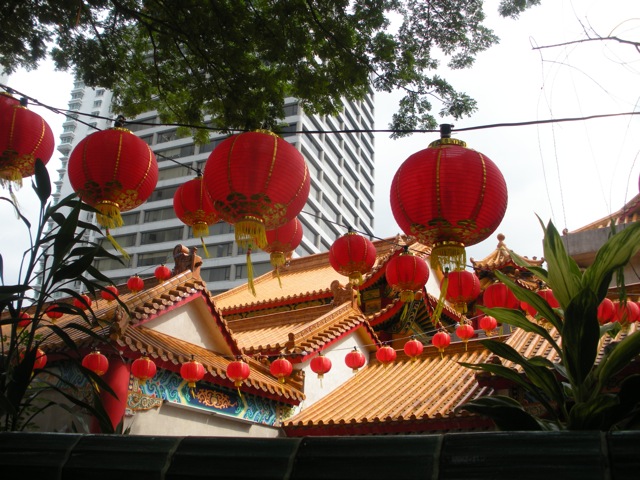
Lanterns at Temple Kun Yam Thong, down the street from our apartment
The only time the Chinese zodiac had crossed my mind was in Chinese restaurants when the placemat would help you figure out what your sign was (1980, year of the monkey). It’s impossible to miss it here! I’d thought they went all out for Christmas, but apparently that was just a warm up.
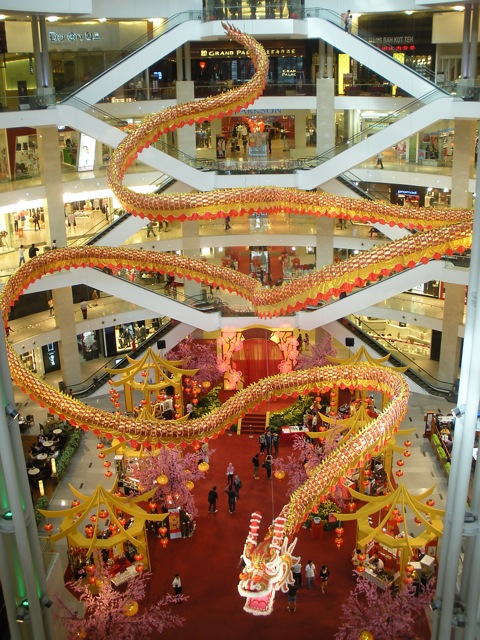
Huge 600 foot long dragon at Pavilion
Both religious and commericial temples are bedecked with red lanterns, and giant dragons swirl in the middle of the malls. We asked if there would be any big celebrations for the holiday, but most people (even Malay and Indian ones) go home to visit family. Since there are so many people traveling, we’re planning to stick around here. There are dragon and lion dances in Chinatown and in some of the malls, and apparently the God of Prosperity will be wandering around so we’re off to look for him.
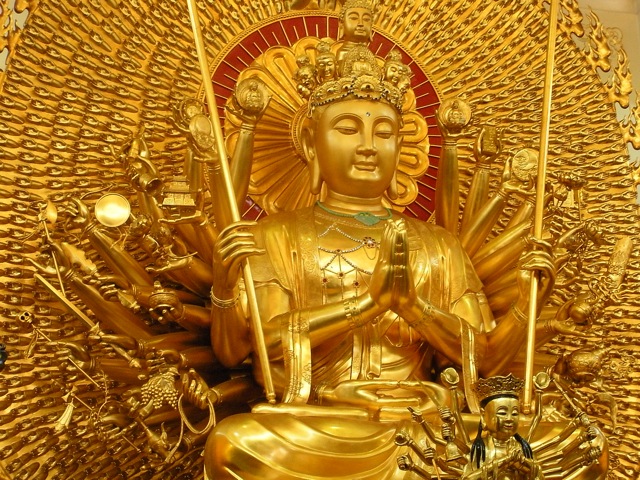
Thousand Hand Buddha at Temple Kun Yam Thong
Special menus are on offer at many restaurants, and there are some unique traditions found in Malaysia and Singapore like “yee sang”. It’s often described as a raw fish salad, but I think that’s oversimplifying it. It’s presented as several small heaps of shredded vegetables on a platter with a small dish of (usually) salmon sashimi on the side and several dishes of toppings: oil, plum sauce, crackers, and whatever else has inspired the chef. Once it is served, the waiter (or someone at the table) adds the ingredients on the side to the main platter, and then everyone joins in to toss the ingredients together while saying auspicious things in Chinese. The higher you toss, the higher your fortunes will grow in the new year, so you’re really supposed to go for it. Grant got to partake in this during a holiday lunch for the team he’s working with, and now I’m jealous so we’ll be seeking this out this weekend.
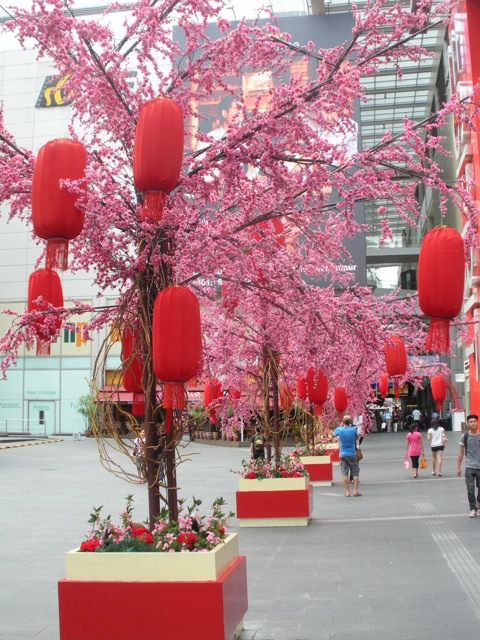
(Fake) cherry blossom trees and lanterns
Actually, he may be a little jealous of me and my new endeavor. I’ve signed up for Mandarin lessons, and will be taking an intensive course starting on February 6th. It meets every weekday from 9 – 1 for a month, so I might be spending more time hearing and speaking (or trying to speak) Mandarin than English. Wish me luck – I’m really excited…and a little bit nervous!
United Buddy Bears in KL
Shortly before Christmas we were walking past Pavilion, one of the upscale malls here, and were surprised to find lots of bears.
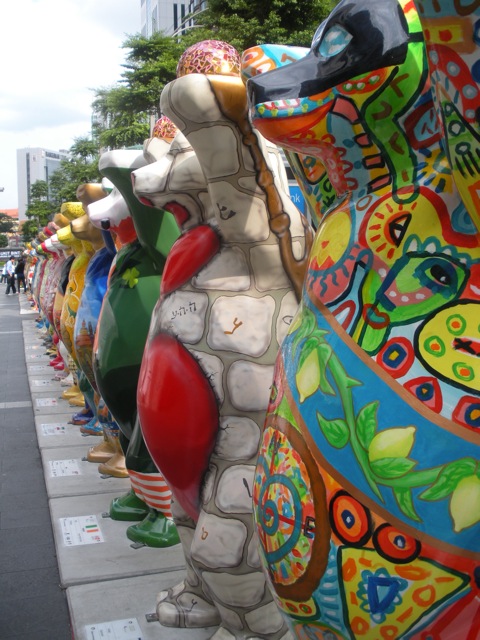
United Buddy Bears
These are particularly well traveled bears; they’ve been on the road since 2002 covering five continents, and Malaysia is the 23rd stop on their world tour.
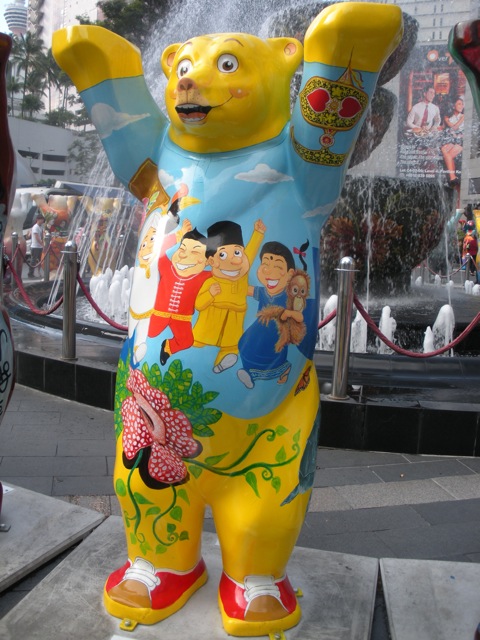
Malaysia's Buddy Bear
There are about 140 bears, one for each country recognized by the United Nations. Each is two meters tall (yes, I’m working on getting used to the metric system again), and they stand in a circle with their arms upraised, “hand in hand” to promote tolerance and living in peace and harmony. These begin with identical fiberglass casts, and each country has chosen artists to decorate the bear in a manner to represent that country. The US went with a pretty iconic choice:
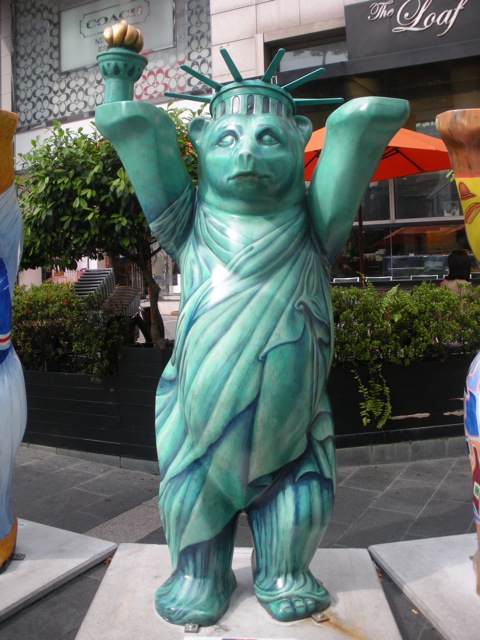
Lady Liberty
But my favorites are usually the lesser known countries, like Moldova.
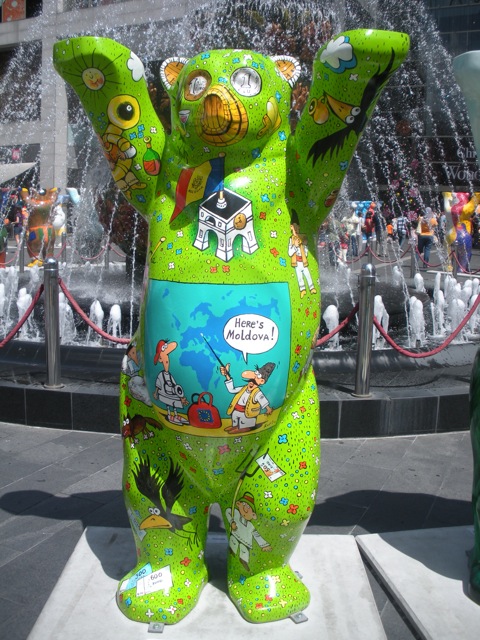
The helpful Moldovan Buddy Bear
They are visiting here until February 15th, and it’s quite a sight to see!
Grocery shopping
I love grocery shopping. Wherever I travel, I always end up in a grocery store whether or not I need anything; I just think it’s neat to see what is sold in different countries.
One of the biggest surprises when we got to KL was how much from home is easily found here, even my favorite brand of apple cider vinegar is here. Lots of fruits and veggies, and even some organic choices are usually available. I had been shopping mostly at the grocery stores in Suria (the nearest mall, the one under the Petronas towers). One of them is a British chain, Cold Storage, and the other is a Japanese one, Isetan, so depending on what I’m looking for I head to one or the other.
That is, until I discovered my new favorite grocery store just steps from my front door.
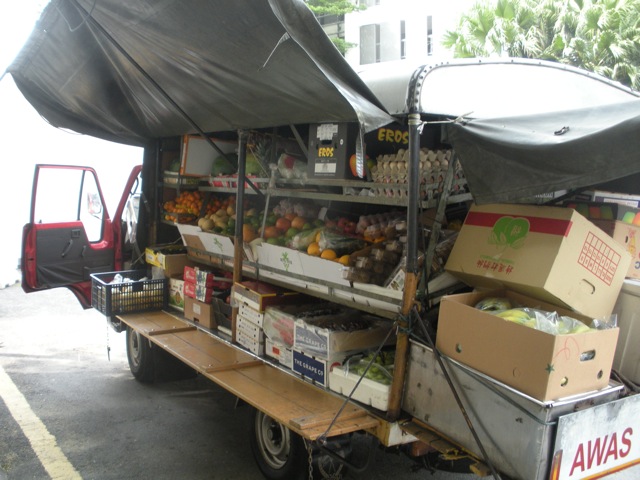
My favorite grocery store in KL
He shows up once a week, Wednesday afternoons around 2:30, and unpacks his scale onto the sidewalk to weigh your purchases. There are several condo buildings in a little cluster here, and I see the same people show up at this truck each week. His produce is fresher than the grocery stores, and it’s a much more social experience with everyone recommending what they got last week and helping each other select the perfect pineapple or whatever.
Next week he’s on vacation for Chinese New Year, and I’ll be missing him!
Recent Comments