
Potato, Potahto
Melaka, Malacca, Melaqa…it seems you can spell it anyway you like! Melaka seems to be the most commonly found version here in Malaysia, so that’s what I’m going with. As with Georgetown in Penang, in 2008 Melaka was listed as a UNESCO World Heritage Site. Since it is only a two hour bus ride away from KL, it is a very popular weekend destination and has the reputation for being pretty touristy.
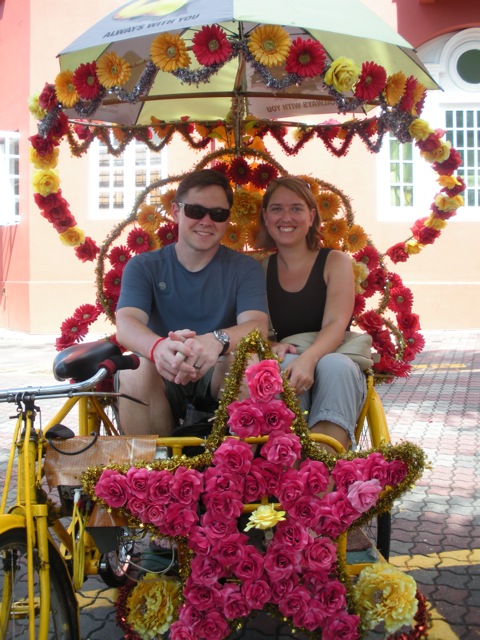
We may look like tourists, but who cares?We're having a great time!
Now I liked Georgetown a lot, but I loved Melaka. Loved it in that slightly giddy way that you love a guilty pleasure, because that’s exactly what it is. Melaka has a ton of history (ruled at one point or another by the Portuguese, Dutch, and British; major shipping port, rich Peranakan culture), and we did the typical tourist circuit of the sights to see, but what I loved about Melaka was the lack of pretension and the mellow vibe. It’s not apologetic about being a tourist draw, and it is hard not to have a good time here.
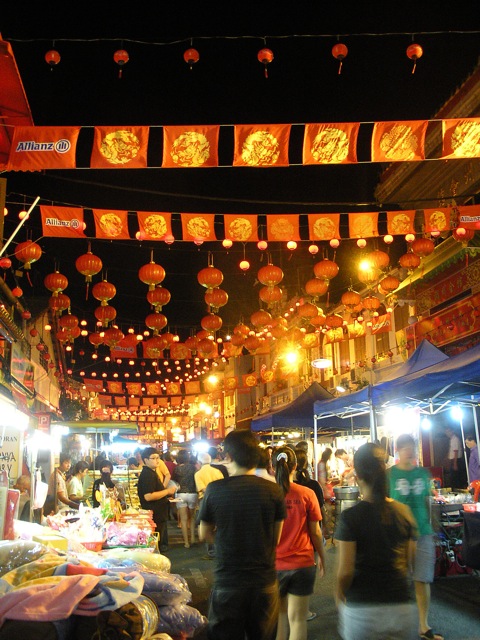
Jonker Walk Night Market
Take for instance Jonker Walk. The main drag in Chinatown, by day it is a narrow street with sidewalks packed full of sweaty tourists poking their heads into every souvenir and “antique” shop. On Friday and Saturday nights, it becomes a night market, with the same shopkeepers you’ve seen all day in the surrounding blocks setting up tables to sell their goods in the street, and with a big karaoke stage at one end. That’s right: karaoke in the street. And I don’t mean the “tentative, takes a few drinks to get going” kind of karaoke, we’re talking about the “singing your heart out with a random back up dancer” type. Now, I don’t have a photo of that performance, because I was too busy picking my jaw up off the ground, but below is a guy rocking a Chinese ballad. Try to look past the Mister Potato sign in the background.
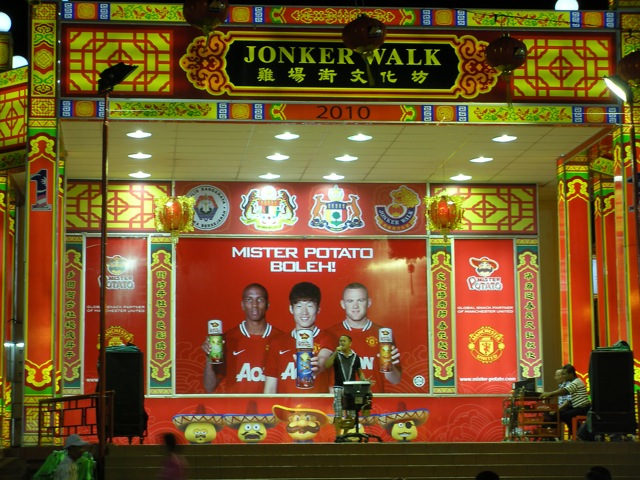
Karaoke at Jonker Walk Night Market
As you may have guessed from the first photo, trishaw rides are de rigueur here and they deck them out in spectacular ways. Fake flowers, ribbons, umbrellas, superhero logos, glittery tinsel, and a powerful sound system are all necessary. It’s difficult not to have a good time when your world view is edged with something sparkly, and the personal soundtrack that followed me around town wasn’t just in my head for once. The prices are fixed, so no haggling here, just sit back and relax while the driver takes you on a tour of the major sights in town. I loved every minute of it!
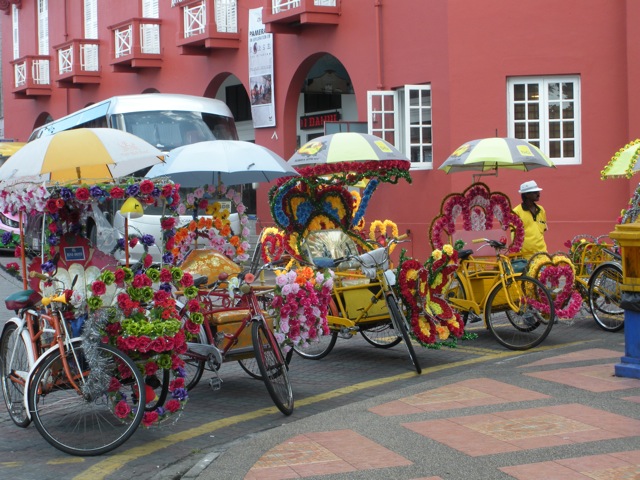
Trishaws galore!
I’m a fan of antique shops and Melaka is known for having lots of those, and also for not everything in the shops being true antiques. As long as you go into it knowing that you’re probably not making the find of a century, you’ll be fine. It was fun to wander through them, but unfortunately we found the best one only shortly before we had to head back to KL. Maybe that was actually a good thing, because it was more of an architectural salvage shop (think huge carved arches from Chinese shophouses, leaded windows, etc), and I don’t think we could have carried anything home with us! Of course, they can ship anywhere…something I’ll be keeping in mind for my next visit. We did get a carved dragon mask from Melaqa House, and his bug-eyed stare is something I’ll enjoy looking at and remembering Melaka for years to come.
My favorite souvenir that we’ve bought thus far in SE Asia is also from Melaka. Across the street from the guesthouse we were staying in, I had noticed a sign for an art gallery and a smaller sign that said: 15 Minute Seal Engraving. In my previous life with the bank, I’d become familiar with the necessity of having a seal or “chop” in doing business in China (often required for signing official documents), and here was a shop making them? Definitely worth checking out! The artwork in the gallery was beautiful, and after we’d looked around a young guy popped his head out of the glassed-in central office and asked if we’d be interested in looking at the seals that they carve.
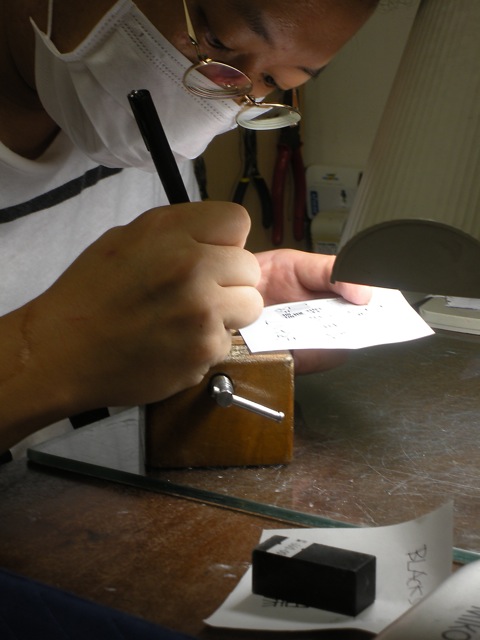
Carving Grant's seal
King’s Seal Engraving is a two man operation (brothers, and their father is the artist-owner of the gallery), and they took their time chatting with us about what they do, and showing us lots of examples of their work. They are artists in their own right, and an do anything from carving your name, your signature, an image or a portrait onto a block of stone – and there’s a lot of customization possible. With your name, they usually (for non-Chinese names) will figure out the phonetic equivalent in Chinese, and create your seal with those characters.
As you may know, I think I have a super cool last name, and I proposed doing a literal translation instead. They liked that idea and drew out the characters for black and stone, and I started looking through the dozens of pieces of stone that they had to pick the perfect one…a black stone. Yes, I’m rather pleased with myself, thank you. Grant decided to have his last name literally translated too, and had his first name phonetically done. He chose complementary stones with small lions carved out of the tops that face each other: one a reddish-brown with tan streaks for Brown and the other mostly tan with reddish-brown streaks for Grant. He also had them carved in opposing manners: for Grant, the characters are carved into the stone (resulting in a red stamp with white characters), but for Brown, the stone around the characters was carved away so the characters stand in relief as red stamped against a white background.
Of course, they also sell the paste needed to stamp these, and they were explaining the different types (darker/lighter, longer lasting). They made the comment that the longer lasting one is also known as the pretty one, since it has the Chinese word for beautiful in its name. After only a week of Mandarin lessons, I casually threw out, “Oh, mei? Like Meiguo?” and managed to impress them with my Chinese! Meiguo is Chinese for America and literally means beautiful country. After one week of Mandarin, I was pretty confident with a couple of sentences: Ni hao, wo shi Chris. Wo shi mei guo ren. (Hi, I’m Chris. I’m american.) It’s all about practical application!
In any case, we now have our own seals, and you might be wondering what on earth we’re going to do with them, since I can’t imagine walking into a bank back home and stamping paperwork. Well, we do have a few books (ok, maybe 25 boxes of books in storage in Massachusetts), and they suggested using the stamps in lieu of a bookplate. Brilliant! We’ve stamped the books we have here in Malaysia, and that’ll be a project to look forward to when we’re eventually unpacking back home.
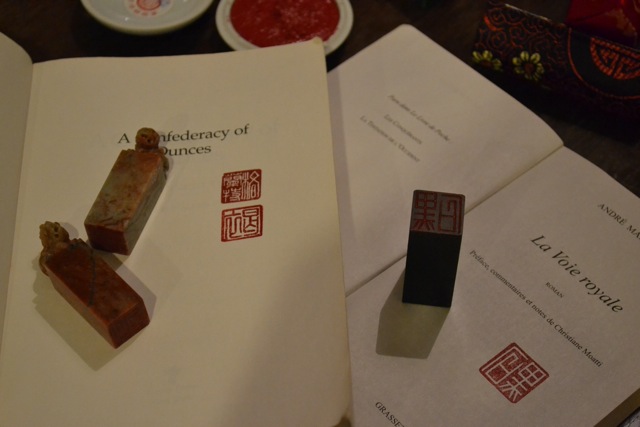
Ta-da!
Recent Comments