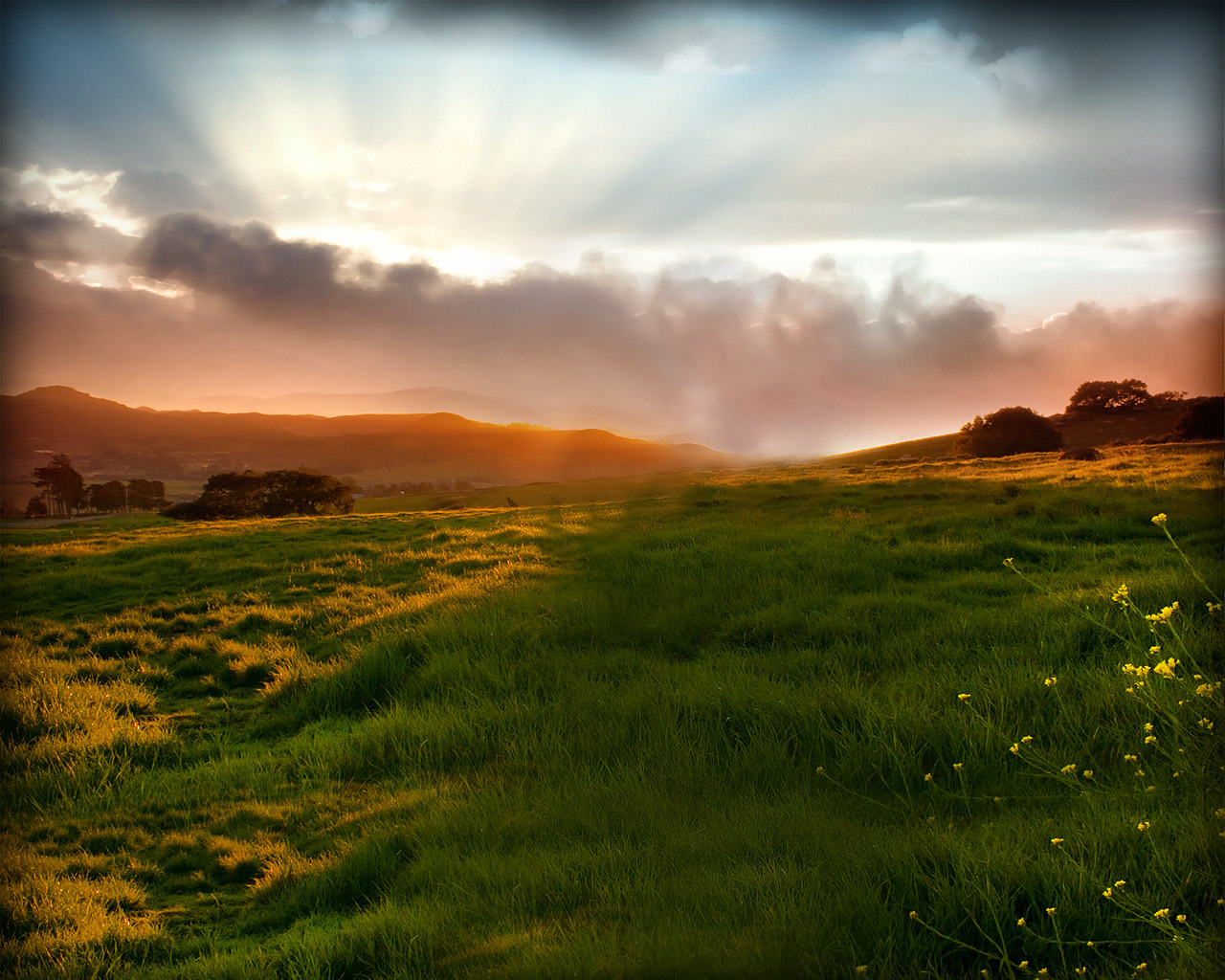

Pearl of the Orient
We spent most of January in KL, partially because my Mandarin lessons were supposed to begin in mid-January, but also to avoid traveling during Chinese New Year when lots of locals take to the roads. Don’t worry, we’ve spent February making up for lost time!
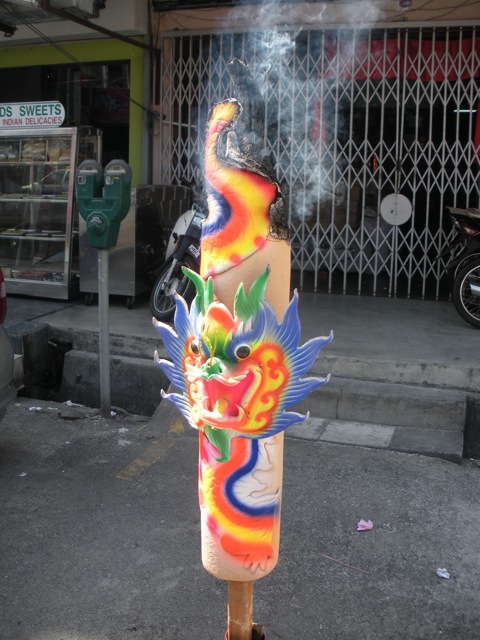
Giant dragon incense in the streets of Penang
Public holidays here have been sneaking up on us, and we learned at the beginning of February that Grant would have two days off in a row: Feb 6 to observe the Prophet Mohammed’s birthday (which fell on Feb 5, a Sunday), and Feb 7 for Thaipusam. Since our Thaipusam outing was early on Sunday morning, we decided at the last minute to take advantage of the bonus weekend and rented a car to drive up to Penang.
Penang is a small state in the northwest part of peninsular Malaysia, made up of a small strip of land on the peninsula itself, and the island of Penang in the Straits of Malacca. It’s a four hour drive north of KL, and can be reached either by bus/train to a ferry or by driving and crossing a 13.5 km bridge – one of the longest bridges in Asia. We wanted to set our own schedule, so this meant enjoying Grant’s first experience driving in Malaysia.
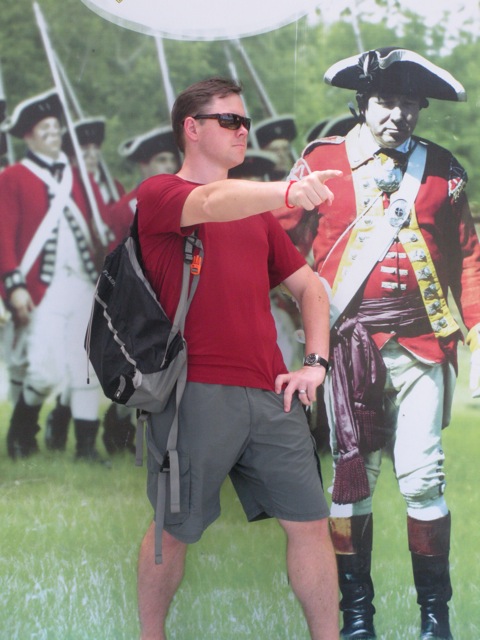
Yes, he drove with this much confidence.
He did an excellent job, especially taking into consideration the fact that we picked the rental car up in downtown KL and spent the first twenty minutes circling in dense traffic while I tried to set up the GPS to get us out of town. Luckily, driving on the wrong side of the road is pretty easy to get used to when there are lots of other cars surrounding you or you’re on a highway!
It was really nice to get out of KL and see more of Malaysia – the only stretch we’d seen before this was the road to/from the airport which is surrounded by palm plantations. Turns out, a lot of Malaysia is covered in palm plantations, but about two hours north near Ipoh we found ourselves driving through a gorgeous valley. Misty limestone hills blanketed with emerald jungles rose up and reminded us that this sure wasn’t Massachusetts!
Four short hours later, I’d reread the guidebook to Penang, and we were ready to explore. Penang is called the “Pearl of the Orient,” and is widely acknowledged as having some of the best food in Southeast Asia. The main town in Penang is Georgetown, which was added to the list of UNESCO World Heritage Sites in 2008. As you can imagine, the main draw here is the heritage zone, and the shophouses that line the streets there.
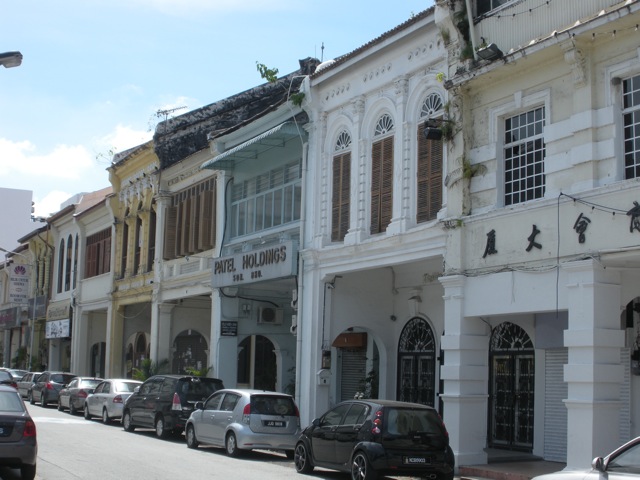
Shophouses in Penang
There are a fair number of “heritage” hotels in some of these shophouses, but the first half dozen I called were fully booked so we opted for an easy budget option: the Tune Hotel. You may not be familiar with the name, but you’re certainly familiar with the concept – it’s owned by AirAsia, the major budget airline in this region, and the same tenets apply: you get only what you pay for. The base rate (about $30/night) gives you a comfortable bed with an adjoining private bathroom with a shower, then you pay additional fees depending on which amenities you select. We added on 24 hour air-conditioning, but skipped the towel rental fee (seriously?) and brought our own stuff. All in all, it was a decent place to stay in a good location, but I’d rather search a little more next time for some personality or charm in a historic setting.
Penang has the largest Straits Chinese population in SE Asia, and in Penang and Melaka they use the terms Peranakan Chinese or Baba-Nonya (literally, gentlemen-ladies) to talk about their culture. It’s a mix of Chinese religion and Malay language and culture, combined through assimilation and marriage. Today, you can delve into the culture mainly in restaurants and museums preserving the intricacies of the pre-war way of life, as modernization and government policies (like 1Malaysia) blur the lines and assimilate Peranakans into mainstream culture.
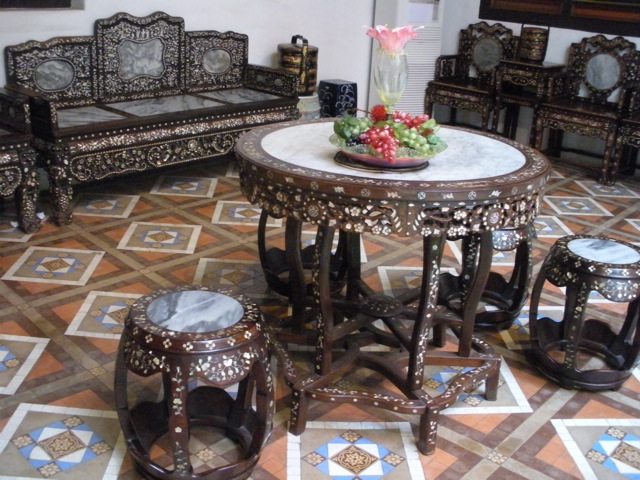
Peranakan furniture inlaid with mother of pearl designs
We began our stay in Penang with dinner at Nonya Baba Cuisine, just a few blocks away from the hotel. What a way to start! The restaurant was almost full when we arrived, but they seated us immediately and brought out the menus. The lovely owner came out to talk about the menu and the type of food we like to eat, and we put ourselves in her hands ending up with four dishes for the two of us. Everything was good, but the appetizers were fantastic – the otak-otak was heavenly, much more of a custard than we’d experienced before and bursting with flavor, and the spring roll and pork roll were yummy too.
What really made this dinner special to us was the atmosphere and interaction with the owners. They chatted with all of their patrons, and we found common interests with Tony, the owner’s husband, and we felt like old friends by the time we left. Actually, I think Grant may have found a soul mate; they talked about watches and cars the whole night! There’s great food everywhere in Penang – is this the best? No, probably not, but we enjoyed the atmosphere and the experience here very much and will definitely be back on future trips to Penang.
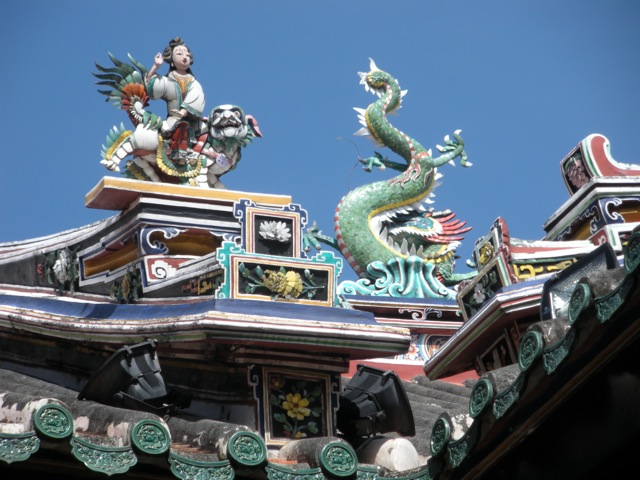
Rooftop decorations at Han Jiang Temple
The next day, we set out to walk the heritage zone, and had a long hot day filled with museums and temples. We started off in the Penang Museum, which was really well curated and a steal at RM1 (about US$0.30). Well worth it for the air conditioning alone, but also interesting as it had different galleries focused on the different ethnic groups of Penang and specific historic events (like WWII). My personal favorite was the wall of old postcards, showing how unchanged many scenes are today.
We strolled along the Esplanade, where they were setting up for fireworks to celebrate the last day of the Chinese New Year celebration – SO many fireworks over the past few weeks – and wandered into the old British Fort Cornwallis. It only took about 10 minutes to walk around the walls, and we poked our heads into the creepiest old chapel and looked at some archeological artifacts that were unearthed during restoration efforts, including… an old bicycle chain?
Little India was only a block or so away and as always, filled with color and sparkle in the form of sari and jewelry shops. We wound our way through the streets towards Chinatown, where we were blown away by the temples and clanhouses (called Kongsi).
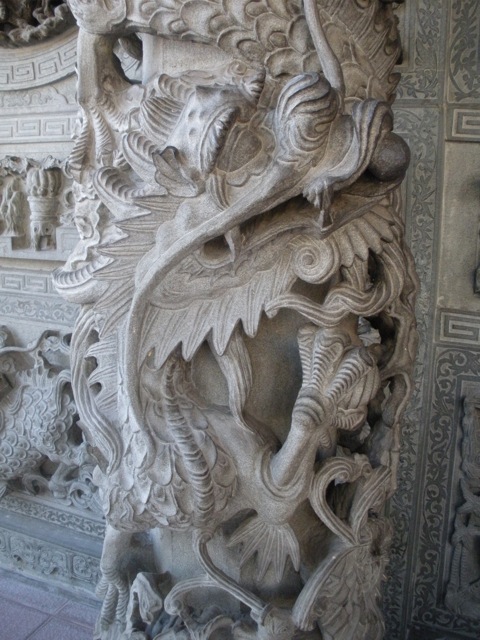
Elaborate carvings at Yap Kongsi
This is heart of the heritage zone. There are many good reasons for Georgetown to be designated as a UNESCO World Heritage Site, but in my opinion these carefully restored temples stole the show. We probably visited five or six within a few blocks radius, and each was unique in its own way: from the detailed dragons of Choo Chay Keong Temple at Yap Kongsi, to the geometric roof beams at Hang Jiang, and last but not least, the ornately decorated Khoo Kongsi.
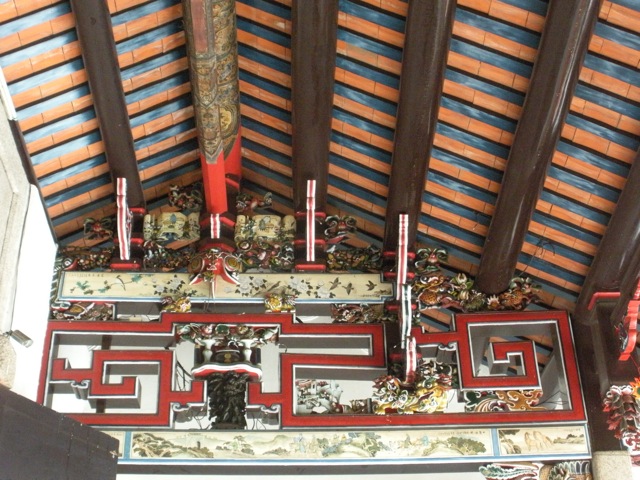
Roof beams at Hang Jiang
Tucked away down a small alley is the entrance to Khoo Kongsi. Don’t let the approach fool you, this is the most impressive clanhouse in Georgetown. The roof explodes in a riot of carvings and inside is just as richly decorated.
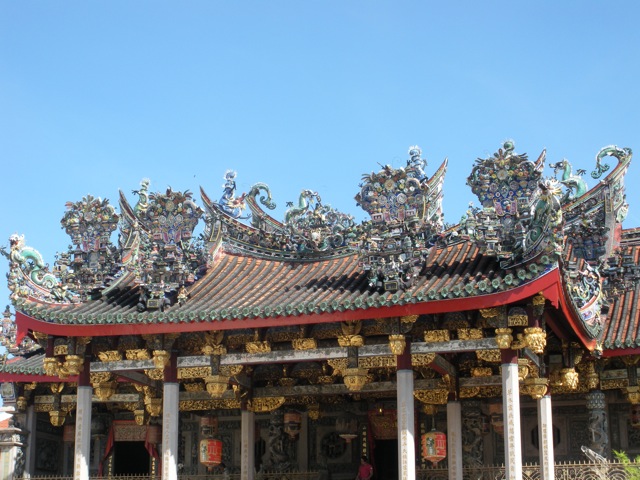
Ornate roofline of the Khoo Kongsi temple
Ancestral worship is a core tenet of Chinese religious beliefs, and inside the temples gilded ancestral tablets are arranged according to the ancestors’ positions in the clan hierarchy.
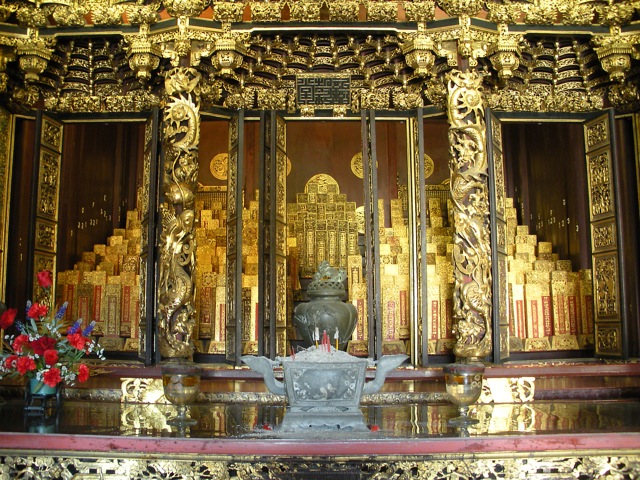
Ancestor tablets displayed for worship at Khoo Kongsi
On the advice of our new friend Tony we also visited the Pinang Peranakan Mansion, which recreates a typical home of a rich Baba from the early part of the 20th century.
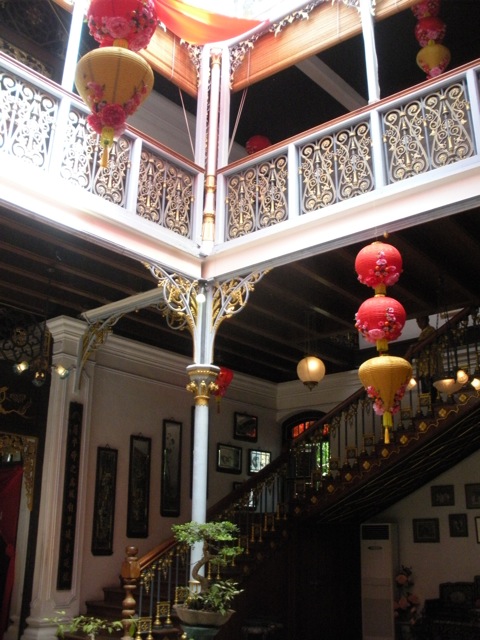
Interior courtyard at the Pinang Peranakan Mansion
The house was full of natural light thanks to the large central courtyard, and the wood carvings on the stairs and walls were gorgeous. There wasn’t a tour, so we were free to wander at will and it was so much fun to imagine life there! I would have fit right in…
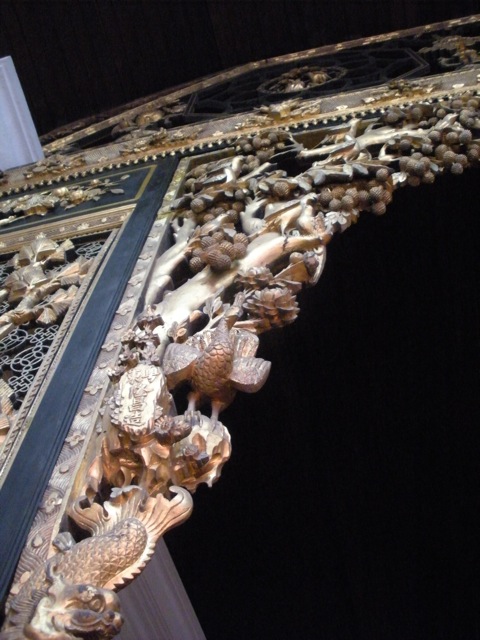
Carved wood panels separating rooms
We spent the evening at the New Lane Hawker Center, stuffing ourselves silly. We started with pork satay, which you don’t often see in KL as many restaurants here are halal, had some delicious char kway teow (a Malaysian fried noodle dish), a big bowl of assam laksa, and finished the night off with a gigantic shaved ice concoction called ABC. ABC is short for Air Batu Campur which is shaved ice topped with tapioca noodles, sweet corn, red beans, sweet syrup and condensed milk – Grant loves it, I’d leave it.
The next day, we circumnavigated the island to make good use of the rental car. The rest of the island isn’t nearly as developed, and we passed through a few small towns, but the most vivid memories are of the twisty and narrow roads on the hilly western side. Lots of sharp switchbacks, and occasionally you’d make a turn and come upon a car stopped in the road while the driver visited a fruit stand! Again, very thankful it was Grant driving and not me. We ended up taking a walk on the beach at Batu Ferringhi. It’s a narrow beach and the water was a bit cloudy, so we weren’t overly impressed. I know, I know, how can I complain about this? I guess I’ve been throughly spoiled by the gorgeous beaches of Southeast Asia!
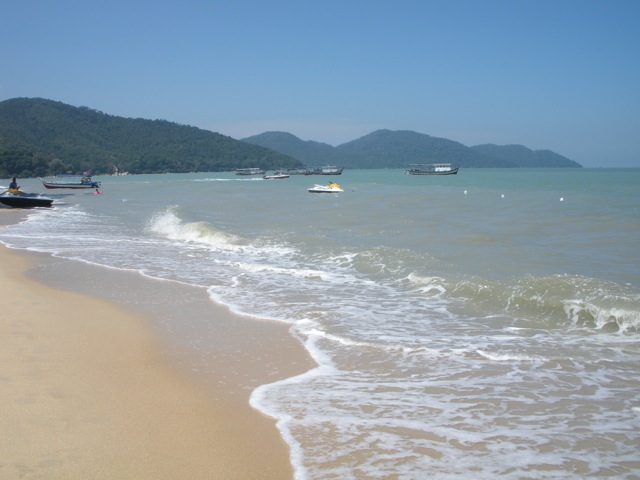
Beach at Batu Ferringhi on Penang
All in all, Penang was a great weekend trip, and I will happily go back and work on eating my way across the city. I think next time I’ll take it a little slower in Georgetown, and spend more time exploring the heritage zone. Since we were there on a long weekend, the main market and many shops were closed, and I’d like to see it at its vibrant best!
Gong Xi Fa Cai!
So I don’t speak Mandarin…yet, but I believe that means “Wishing you will be prosperous” in the New Year. Chinese New Year is January 23rd, and we’re welcoming the year of the dragon.
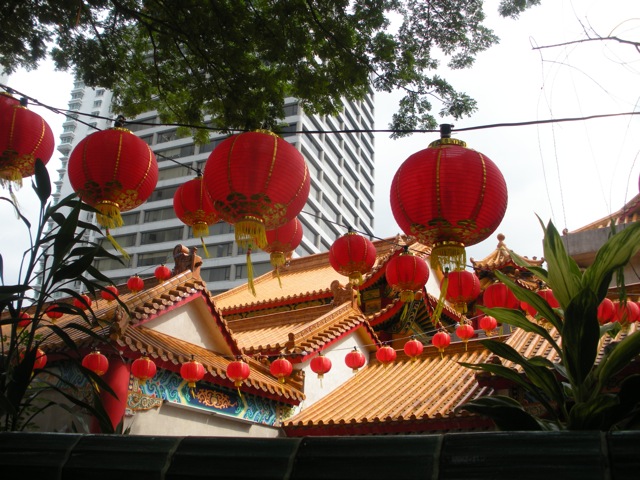
Lanterns at Temple Kun Yam Thong, down the street from our apartment
The only time the Chinese zodiac had crossed my mind was in Chinese restaurants when the placemat would help you figure out what your sign was (1980, year of the monkey). It’s impossible to miss it here! I’d thought they went all out for Christmas, but apparently that was just a warm up.
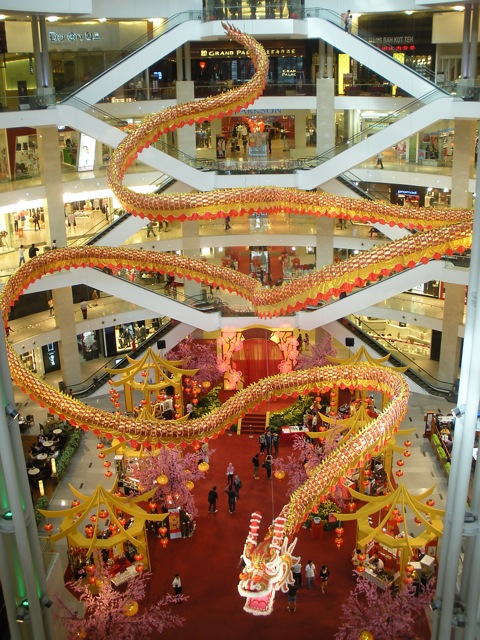
Huge 600 foot long dragon at Pavilion
Both religious and commericial temples are bedecked with red lanterns, and giant dragons swirl in the middle of the malls. We asked if there would be any big celebrations for the holiday, but most people (even Malay and Indian ones) go home to visit family. Since there are so many people traveling, we’re planning to stick around here. There are dragon and lion dances in Chinatown and in some of the malls, and apparently the God of Prosperity will be wandering around so we’re off to look for him.
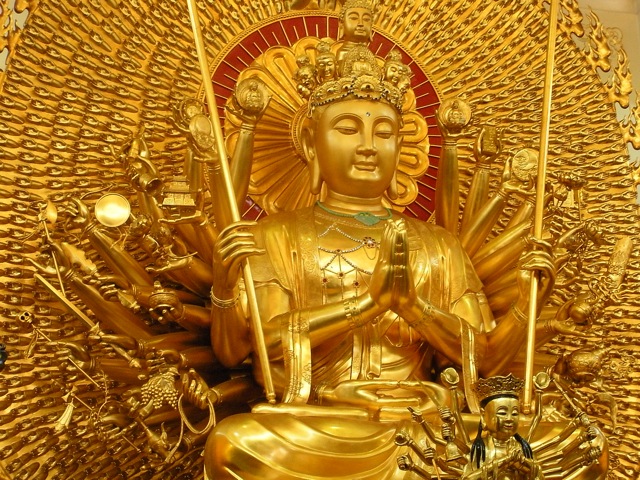
Thousand Hand Buddha at Temple Kun Yam Thong
Special menus are on offer at many restaurants, and there are some unique traditions found in Malaysia and Singapore like “yee sang”. It’s often described as a raw fish salad, but I think that’s oversimplifying it. It’s presented as several small heaps of shredded vegetables on a platter with a small dish of (usually) salmon sashimi on the side and several dishes of toppings: oil, plum sauce, crackers, and whatever else has inspired the chef. Once it is served, the waiter (or someone at the table) adds the ingredients on the side to the main platter, and then everyone joins in to toss the ingredients together while saying auspicious things in Chinese. The higher you toss, the higher your fortunes will grow in the new year, so you’re really supposed to go for it. Grant got to partake in this during a holiday lunch for the team he’s working with, and now I’m jealous so we’ll be seeking this out this weekend.
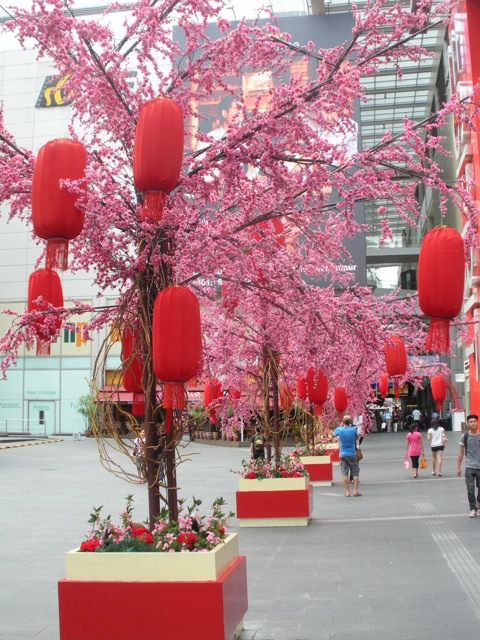
(Fake) cherry blossom trees and lanterns
Actually, he may be a little jealous of me and my new endeavor. I’ve signed up for Mandarin lessons, and will be taking an intensive course starting on February 6th. It meets every weekday from 9 – 1 for a month, so I might be spending more time hearing and speaking (or trying to speak) Mandarin than English. Wish me luck – I’m really excited…and a little bit nervous!
Angkor Archaeological Park
I had wanted to see the temples of Angkor since we visited Ayutthaya in Thailand and learned that they had drawn their inspiration from Angkor. We visited over 20 temples on our three day pass, and were awed by the experience. I could post hundreds of photos (literally), but I am trying to exercise a little restraint here. Seriously, it’s hard to do! I’ll highlight a few of our favorites, and then you poor friends (or fools) who ask to see more photos will have to suffer through a longer version some time in the future.
One of the big surprises for us on this trip was how much you interact directly with the temples. The shallow but steep staircases that would be roped off for everyone’s safety back home are open for exploration and you can climb up and down to your heart’s content. There are signs that caution you not to touch the carvings, although that didn’t stop some people that we saw and one can only hope that the horde of tourists are not causing too much wear and tear on the temples.
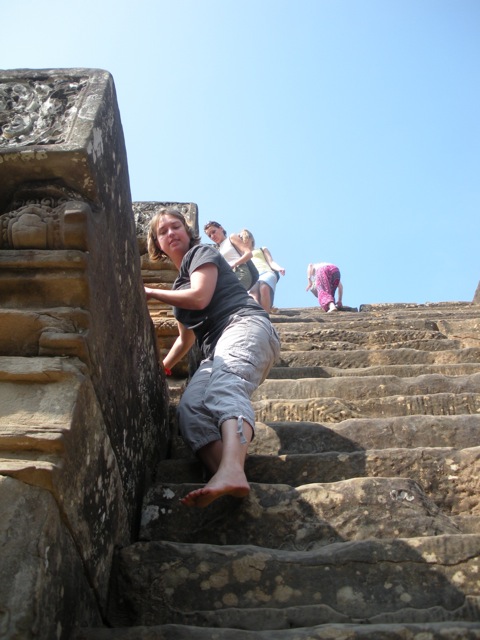
Climbing (carefully) down Ta Keo
The other pleasant surprise was in the volume of tourists. This is the high season, since the weather is cool and dry in Cambodia, and we’d been warned to expect the area to be packed. The most popular temples were more crowded, but even at Angkor Wat you could find areas where you’d be the only one in sight. I had thought we would be elbow to elbow, but we were happy to be sharing most of the temples with only a few others.
Putting this in context: The Khmer Empire was the major power in Southeast Asia for five centuries, and Angkor was its capital. From the 9th through 13th centuries, the succession of Khmer kings built temples to glorify their gods and themselves. Thinking in terms of other buildings in the world, this building period would overlap with Chichen Itza and the Maya-Toltec civilization (10th- 15th centuries), the completion of Westminster Abbey (1065), and the beginning of the construction of Notre Dame (1163).
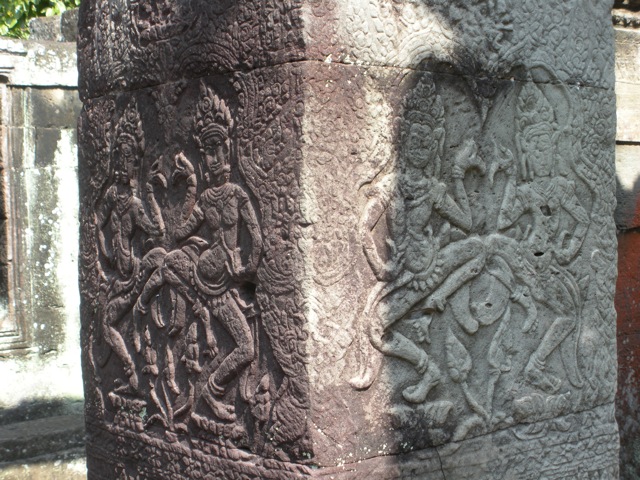
Dancing apsaras
Hinduism dominated in the Khmer Empire until the end of the 12th century, when Mahayana Buddhism gained favor. Hindu imagery is the main focus of the carvings, and you’ll find Vishnu in his many forms (including scenes from the Ramayana), Shiva or lingas (a pillar of stone representing a phallus or the essence of Shiva), and lots of dancing apsaras (celestial nymphs) and nagas (multi-headed snakes). The temples themselves are constructed to represent the universe: the central tower represents Mount Meru, the enclosures are the mountains around it, and the moat that usually surrounded the temple is the primordial ocean.
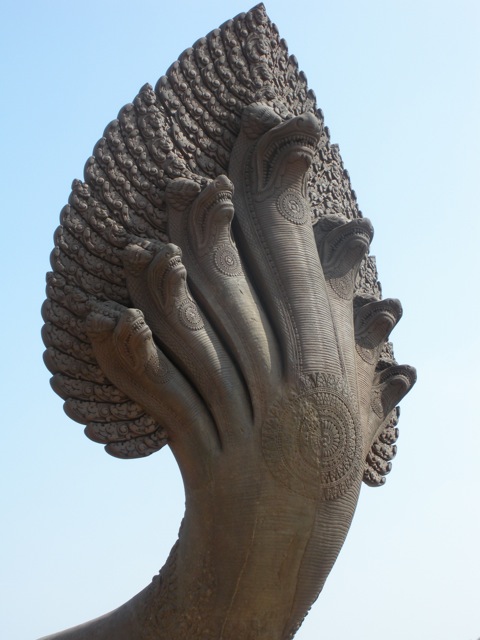
Restored naga at Angkor Wat
Buddha is everywhere. That’s not a religious statement; you will find statues of him around many corners, or remnants of statues (in some cases, just feet). As Buddha’s popularity rose, existing Hindu shrines were converted to Buddhist temples along with new construction like Bayon, and the imagery existed happily side by side. In the middle of the 13th century, there was a brief resurgence in Hinduism and some of the Buddhas lost their heads by order of the king. Today, Theravada Buddhism is the main religion in Cambodia, and it’s common throughout Southeast Asia to dress both whole and fragmented Buddha statues.
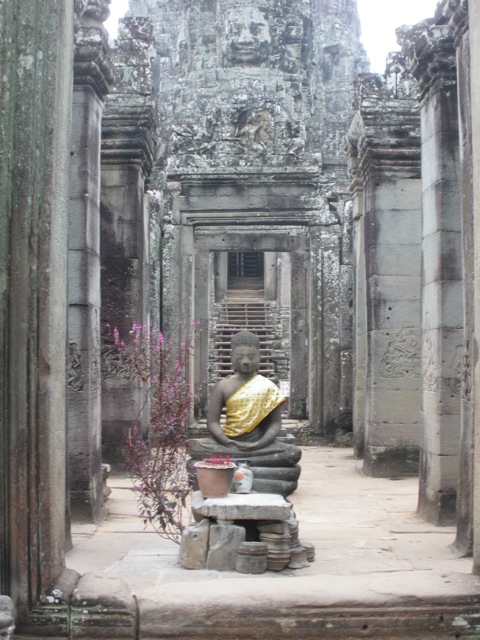
Buddha at Bayon
Ok, on to the temples!
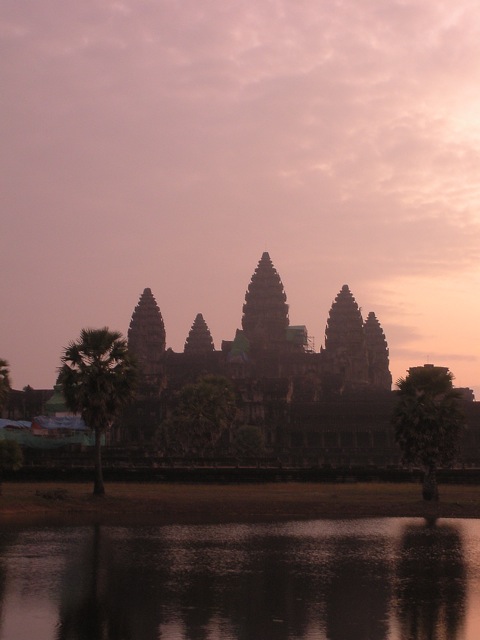
Dawn at Angkor Wat
Angkor Wat: Built in the early 12th century, it’s the world’s largest religious monument. Sunrise is a big attraction here, and we obligingly attended on Christmas morning. We stood on the central causeway in the dark for a while, watching the tour groups gather by the reflecting pool on the left, where you can angle to get the sun rising between the towers. We skipped this view; in the overcast dawn it wasn’t the most impressive sunrise we’ve ever seen, and we didn’t feel like joining the pack quickly forming. Once the sun rose, we joined the smaller group of like-minded folks by the reflecting pool on the right.
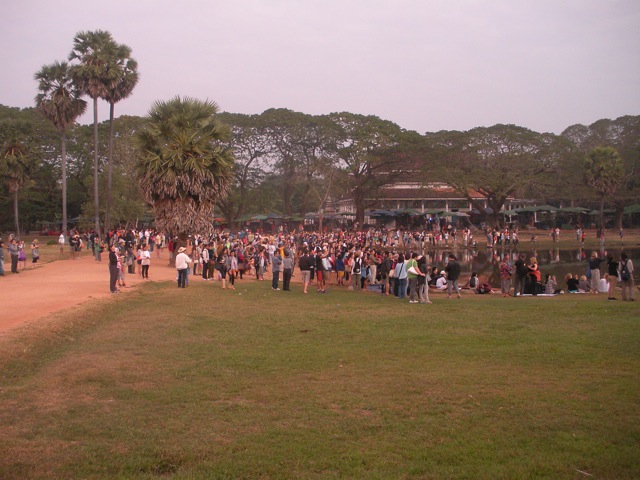
Where we did not want to be
Many temples later, we were exhausted when we returned to Angkor Wat in the afternoon. Our spirits were lifted when we spotted a big guy in a Santa hat and we followed Santa around the bas-relief panels. These are simply massive, spanning the entire length of each side of the temple and depicting battle scenes and mythological stories.
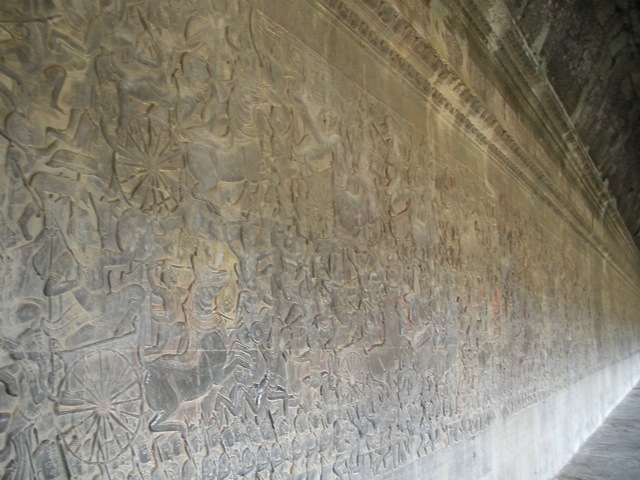
Bas-reliefs at Angkor Wat
We worked our way in and up, admiring the view from the central towers. Even this guy had to sit down to take it all in.
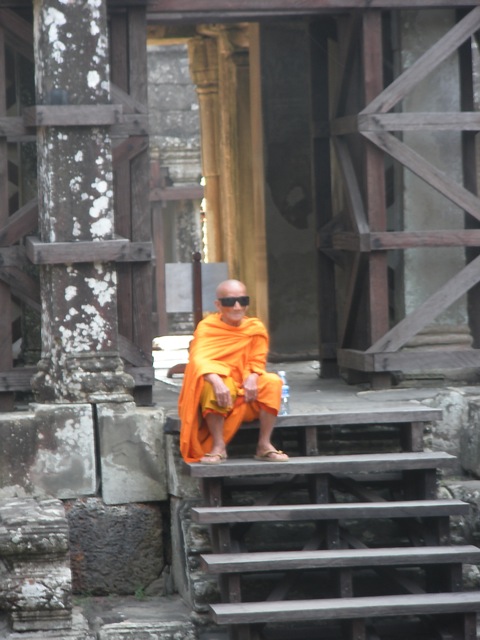
Coolest monk in the world
Bayon: This was our favorite temple, and I doubt we’re alone in this although we certainly were when we saw it. Per the agenda of our tuk-tuk driver, Mr. T, we saw sunrise at Angkor Wat and then skedaddled to get ahead of the tour groups so we were the only ones here early on Christmas morning.
Bayon is at the center of Angkor Thom, one of the largest Khmer cities ever built. The approach is impressive, over a bridge lined on each side with large figures holding the body of a giant naga. Nagas signify the connection between heaven and earth, and this bridge links the world of men outside with the world of gods inside the temple. To enter Angkor Thom, you first pass through a gate mounted by a face-tower (see the photo from Back in KL). Inside it is mostly forest now, and Bayon rises up through the trees as a mass of face-towers. Most of these have four enigmatically smiling faces, adding up to over 260 faces total, and the overall effect is one of profound calm.
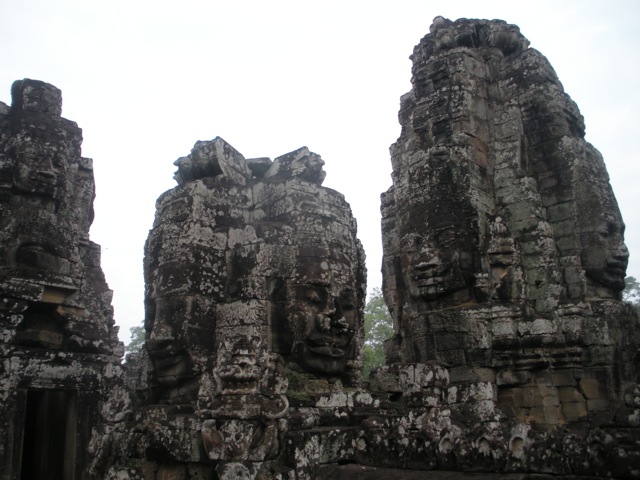
Face-towers at Bayon
We took our time exploring here, enjoying the illicit thrill of climbing all over the temple accompanied only by the sound (but not sight) of dozens of birds. At first, we weren’t sure how much exploration was truly sanctioned and we started out sedately admiring the bas-reliefs on the lower level before we found a steep wooden staircase. We hesitated here, because there was a sign off to the side saying “do not climb.” We finally decided that if they were serious about that message, the sign would have been in the middle of the stairs so up we went, to find ourselves eye to chin with the giant faces.
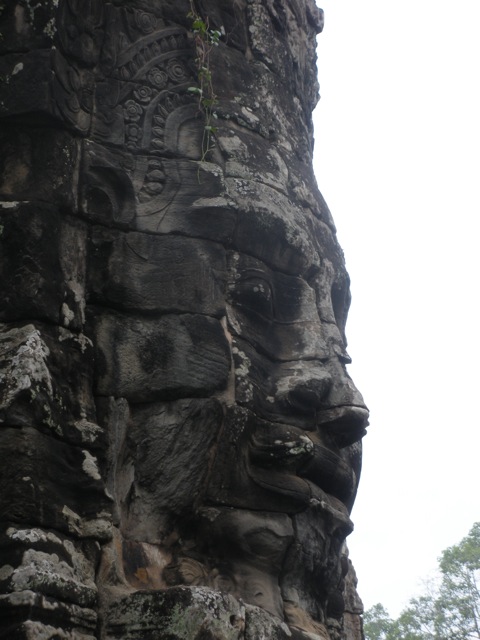
Face at Bayon
Eventually we came back down, and when we reentered the lower level we almost walked right into a small, smiling woman. She silently handed us incense sticks and demonstrated how to respectfully fan the smoke towards the headless seated Buddha in her alcove. Once we had done that, she tied a braided red string around our right wrists and muttered a blessing (surely, not a curse?). We gave a small donation, and I loved the quiet moment.
Banteay Srei: Located a bit further away from the main tourist circuits, we were surprised and a little wary when we pulled up and saw a well developed visitors center (which we didn’t see anywhere else, even at Angkor Wat). We knew this temple was going to be unique, and it was in many ways, starting with the thoughtfully curated expo that introduced the temple and placed it in a historic and artistic context. It was nice to have this available at a slight remove from the temple itself, so if it was of interest it was easy to visit, but if you preferred to view the temple on its own you could.
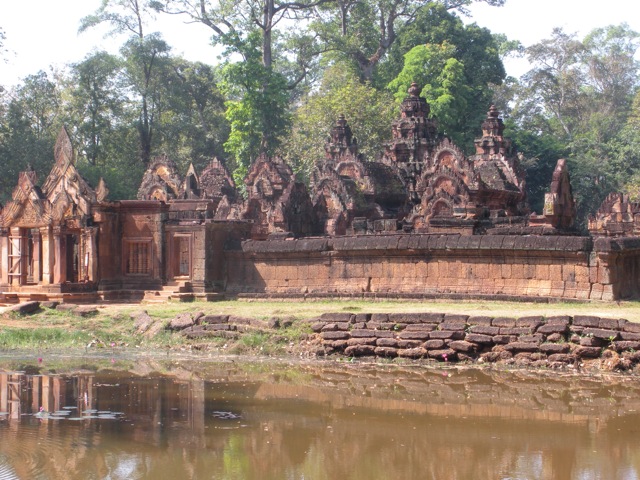
Banteay Srei
The name says it all: it translates to either Citadel of the Women or Citadel of Beauty. This temple was stunning. It’s built out of rosy sandstone, on a much smaller scale than the others and covered with intricate and delicate carvings unlike anything else we saw. I’ll let the pictures speak for themselves.
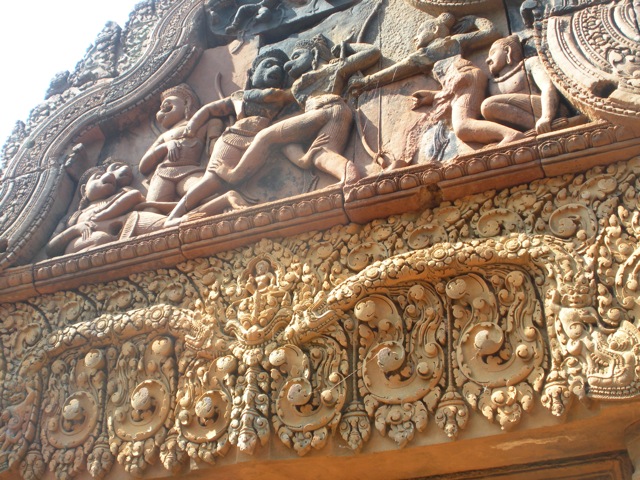
Lintel at Banteay Srei
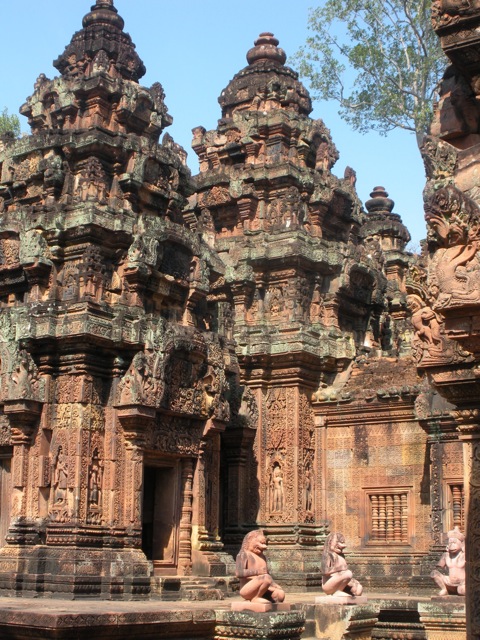
Banteay Srei's carvings
Beng Mealea: There’s a fair amount of reference to the “discovery” of the temples, but it is truly absurd to imagine that they were ever lost. To the Khmer, even when neglected, they have always been sacred places and it’s impossible to overlook these immense stone monuments. When this “discovery” is mentioned, I mentally add “by the Western world” which occurred in the mid to late 19th century. With this reference point in mind, several temples have been preserved in the state in which they were “discovered”.
Ta Prohm is the most well known of these, being the temple used in the filming of Tomb Raider. It was exciting to see on our first day touring the temples, but it was also where we encountered some of the densest tour groups of the trip. The outer enclosures there were quieter, but the inner area was packed with people, stones and signs warning you not to climb on the rubble.
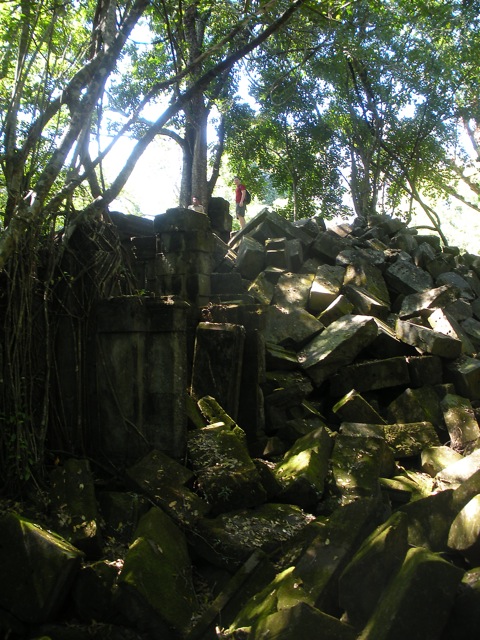
Grant on top of Beng Mealea
We had saved Beng Mealea, another semi-collapsed temple, for our last day. What a way to end it! When the guidebooks talk about living out your Indiana Jones daydreams, they aren’t kidding. Swinging on roots, ducking beneath propped up doorways, scrambling up one side and down the other, this was a great adventure.
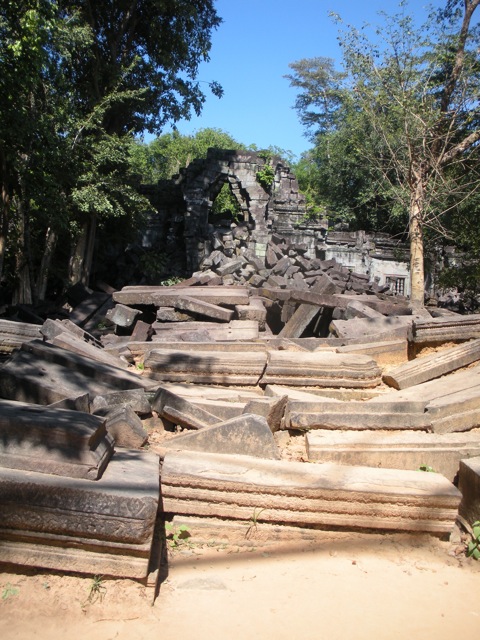
Beng Mealea's former entrance
At this point, we knew what to expect visually as Beng Mealea is a contemporary of Angkor Wat and we’d seen a few ruined temples, but we were unprepared for how we would experience it. There are no signs at all here, and several locals were hanging around near the entrance. They encouraged us to ignore the main path and cross a narrow board “bridge.” We peeked into the enclosure, and then one of them nimbly ducked through the doorway, turned around and said “Come on!” so off we went! He knew exactly where to place his feet and even though some of the stones were a little loose, it felt safe to follow him. Indy always has a local guide, right?
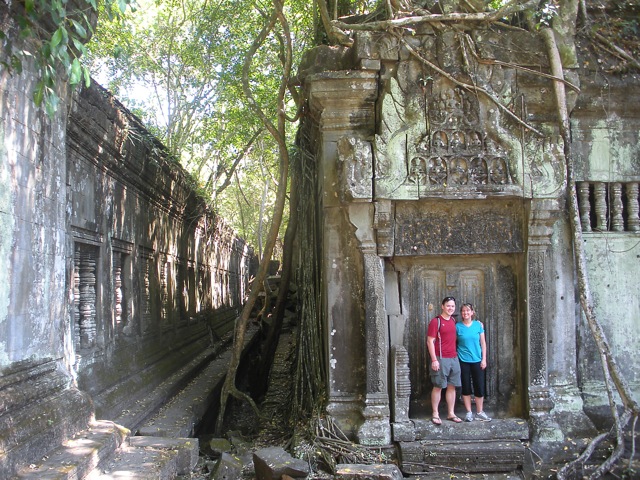
Beng Mealea
Roots looped down, creating natural swings and arches, and we felt completely alone during most of our exploration. Eventually, we bumped into a couple of other people, and ended up back on a boardwalk built to allow the not-so-adventurous to view the temple as well. Just as I thought things were winding down, our guide asked Grant if he wanted to climb up and over the central tower that was now a mass of broken blocks. You don’t have to ask Grant twice if he’d like to climb on something, so he went up while I went around. You do have to ask me twice when heights are involved, and I’d already gotten my fill of steep stuff for the trip!
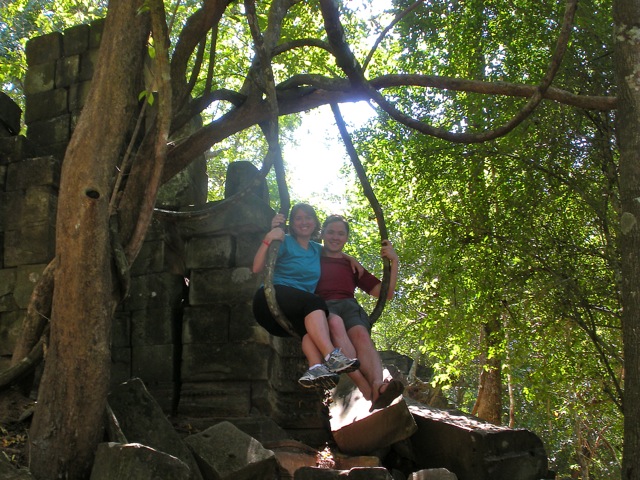
Just hanging around
Would I go back? Absolutely. There are still more temples to see, and I think I would continue to notice new things at the ones we saw on this trip. The people of Siem Reap were some of the friendliest we’ve met, and we had a great time. As you would expect, this was the highlight of Cambodia for us.
Phnom Penh
We decided to skip the Killing Fields and the genocide museum. I know a lot of people feel it is important to bear witness to this period of Cambodian history, but we thought that it would be too sad and depressing. Instead, we visited the Royal Palace and the Silver Pagoda, the National Museum, Wat Phnom, and the Central Market.
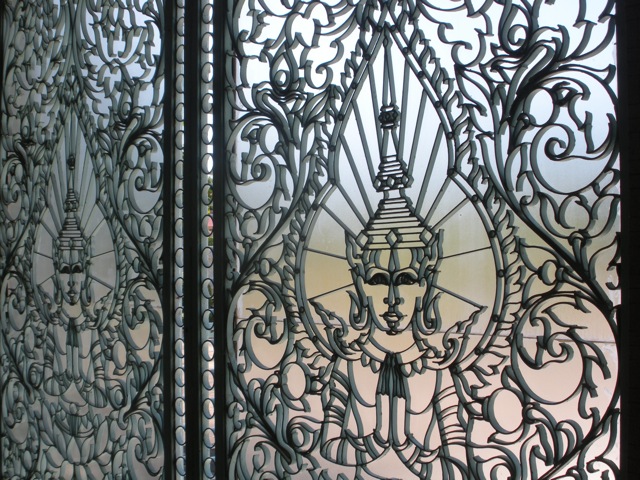
Gates at the Royal Palace
From our hotel, you could see the tips of the ornate pagoda style rooftops of the Royal Palace and the National Museum peeking over the tin roofs of the buildings around us. When we visited the palace, I was struck by the fact that there were more gardeners than guards. Much of the palace itself is off limits, but we visited the throne room pavilion, strolled through the well manicured gardens, and spent most of our time in the Silver Pagoda area.
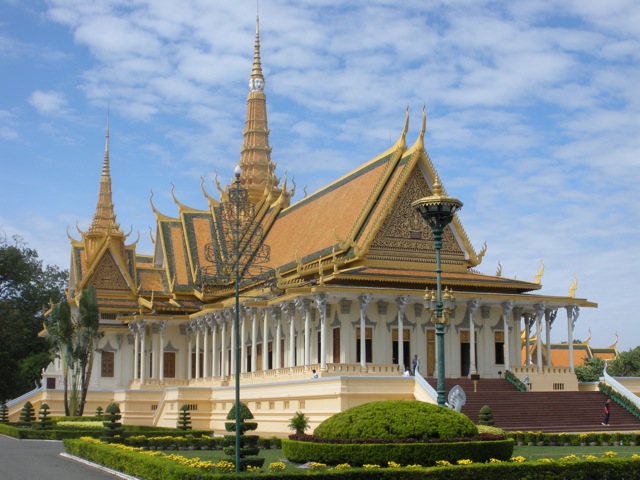
Throne Room Pavilion at the Royal Palace
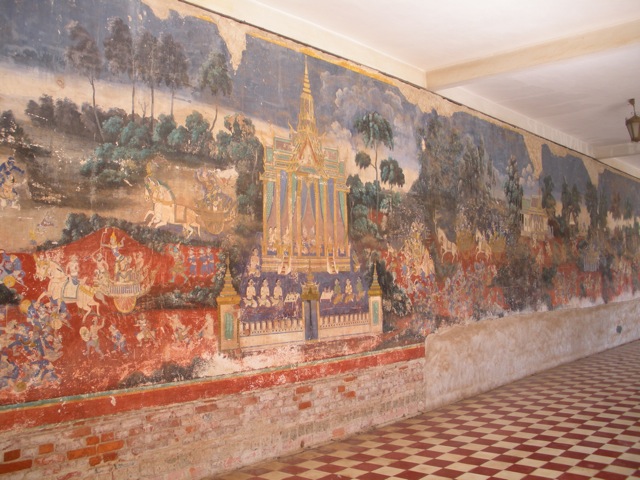
Ramayana mural at the Silver Pagoda
The wall of the outer enclosure is decorated with a mural depicting the Ramayana (a Hindu epic originating in the 5th or 4th century B.C.). We didn’t know the story at the time (wish we had), but it appears that the gist of it is that Rama’s wife Sita gets abducted by a neighboring demon king, and a great adventure ensues while he is trying to get her back. Our favorite moments included a human bridge and a serious malady:
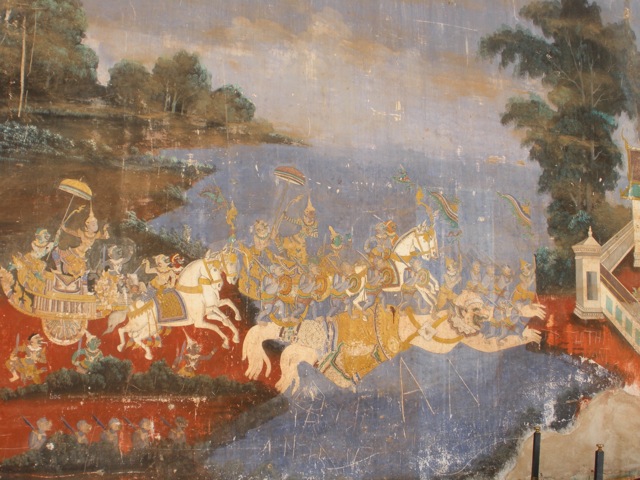
Go go gadget, supersize!
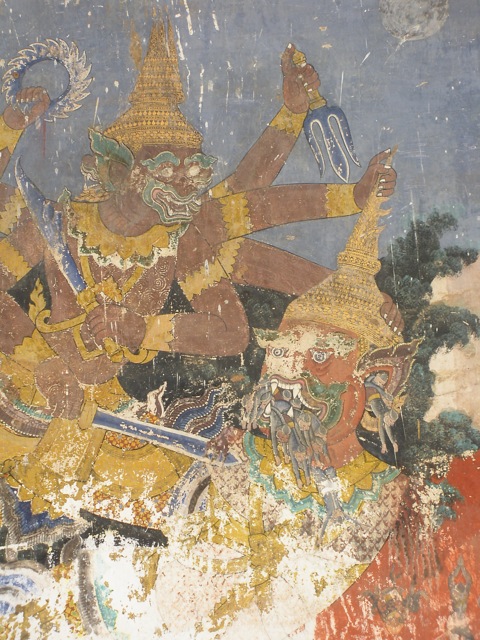
Monkey armies coming out of his ears
The Silver Pagoda itself houses many Buddhas (including an “Emerald” one, as in Thailand) and other relics, and is named for its floor, which is covered by more than 5,000 silver tiles. Most of them are covered by a carpet, but you are walking across them nonetheless, and it was unnerving to hear the floor creaking loudly beneath your feet.
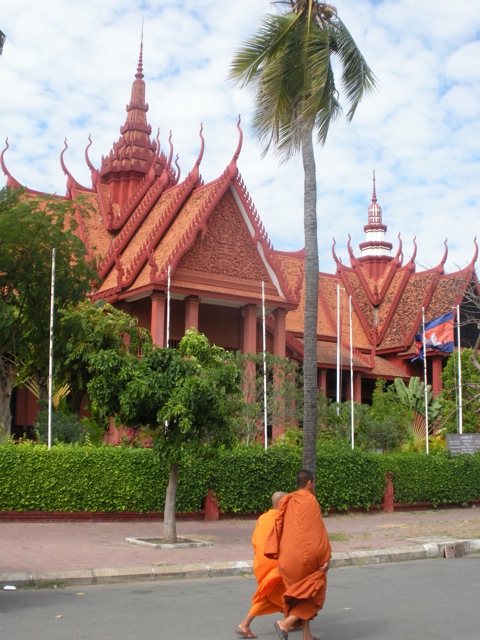
National Museum
The National Museum is one block over and was worth a visit. It focuses on Angkorian artifacts, as one would expect, and the courtyard provided a nice space to relax. Lots of sculptures here with minimal explanation, and there were two exhibits that I found particularly interesting. One of the museum’s goals is to preserve Cambodian traditions, and there was a room full of photographs of dancers from the Royal Ballet holding poses. Accompanying this were excerpts from interviews with them talking about the differences in traditional dance the way they had performed it previously and the way it was being performed at the time the photos were taken (in 1927). The other exhibit that surprised me was detailing some of the archeological work being done in the country, and the problems they have encountered with ancient bronze drums being looted as recently as in the early 2000s and sold for the value of the metal. Of course, it also focused on the education efforts and the attempts to convert former looters to archeological assistants.
After the museum, we strolled along the riverfront, and noticed stationary exercise equipment installed there. The next morning, when we were picked up for our bus ride to Siem Reap, a German woman who had stayed opposite that area commented that when she woke up, she thought she had joined the army! Apparently, there were loud early morning aerobics classes held there as well. We did see badminton being played in the squares in front of the Ministry of Defense; it’s a very popular game in Southeast Asia.
Made it to Wat Phnom, where we paid the stupid foreigners tax by walking around the base of the hill to the main entrance, and going up to the ticket booth. It was just as easy to approach the temple from any other side, and no one was asking to see tickets. I’m trying to think of it as stimulating their economy, and not just as taking advantage of us.
The Central Market was memorable for its Art Deco dome, which did create a sort of natural air conditioning effect. We had a quick lunch here at the food stalls, which ended up costing us $1.50 total! Basic and delicious.
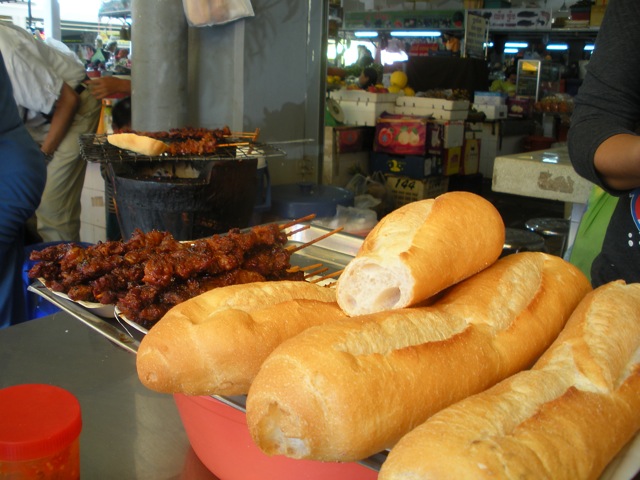
Grilled meat at Central Market
Probably safe to say that our favorite part of Phnom Penh was one of my new favorite restaurants in the world: Romdeng. This was initially suggested to us by our hotel, and we later realized that it is one of the Lonely Planet’s top picks too, and deservedly so. It’s in a villa set in a quiet enclosed garden, and we ate upstairs on a balcony with friendly geckos for company. The restaurant is associated with Friends International, which works to help get children off the streets, and in this case to give them the training they need to succeed in the hospitality industry. Romdeng is a “training” restaurant specializing in creative Cambodian cuisine, and all profits go back their projects for street children. We loved it so much that we ate here three times, even leaving Kampot a little early on our last day to squeeze in one last lunch. Great food and a worthy cause, what’s not to love?
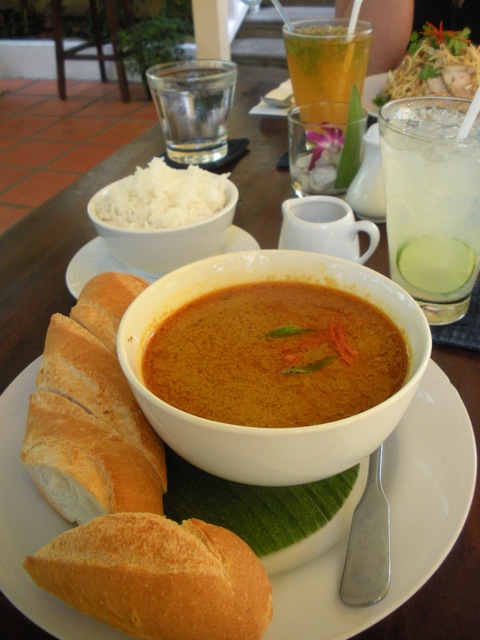
Grant's favorite meal
So when they say creative, they mean it! One of the most famous/infamous dishes on the menu is Fried Tarantulas. No, we didn’t order it (too many tasty sounding dishes on the menu to go for the shock factor), but the table next to us on our first night did. They had three young kids, and we were duly impressed with their willingness to try new foods. The oldest one (maybe seven years old?) seriously confided in me that he didn’t like spiders at all, but the littler ones were diving right in. No problem munching on the legs, which were apparently nice and crispy, but we all recoiled a little when the youngest who couldn’t have been more than four stuffed a whole body into her mouth. Gross. The next night (yup, twice in a row), a table near us tried to order them, only to be told that they were out of tarantulas, and only had one left…which they proceeded to bring out alive on a plate for us all to see. I prefer hanging out with the geckos, thank you!
Everything we did eat there was amazing, and we bought their cookbook to try to reproduce some of our favorite dishes: Banana Flower Salad with Cambodian Bacon, Khmer Muslim Beef Curry, and Fish Amok. They sell banana flowers in some of the local supermarkets here in KL, and I made that on Sunday – a pale imitation of the one we had here, but I think I’ll get there eventually and have a lot of fun trying!
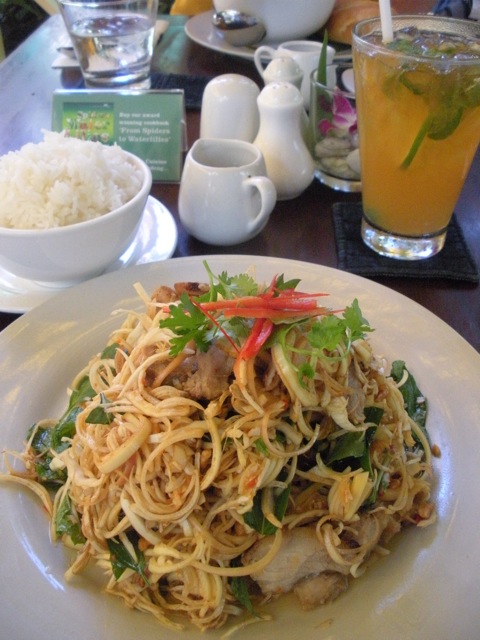
Banana Flower Salad at Romdeng
More to follow on Angkor, the cooking class I took in Siem Reap, and our time on the Cambodian coast…
“Home” from Cambodia
And the surprising thing is, KL does feel a bit like home. We had a wonderful trip to Cambodia and really fell in love with the people and the country. I’d go back in a heartbeat. I’ll share more stories and photos later, but for now here we are on Christmas morning.
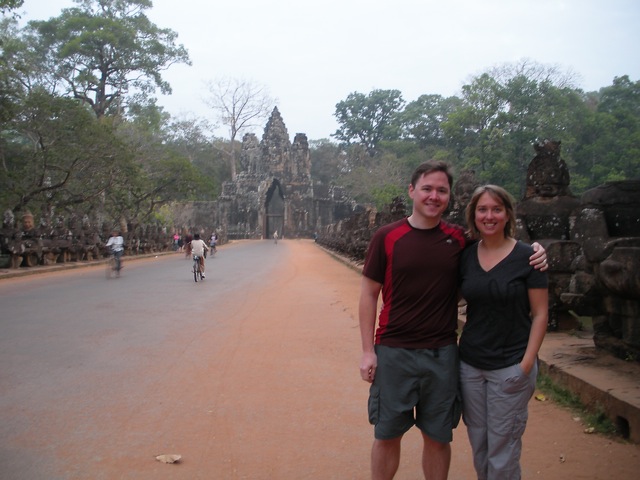
South Gate of Angkor Thom on Christmas morning
Recent Comments